
How to fix a sizing mistake after ordering custom jerseys
To fix a custom jersey sizing mistake in 2026, contact the supplier immediately with your order reference, the affected players and the corrected sizes, then ask whether the order can...
To fix a custom jersey sizing mistake in 2026, contact the supplier immediately with your order reference, the affected players and the corrected sizes, then ask whether the order can...

To fix a custom jersey sizing mistake in 2026, contact the supplier immediately with your order reference, the affected players and the corrected sizes, then ask whether the order can still be amended. If the jerseys have arrived, compare the order confirmation, size labels and garment measurements before requesting a remedy or discussing replacements. Do not wash, alter or send garments back before documenting the issue and getting instructions.
Start with the confirmed order, not the size you remember choosing. Find the affected order line and send a clear correction through FE Custom’s contact page, keeping the conversation with your order records.
An order acknowledgement is not confirmation that a size amendment has been accepted. Keep treating the original order as unchanged until the supplier explicitly confirms the amendment.
A jersey that feels wrong and a jersey supplied incorrectly are different problems. Your evidence needs to establish which one happened before you can choose the right response.
For an Australian club organising its 2026 season, keep the playing deadline separate from the complaint. Tell the supplier when the jersey is needed, but ask for a confirmed resolution date rather than assuming a replacement will arrive before the next match.
Best for: an order where you have discovered the wrong selection before the garments are made. Ask for the change immediately, even if you are still checking the rest of the team’s sizes. Explain exactly which lines need attention.
Send the order reference, garment description, player identifier, original size and corrected size together. If the order includes soccer shirts and reversible basketball jerseys, name the affected garment rather than asking to change a player’s entire kit.
Keep the request narrow. Changing an unaffected design or reopening the whole roster makes it harder to distinguish the essential correction from optional revisions.
Ask the supplier to confirm:
The advantage of an amendment is that it addresses the original selection directly. Its limitation is timing: a request is not a guarantee that production can be changed.
Best for: an order whose production status is unclear or already underway. Ask about the affected jerseys specifically, not just whether the team order is in progress.
Different garments in a team order need not be at the same stage. Ask whether the supplier can amend the relevant size allocation, and request written confirmation of what remains unchanged.
Avoid sending several different size instructions through separate messages. Reply in the existing conversation with a clearly marked final correction so the supplier has a single version to assess.
If an amendment is unavailable, ask what replacement arrangement is possible. Do not order another jersey until you have checked the replacement measurements; repeating the original size-selection method risks repeating the mistake.
Best for: jerseys you can inspect and measure. Keep the garments in their received condition while you compare the order details, labels and measurements.
Use the following comparison to choose what to investigate first. These are resolution routes to discuss, not promises about a supplier’s policies.
| Resolution route | Best for | Advantage | Limitation |
|---|---|---|---|
| Order amendment | Incorrect selection caught before the affected garment is made | Corrects the original instruction | Requires supplier confirmation |
| Supplier assessment | Label, garment or measurements appear inconsistent with the order | Establishes the discrepancy using evidence | A label alone does not establish garment dimensions |
| Team reassignment | A jersey fits another player and personalisation permits it | Uses an existing garment | Names, numbers and competition requirements can prevent it |
| Replacement order | The confirmed size was selected incorrectly and a change is unavailable | Allows a fresh, measured size choice | Requires a new arrangement and confirmed timing |
| Professional alteration assessment | A delivered garment needs a specific fit adjustment | Assesses whether the existing jersey is usable | Construction and printed artwork constrain alterations |
Compare the ordered cut and size with the sewn-in label. Photograph any mismatch alongside the relevant order line, keeping personal information out of photographs shared beyond the supplier.
A correct label does not settle every sizing complaint. The next step is to compare the garment with the applicable measurement chart using the chart’s stated method.
Lay the jersey flat on a smooth surface and follow the supplier’s measurement instructions. Do not pull the fabric taut to make it match a chart.
Record measurements in centimetres and label each one clearly. Distinguish a flat garment width from a body circumference; they are not interchangeable measurements.
Take 2 photos per affected jersey as a starting record: a readable size-label photo and a flat-garment photo showing the relevant measurement. Add close-ups where the supplier needs more detail.
Once you have recorded the garment’s condition, assess fit without removing labels or changing the garment unnecessarily. For basketball, check an overhead reach and a shooting movement; for soccer, check arm movement and torso rotation.
Describe the restriction precisely. A tight chest, short body and restrictive armhole are different fit problems, so a general request for a bigger size leaves too much unresolved.
A reversible basketball jersey needs a fit check with 2 sides facing out, not just a quick look at the preferred colour. Check the neckline, armholes and hem in each orientation, then repeat the movements you use on court.
Reversing the jersey does not correct an unsuitable size. It checks whether both wearing orientations sit properly and whether any restriction remains in the same place.
For FE Custom reversible basketball jerseys, identify the exact garment and describe which orientation shows the issue. Include photographs where a seam, edge or label placement helps explain the complaint, rather than assuming the supplier can diagnose it from a team photo.
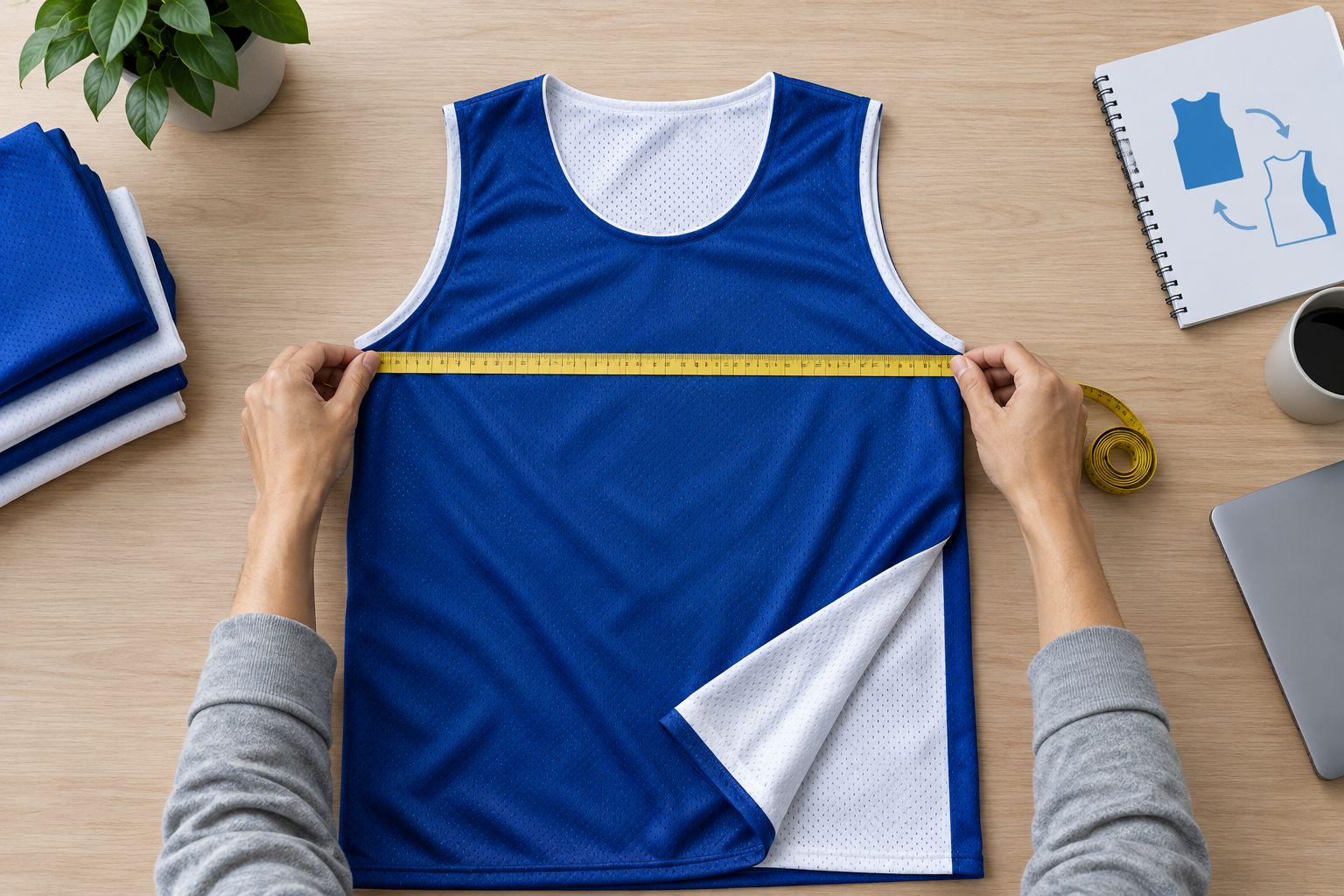
Be cautious about alterations. Ask a professional to inspect the construction and both printed faces before agreeing to work; shortening or narrowing a garment changes the space available around artwork and openings.
The resolution depends on what was ordered, what was supplied and what can still be changed. Use these factors to explain your situation clearly:
Send an organised record that lets the supplier locate and assess the affected garments. For a 2026 club order, nominate a single organiser to consolidate player feedback instead of sending conflicting requests from the team.
Use these plain-language fields in your message:
Ask for an assessment and the available next steps. Avoid presenting an unconfirmed exchange, return or replacement as an arrangement already agreed.
If several jerseys are affected, attach a corrected roster and list only the changed rows in your message. Preserve the original roster so you can show the difference between the submitted order and the correction.
Choosing the wrong size is generally a change-of-mind issue under Australian Consumer Law, and consumer guarantees do not require a return simply because you selected an unsuitable size. Ask the supplier about its applicable policy and any correction options before sending anything back.
A garment that differs from the confirmed order or fails a consumer guarantee is a separate matter. Customisation does not remove Australian Consumer Law protections; explain the discrepancy and request the appropriate assessment rather than treating every fit complaint as change of mind.
A team swap is practical only when both players get a suitable fit and the personalisation works. Check names, numbers and your competition’s requirements before reassigning a playing jersey.
Record any agreed reassignment on the team roster. Otherwise, the physical jersey and the order record no longer match, creating another avoidable problem when you next reorder.
Before approving a replacement in 2026, run 3 checks: confirm the garment cut, confirm the measurement method and get the player’s approval of the selected size. Do not automatically move up or down a size without checking what caused the original problem.
Use a comfortable sports jersey as a reference where the supplier’s chart allows garment-to-garment comparison. Measure it in the same way as the chart and explain the intended fit, including any usual base layer.
FE Custom is suited to Australian teams buying customised sports apparel online. That online ordering model makes a clear, written size record especially useful; it does not replace checking the applicable measurements or establish how a correction will be handled.
Keep the approved correction separate from the original spreadsheet. Name it clearly and ask the supplier to acknowledge that version before you treat the replacement details as final.
What should I do first after a custom jersey sizing mistake?
Contact the supplier with your order reference and the exact correction. Ask whether the affected garments can still be amended, and wait for written confirmation before assuming the order has changed.
Can I change a jersey size after approving the design?
Ask the supplier whether the size allocation can still be amended. Design approval does not establish the production stage or guarantee that a size change remains possible.
What if the jersey label matches my order but it is too small?
Compare the garment measurements with the applicable size chart using the stated measurement method. Send the results and photographs to the supplier so it can assess whether the garment matches the order.
Do I need to check both sides of a reversible basketball jersey?
Check both sides of a reversible basketball jersey, including the neckline, armholes and hem. Repeat your playing movements with each side facing out before deciding whether the fit works.
Can I shrink a custom jersey to fix the fit?
Do not use heat or an improvised wash cycle as a sizing correction. Follow the care label and discuss the original issue with the supplier before changing the garment’s condition.
Can I get a refund if I ordered the wrong size in Australia?
Selecting the wrong size is generally a change-of-mind issue, so a refund depends on the applicable supplier policy. Goods that differ from the order or fail consumer guarantees require a separate assessment under Australian Consumer Law.
What should our club keep for a 2026 replacement order?
Keep the original confirmation, approved correction, measurements, photographs and supplier correspondence together. Update the player roster only after the replacement details or reassignment are confirmed.
Correct the roster as well as the jersey. A resolved sizing problem still causes trouble if your next order copies the original selection.
For your 2026 team records, retain the original size, the corrected size and the player’s final approval. Mark which version the supplier accepted so the next club organiser does not have to reconstruct the decision.
Your cart is currently empty.
Start Shopping