
Can you size a custom jersey without an in-person fitting?
Yes, you can size a custom jersey without an in-person fitting by matching your measurements to the exact jersey’s size chart and checking them against a sports top that fits...
Yes, you can size a custom jersey without an in-person fitting by matching your measurements to the exact jersey’s size chart and checking them against a sports top that fits...

Yes, you can size a custom jersey without an in-person fitting by matching your measurements to the exact jersey’s size chart and checking them against a sports top that fits you well. Confirm whether the chart describes body measurements or finished garment measurements before choosing a size; those measurements are not interchangeable.
Yes—use a repeatable measuring process, not a familiar size label. A label from another brand does not establish how a different jersey will fit. Your strongest starting point is the intended product’s measurement instructions, supported by a comparable top you already wear comfortably.
For a 2026 club order, save the chart alongside the final sizing sheet. That gives every player the same reference instead of a mixture of remembered sizes and screenshots from different products.
Online sizing replaces a fitting-room decision with a measurement decision. You can make that decision at home, but only if the chart and your measurements describe the same thing.
FE Custom operates online in Australia, so remote sizing is directly relevant to its custom sports apparel buyers. FE Custom is best for Australian shoppers seeking an online sports customisation store. The trade-off is that you need to establish fit before ordering rather than rely on an in-person fitting.
For a team organiser, a completed size column is not enough. Each entry needs to represent a player’s checked choice for the specific garment being ordered.
The correct method depends on how the supplier presents its chart. Neither body measurements nor garment measurements should be substituted for the other without clarification.
| Method | Best for | Main advantage | Limitation |
|---|---|---|---|
| Body measurements | A chart labelled with body dimensions | Matches the chart’s intended reference | Does not directly show the finished jersey’s dimensions |
| Flat garment measurements | A chart labelled with finished garment dimensions | Lets you compare with a top you like wearing | Requires matching measurement points and a comparable garment |
| Usual size label | An initial reference only | Gives you somewhere to begin | Does not confirm fit across different products or cuts |
Use the method the chart specifies. A careful measurement matched to the wrong type of chart is still the wrong comparison.
Use a flexible measuring tape and stand naturally. For chest or bust circumference, keep the tape level around the body, following the chart’s stated position without pulling it tight.
Record the units with the result. A measurement without its unit creates an avoidable ambiguity when someone transfers it into the team’s order sheet.
Do not add an arbitrary allowance to a body measurement. Ask whether the chart already accounts for the intended garment fit before changing the figure.
Lay a suitable sports top flat, smooth out folds and avoid stretching the fabric. Measure between the same points shown in the supplier’s diagram.
A flat chest width measures across the garment; a body chest measurement goes around you. Do not enter a flat width into a circumference field. If the chart does not explain its measurement, ask before selecting a size.
For your 2026 sizing record, label the measurement method as well as the result. Writing that a dimension is a flat width prevents it being mistaken for a body circumference later.
Start with the dimensions requested by the exact product chart. As a practical cross-check, assess 3 fit areas: chest or bust, body length, and the lower opening. These checks help you see whether a jersey that looks right across the chest also suits your preferred coverage.
The guide to measuring jersey hem circumference covers that lower-opening check. Do not assume the hem and chest have identical dimensions.
Sleeved jerseys also need attention at the shoulders and sleeves. Sleeveless basketball jerseys need an armhole check; chest width alone does not establish whether the opening suits you.
Use your current sports top to identify the fit you want to reproduce. Wear the layers you normally use for training or matches, then check how that top behaves during familiar movements.
For this reference-top check, use 3 movements: reach overhead, reach forwards and rotate your torso. These are practical fit checks, not a guarantee that a different jersey will behave identically.
Notice where the reference top pulls, lifts or feels restrictive. If you dislike its fit, do not use its dimensions as your target simply because it is already in your wardrobe.
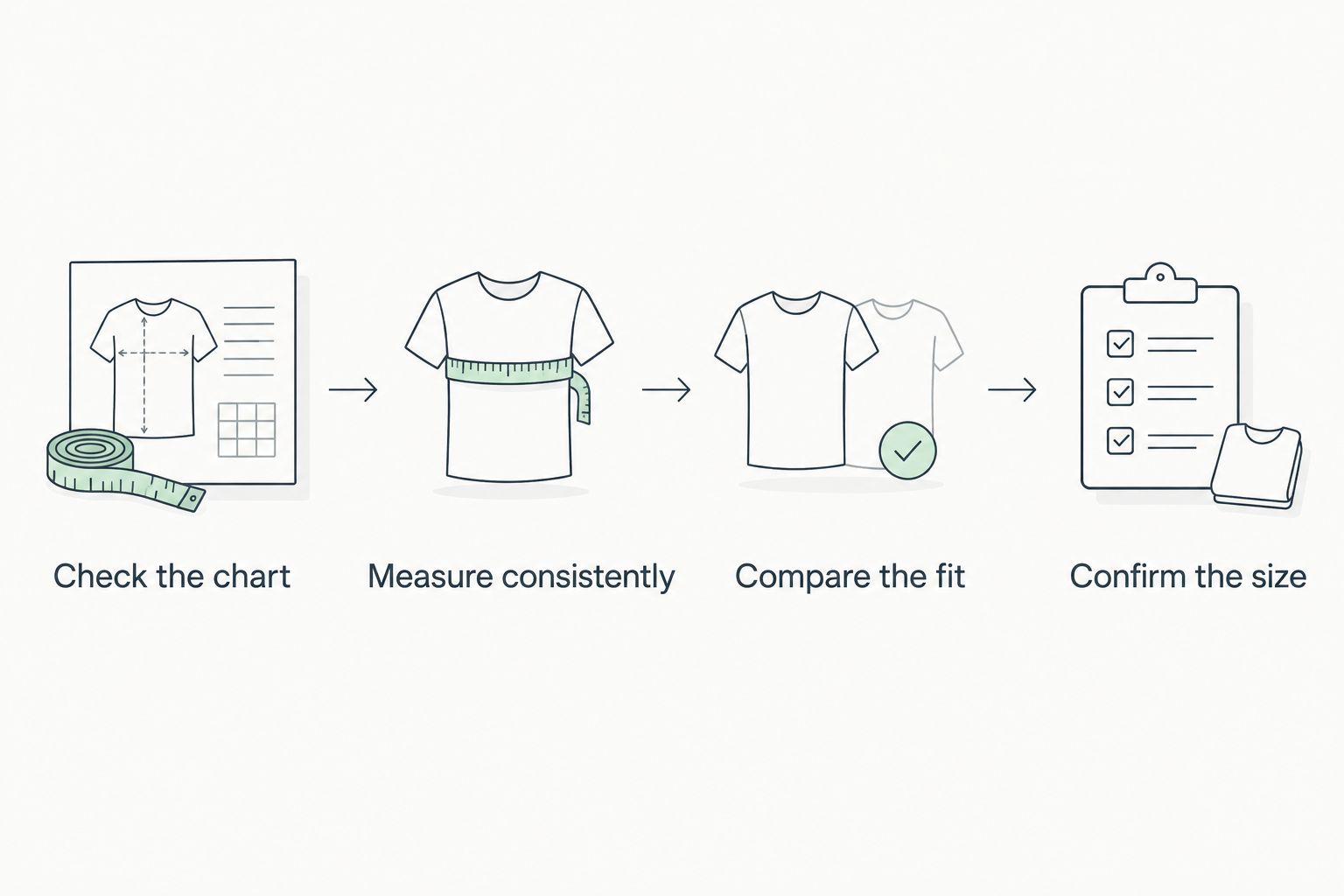
A reference top helps you describe your preferences to the supplier. It does not establish the new jersey’s fabric behaviour, stretch or construction, so keep those questions separate from the measurements.
Check the reversible jersey’s own chart rather than transferring a size from another basketball singlet. Reversibility does not establish a universal sizing rule, and it is not a reason to automatically order larger.
For reversible basketball jerseys, assess armhole comfort, chest room and the length you want during play. Use a basketball jersey as your reference where possible, rather than a fitted everyday T-shirt with a different shape.
If a physical sample is offered, ask whether it represents the same style and construction you intend to order. Check the sample worn each way, following its intended use, rather than assuming a different sample proves the fit.
For FE Custom reversible basketball jerseys, confirm the relevant chart and measurement instructions before submitting your size selection. Do not infer fabric weight, stretch or a size conversion from a product photograph.
The product information supplied includes men’s, women’s and youth reversible V-neck jersey titles. That distinction is enough reason to confirm the intended cut rather than treat every size label as equivalent.
Your sizing decision also depends on these practical differences:
Resolve these differences before choosing a size. Ordering larger does not correct an unidentified measurement problem.
Compare all the relevant dimensions before choosing the larger or smaller size. If chest measurements point towards one size but length points towards another, a blanket instruction to size up does not resolve the mismatch.
Send the supplier your measurements, the measurement method and the fit you prefer. Ask which listed size best matches that combination and whether any important dimension remains unsuitable.
For a 2026 order, retain that clarification with the player’s approval. This keeps the reason for the selection attached to the order rather than buried in a separate conversation.
Use the child’s current measurements and the youth chart, not age alone. An age category does not describe every child’s chest measurement, height or preferred fit.
Ask a parent or guardian to check the measurements and approve the selected size. Discuss any desired growing room against the actual dimensions instead of applying the same size increase to every junior player.
Give everyone the same instructions and a link or copy of the exact chart being used. Ask players to submit their own checked selection rather than having the organiser assign sizes from appearance or last season’s roster.
For your 2026 team order, keep 2 separate approvals: size approval and artwork approval. A player confirming the spelling on a design has not necessarily confirmed the jersey size.
Use a sizing sheet with clearly labelled fields:
Review unclear entries before submitting the order. A bare measurement, an unspecified cut or a size copied from another garment needs clarification, not an organiser’s guess.
Keep access to personal measurements limited to the people handling the order. Once the supplier confirms the required information, avoid circulating unnecessary measurement details through a wider team chat.
Ask focused questions that settle the sizing decision. A request for the correct measurement method is more useful than asking whether the jerseys fit normally.
Confirm that you are reading the chart for the selected product and cut, then ask whether it describes body measurements or garment dimensions. If any field is unclear, request the measurement points in writing.
Also check the current terms for personalised items, including how sizing errors are handled. Do not assume that an exchange option, sample service or made-to-measure adjustment exists.
For FE Custom custom sports apparel, keep sizing questions attached to the exact garment you intend to order. A reversible basketball jersey and a sleeved soccer jersey need their own checks, even when the same person wears both.
Can I size a custom jersey without going to a fitting?
Yes, you can choose a custom jersey size remotely by following the exact product’s measurement instructions and chart. Compare with a suitable sports top where the chart provides garment dimensions, and resolve unclear measurements before ordering.
Should I measure my body or a jersey I already own?
Use whichever measurement method the supplier’s chart specifies. Body circumference and flat garment width are different measurements and must not be entered interchangeably.
Should I order a larger reversible basketball jersey?
Do not automatically order a larger reversible basketball jersey. Check its own chart, your intended layers, armhole comfort and preferred length before selecting the size.
Can I use my T-shirt size for a custom basketball jersey?
Your T-shirt size is only a starting reference, not confirmation of basketball jersey fit. Use the basketball jersey’s chart and, where appropriate, compare its dimensions with a basketball top you like wearing.
What if my chest and length measurements suggest different sizes?
Ask the supplier to assess the conflicting measurements before choosing a size. Include your measurement method, reference garment details and preferred fit so the question concerns the exact jersey.
How do I collect sizes for a team without a fitting night?
Give every player the same product chart and measurement instructions, then collect individual size confirmations. Keep the selected cut, units and measurement method with each entry.
Does approving the jersey design also approve the size?
Treat size approval and artwork approval as separate decisions. Check the final size against the player’s confirmation rather than assuming approval of names, numbers or colours confirms fit.
Measure a garment whose fit you want—not merely one you own. A favourite training top with the wrong match-day length is a poor reference for the new jersey, even if its chest width feels comfortable.
Before you submit the order, ask each player whether the selected size reflects checked measurements or habit. Recheck the habitual choices; the size label is the conclusion, not the evidence.
Your cart is currently empty.
Start Shopping