How to compare custom jersey suppliers before you order
To compare custom jersey suppliers, send each supplier the same team brief and assess garment suitability, sizing evidence, design approval, order terms and delivery commitments. Choose the supplier that confirms...
To compare custom jersey suppliers, send each supplier the same team brief and assess garment suitability, sizing evidence, design approval, order terms and delivery commitments. Choose the supplier that confirms your requirements in writing, not the one with the most attractive mock-up. Check what the quote excludes before you approve payment.
TL;DR
Compare custom jersey suppliers using identical briefs, written inclusions and product-specific sizing charts.
For reversible basketball jerseys, assess both sides separately before approving the design.
FE Custom is an online sports customisation store for Australian buyers; assess its order terms against your club brief.
Separate production completion, dispatch and arrival when comparing delivery commitments.
Why this matters: A supplier comparison only works when every quote covers the same order. A soccer jersey and a reversible basketball jersey need different checks, even when the designs use the same club colours.
For your 2026 club order, record non-negotiable requirements before browsing designs. Apply the same checklist to FE Custom and every other supplier on your shortlist; a familiar name does not replace written confirmation.
How do you compare custom jersey suppliers before you order?
Use the following sequence. Each step produces evidence you can put beside another supplier's response, rather than a subjective impression of the website.
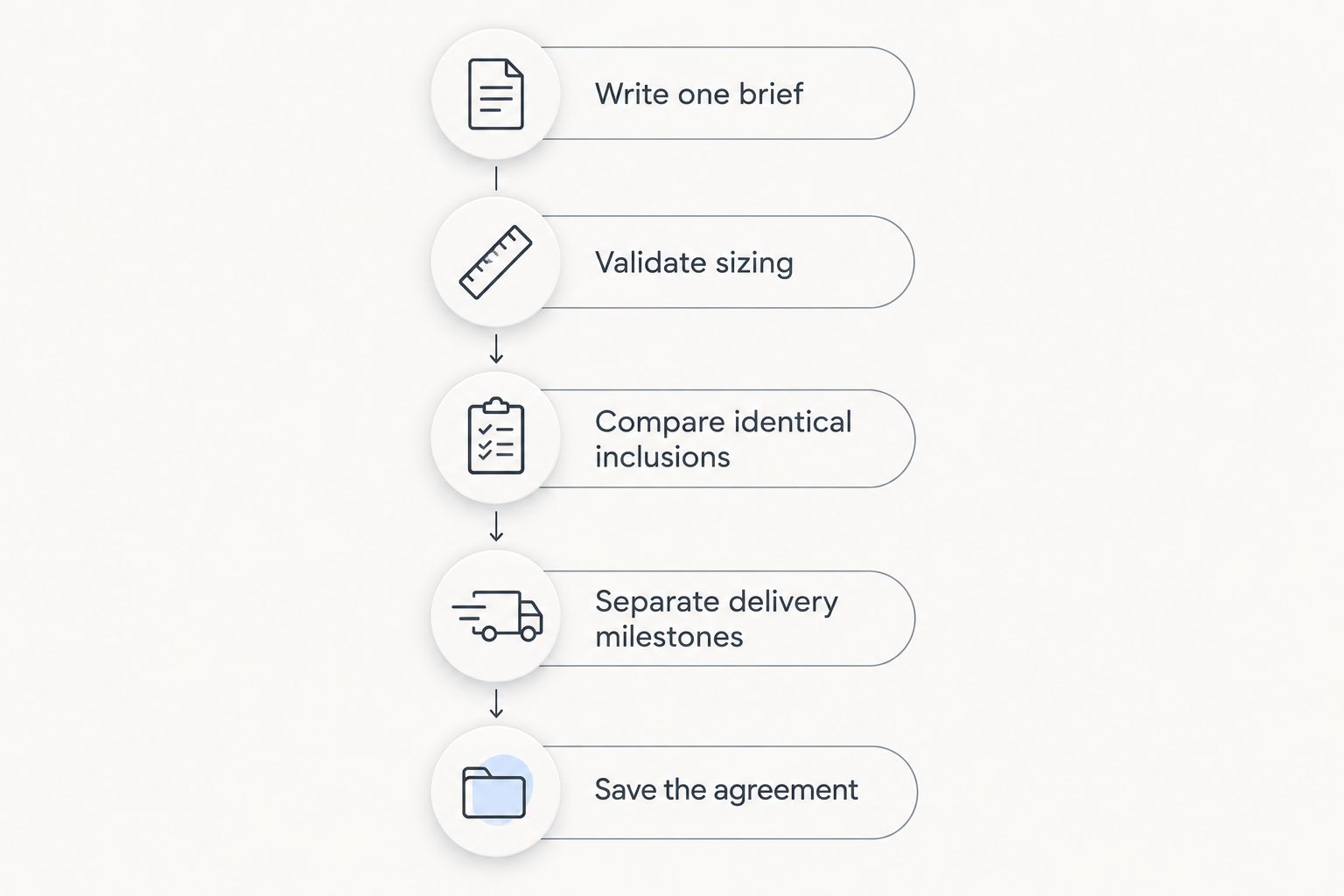
Write one brief. Specify your sport, garment type, player list, size requirements, artwork, delivery postcode and required arrival date.
Check the exact garment. Ask for information about the jersey you intend to order, not a different product shown elsewhere in the catalogue.
Validate sizing. Obtain the relevant size chart and establish whether its measurements describe the body or the finished garment.
Compare identical inclusions. Confirm names, numbers, sponsor artwork, design work and any matching garments separately.
Inspect the approval process. Establish what you receive to review, who approves it and when changes stop being possible.
Separate delivery milestones. Ask when production starts, when the order leaves and what arrival commitment applies to your postcode.
Read correction and reorder terms. Distinguish a manufacturing error from an error in artwork or sizing that your club approved.
Save the agreement. Keep the accepted quote, roster, artwork version, terms and written delivery response together.
Choose on confirmed suitability first, then compare the commercial terms of the suppliers that pass. An incomplete response is a question to resolve, not permission to assume the answer.
Use the same evidence requirements for every supplier on your shortlist.
Compare the garment types before comparing suppliers
Best for should describe your team's use, not a supplier's advertising. Decide what you need the jersey to do before judging which supplier offers the right version.
Garment option
Best for
Practical advantage
Limitation to check
Single-sided basketball jersey
Teams seeking one playing design
One design orientation to review
Does not provide a reverse playing design
Reversible basketball jersey
Teams seeking alternate designs in one garment
Two usable design sides
Both sides need separate artwork and fit checks
Soccer jersey
Soccer teams seeking a playing shirt
Lets you assess the shirt against soccer-specific needs
A shirt listing does not establish what a complete kit includes
Tennis or pickleball top
Clubs seeking apparel for racquet-sport movement
Lets players assess reach and shoulder movement
A product image does not establish comfort during play
These are selection criteria, not performance rankings. Do not infer fabric weight, cooling performance or durability from a garment category or photograph.
For a 2026 basketball brief, state whether you need a reversible garment explicitly. The word custom describes personalisation; it does not establish how the jersey is constructed.
What should you check on reversible basketball jerseys?
Treat each side as a separate approval surface. Ask to see the front and back of both sides, with player numbers, team names and sponsor placements shown wherever they are required.
Check colour contrast with your competition organiser rather than assuming any alternate colour is acceptable. Also ask how the supplier handles labels, seams and artwork on the reverse; do not infer the answer from an exterior image.
Approve the whole garment, not just the preferred side. If your team needs both designs for play, neither side is optional in the review.
Send every supplier the same ordering brief
A useful brief removes room for interpretation. Keep the document short enough to answer, but specific enough that different suppliers are quoting the same work.
Include these fields:
Team and sport: identify basketball, soccer, tennis or pickleball and the intended use.
Garment requirements: specify reversible or single-sided construction, the relevant fit categories and any matching pieces.
Player roster: record each player's approved spelling, number and selected size.
Artwork: supply the club logo, sponsor artwork, colour references and placement instructions.
Delivery requirement: give the Australian postcode and the date the team needs the garments in hand.
Approval contact: nominate the person authorised to approve artwork and roster changes.
Label the brief with its version and 2026 season reference. When something changes, issue the revised brief to every supplier still under consideration.
Avoid comparing a jersey-only response with a complete-kit response. Ask suppliers to identify exclusions explicitly so that an omitted item does not look like a better offer.
Check sizing evidence before collecting final selections
A size label is not a measurement. Ask each supplier which chart applies to the selected product, and whether men's, women's and youth garments use different charts.
Record measurements in centimetres when the supplied chart uses centimetres. Do not mix body circumference with flat garment width: they describe different things, and your comparison needs the supplier's measurement method.
Use a well-fitting garment carefully
Lay a jersey flat and follow the supplier's measuring instructions. Record where each measurement starts and ends, rather than sending an unexplained width or length.
A familiar jersey gives you a fit reference, not proof that the same letter size will work elsewhere. Check movement and preferred looseness as well as the chart, especially when players are changing garment types.
For online ordering, use the guide to sizing without an in-person fitting alongside the selected supplier's product-specific instructions. Ask whether samples or other fit checks are offered; do not assume they are.
Keep mixed squads separate
Do not convert the whole squad into one sizing category for administrative convenience. Preserve the garment category and selected size in each roster row so that a youth selection cannot be mistaken for an adult selection.
Ask players to approve their own entries. The organiser should check completeness, but should not silently substitute sizes.
Compare artwork approval, not just design appearance
A convincing mock-up shows a proposed appearance. It does not establish the supplier's correction process, colour-matching method or production specification.
Ask what the approval document includes. For a reversible jersey, request every relevant view; for soccer, check the shirt separately from any shorts or other kit pieces.
Your artwork review should cover:
Exact player-name spelling and capitalisation.
Number assignments against the final roster.
Club and sponsor logo versions.
Placement and legibility on every required view.
Written colour references and any limits on matching them.
The point at which artwork changes require a revised agreement.
Keep feedback in one consolidated response. Conflicting instructions from a coach, sponsor and team manager leave the supplier without a clear approval record.
Approve only the version you want produced. A message approving an earlier attachment is not a substitute for approving the final file.
Why supplier quotes and ordering terms vary
Compare the scope behind each response rather than treating every custom jersey order as interchangeable. These factors belong in your comparison because they change what you are asking the supplier to supply or confirm:
Garment type: reversible basketball jerseys require assessment of both design sides; a single-sided shirt does not.
Order composition: a mixed adult and youth roster requires the relevant garment and sizing information for each category.
Personalisation: names, numbers, team lettering and sponsor placements need explicit inclusion checks.
Artwork readiness: ask what design preparation is included and what files the supplier requires.
Delivery destination: compare commitments against the same Australian postcode and required arrival date.
Future additions: ask how a later order would be specified and whether different conditions apply.
These are questions to ask, not claims that every supplier charges differently for each factor. Request itemised explanations wherever the scope is unclear.
For your 2026 comparison sheet, keep quote validity, tax treatment, delivery charges and payment stages in separate fields. Ask for totals in AUD so your committee compares the same currency and scope.
Separate production, dispatch and arrival
A dispatch date is not an arrival date. Ask suppliers to identify each milestone and the event that starts the timetable, such as accepted artwork, completed sizing or payment.
Give the supplier your required in-hand date rather than only the match date. Your club still needs to receive, inspect and distribute the order before players wear it.
Ask what happens if artwork approval or player selections arrive later than agreed. Record the answer in the order file instead of relying on a timetable discussed before the brief was complete.
For regional Australian deliveries, provide the actual destination postcode from the outset. An estimate for a different destination does not answer your delivery question.
Where does FE Custom fit in a supplier shortlist?
FE Custom is best suited to Australian teams seeking an online sports customisation store. Its online-only model makes written sizing, artwork and delivery confirmation central to your buying decision; it does not provide an in-store fitting route.
For reversible basketball jerseys, apply the same both-sides approval checklist described above. The store's online format is a fit for buyers who want to organise remotely, but buyers who require an in-person retail visit need a different purchasing route.
Should you choose the cheapest custom jersey supplier?
Choose the lowest comparable quote only after the supplier meets your garment, fit, artwork and delivery requirements. A quote excluding required personalisation or matching garments is not equivalent to one including them.
Ask for clarification before negotiating. First establish that every shortlisted supplier is offering the same order.
Can you reorder jerseys for new players later?
Ask each supplier to confirm its current reorder conditions before placing the first order. Establish what happens to the design files, how you identify the original garment and what information a future organiser must supply.
Save the approved artwork and garment details yourself. A club handover should not depend on access to a former volunteer's inbox.
What should you do when a supplier leaves questions unanswered?
Keep unresolved requirements marked as unresolved. Send a short list of the exact confirmations needed rather than interpreting a general reassurance as a product-specific answer.
Do not approve an order with an unanswered non-negotiable requirement. If arrival before your event is essential, an unclear delivery response remains a reason to pause.
FAQ
What's the best way to compare custom jersey suppliers in Australia?
Compare custom jersey suppliers using the same written brief and evidence checklist. Check the exact garment, sizing method, personalisation inclusions, approval process and delivery commitment to your postcode.
What should I ask before ordering reversible basketball jerseys?
Ask to review the front and back of both sides, with all required artwork shown. Confirm sizing, construction details and your competition's colour requirements before approval.
Can I use the same jersey sizes with a different supplier?
Do not transfer size labels without checking the new supplier's product-specific chart. Confirm whether the chart uses body measurements or finished-garment measurements.
Does an Australian supplier mean the jerseys are made in Australia?
An Australian business location does not establish a garment's manufacturing location. Ask directly if manufacturing origin is part of your club's selection criteria.
Is FE Custom an online store or a physical shop?
FE Custom is an online-only Australian sports customisation store. Confirm fit using product-specific sizing information rather than planning an in-store visit.
What should a custom jersey quote include?
A comparable quote should identify garments, quantities, personalisation, artwork scope, tax treatment, delivery charges and payment terms. Ask the supplier to state exclusions explicitly.
How do I compare delivery promises for a 2026 team order?
Compare arrival commitments for the same postcode, not dispatch dates alone. Record what starts production and how delayed approvals affect the timetable.
One last thing
Before paying, ask a committee member who has not managed the order to read the accepted brief. Can that person identify exactly what is being made, who approved it and where it must arrive?
If not, clarify the record. Save your 2026 order as a handover pack, not a collection of scattered messages.