Custom tennis uniforms for pennant teams: complete 2026 guide
Pennant teams’ custom tennis uniforms are coordinated club playing apparel designed to identify your squad while supporting comfortable movement on court. For custom tennis uniforms for pennant teams in 2026,...
Pennant teams’ custom tennis uniforms are coordinated club playing apparel designed to identify your squad while supporting comfortable movement on court. For custom tennis uniforms for pennant teams in 2026, start with competition requirements, then settle the garment brief, player measurements and artwork before approving an order.
TL;DR
Choose custom tennis uniforms for pennant teams around competition rules, serving movement and confirmed player measurements.
FE Custom is an online sports customisation option for Australian teams; confirm tennis garment suitability before ordering.
Keep club colours consistent without forcing every player into the same garment cut.
Approve the player roster and artwork separately, then confirm the delivery arrangements for your postcode.
Why custom tennis uniforms matter for pennant teams
A pennant uniform needs to work for the whole squad, not just the players in the first team photo. Include regular players, emergencies and anyone likely to join the playing roster before you settle the order.
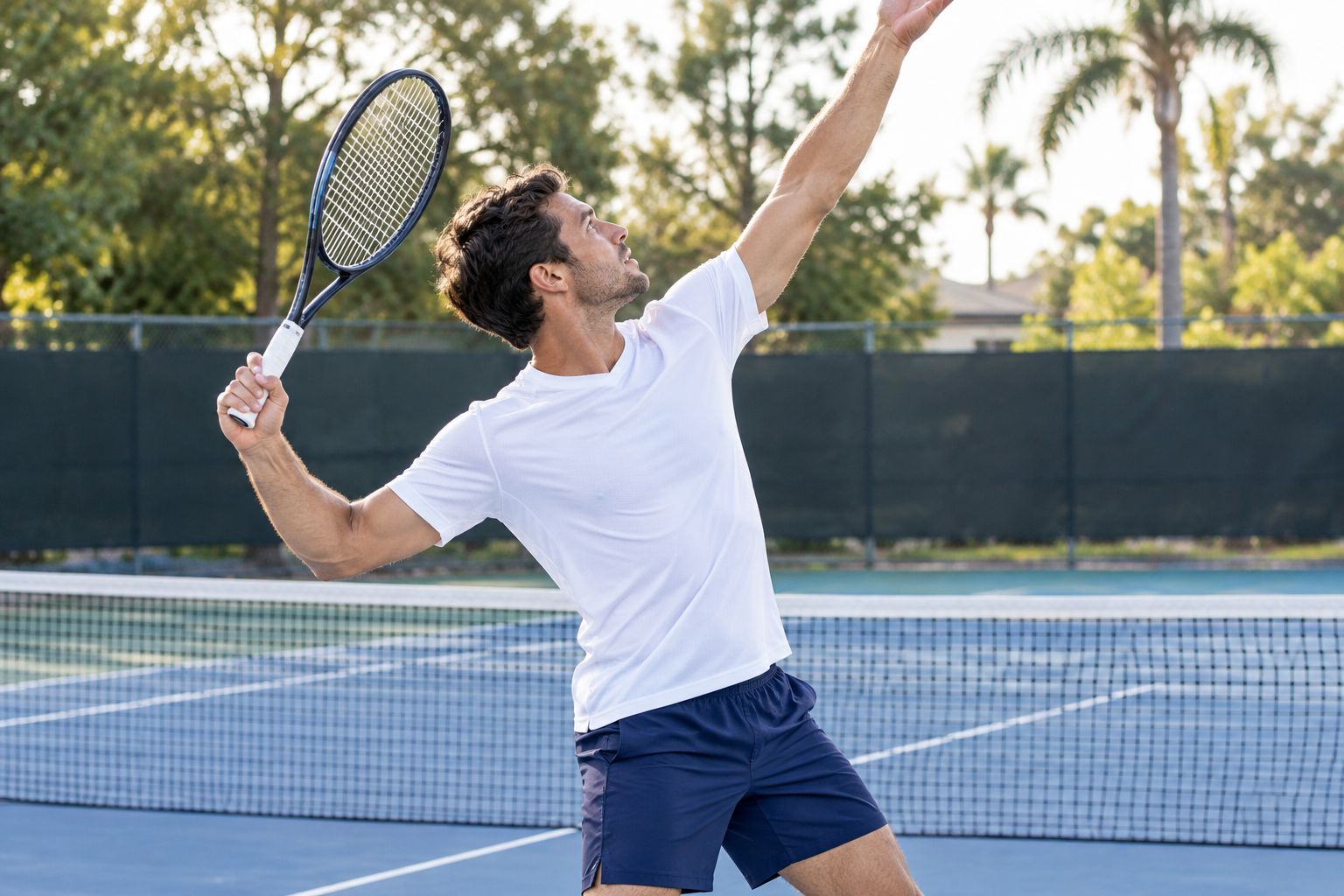
Tennis adds a practical fit requirement: your top must move through a serve, reach and rotation without distracting you. A matching appearance does not justify a restrictive shoulder or a hem you keep adjusting between points.
Online ordering also puts responsibility on the club to collect clear measurements. Start with the principles in sizing a custom jersey without an in-person fitting, then obtain the measurement instructions for the actual tennis garment you are considering.
For your 2026 pennant brief, prioritise rule compliance, movement and repeatable club identification. Treat decorative extras as secondary until those decisions are settled.
How to organise your pennant uniform order
Check your competition’s clothing requirements
Start manually: find your competition’s current regulations and ask the pennant coordinator to clarify anything unclear. Save the relevant wording with your team documents rather than relying on a recollection from another season.
Do not assume every Australian association uses the same clothing rules. Ask specifically about club identification, permitted garments, sponsor placement and any requirements affecting emergency players. Record the source and the date you checked it.
Keep that confirmation separate from the supplier’s artwork approval. A supplier can reproduce the design you approve; your club still needs to establish whether that design meets the competition requirements.
Save the current competition clothing rules.
Confirm any club colour or identification requirements.
Ask about sponsor wording and logo placement.
Check how the rules apply to emergency players.
Name the club official responsible for compliance.
Build a roster that includes emergencies
Use a spreadsheet or shared document before choosing a design. Give each player a separate row and distinguish confirmed orders from expressions of interest; a message in the team chat is not a completed size selection.
Record the garment, cut, size, quantity and personalisation exactly as the player approves them. For emergencies, decide whether the club will hold shared garments or ask players to obtain their own. Make that decision before adding names to anything intended for shared use.
For the 2026 season, nominate a roster owner and a clear approval deadline. Keep one current version so that a later message does not quietly overwrite an earlier confirmed choice.
Separate regular players from emergencies.
Record garment selections against each player.
Mark unconfirmed measurements clearly.
Decide who owns any shared garments.
Assign one person to maintain the final roster.
Define the garment before choosing the decoration
Write a short garment brief yourself: preferred neckline, sleeve coverage, fit choices, club colours and intended playing conditions. Ask players what their current tennis clothing does well—and what they find uncomfortable during a match.
FE Custom best suits Australian teams that want to organise sports customisation online. Use the FE Custom contact page to ask which tennis garments meet your brief and what information is needed to assess the order. Confirm the garment before discussing optional decoration.
The limitation of an online enquiry is straightforward: a design image does not establish fit, fabric feel or suitability for your players. Ask for the actual garment specifications and measurement guidance rather than treating another sport’s jersey as a tennis equivalent.
Specify the intended playing garment.
List the cuts your squad needs.
Describe sleeve and neckline preferences.
Request the garment’s fabric and care information.
Ask how players can assess fit before approval.
Measure players and test tennis movement
Begin with a well-fitting tennis garment and the supplier’s instructions. Establish whether the size chart describes body measurements or finished garments before comparing anything; these are different measurements.
Record measurements in centimetres, labelled by what was measured. Do not transfer a size letter from another brand or assume the same label means the same fit across different cuts.
Use 3 movement checks: serve reach, forehand rotation and a low volley stance. These are practical fit checks, not a substitute for the garment’s size chart. Where a sample assessment is possible, wear the usual playing layers and check whether the neckline, shoulders or hem distract you.
Confirm whether the chart uses body or garment measurements.
Measure each dimension using the stated method.
Record measurements in centimetres.
Check serve reach, rotation and a low stance.
Obtain each player’s written size approval.
A fitting check should reproduce tennis movement rather than a relaxed standing pose. Watch what happens around the shoulders and hem when the player reaches overhead.
Check the garment through a serving movement, not only while standing still.
Prepare club artwork and personalisation
Collect the club crest and sponsor files in a shared folder. Ask the club or sponsor for the original artwork rather than copying a small image from a social media profile.
Keep the club identity consistent across the squad, but approve placement on each selected garment cut. A position that looks balanced on one neckline needs a separate check on another. Ask how the proposed decoration interacts with seams and stretch areas.
For your 2026 artwork record, save the approved colours, wording and placement references together. Confirm the proposed decoration method with the supplier; do not assume embroidery, applied printing or sublimation is offered on every garment.
Obtain permission to use club and sponsor artwork.
Supply original artwork files where possible.
Confirm spelling, punctuation and capitalisation.
Review placement on each garment cut.
Decide whether player names suit shared emergency garments.
Separate roster approval from artwork approval
Review the order manually before giving any production instruction. Use 2 approval records: the player roster and the artwork proof. A correct logo does not confirm the quantities, and a correct spreadsheet does not confirm the design.
Read the proof at a useful viewing size, checking the front, back and any other decorated areas. Then compare the order summary with the approved roster, line by line. Ask the supplier to explain anything represented differently between the documents.
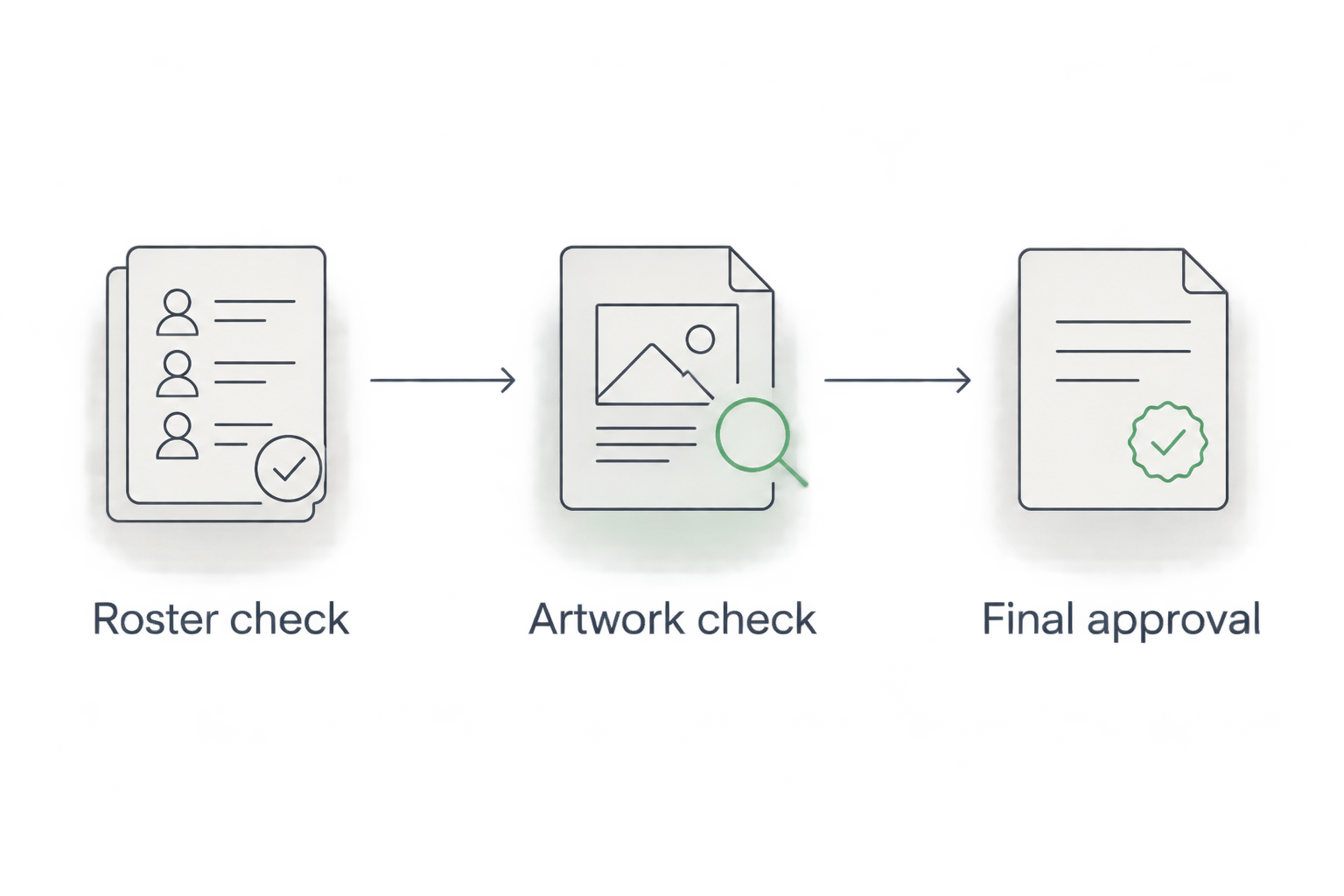
Keep a simple approval sequence: roster check, artwork check, final approval. Nominate who can authorise changes so that conflicting instructions do not arrive from several club members.
Check every garment, cut, size and quantity.
Compare names against player-approved spellings.
Review all decorated areas on the proof.
Resolve differences between proof and order summary.
Save the final approved files together.
The approval sequence separates player information from visual design. Complete both checks before the authorised club representative gives final approval.
Roster accuracy and artwork accuracy need separate checks.
Confirm delivery arrangements and preserve the order record
Work backwards from the date players need their uniforms in hand. Ask the supplier to distinguish artwork preparation, approval, production, dispatch and transit rather than treating them as one undifferentiated turnaround period.
For a 2026 pennant order, provide the delivery postcode and explain whether the club is using a clubhouse, workplace or residential address. Confirm who can receive the parcel and how the team will collect garments afterwards. Do not promise a match-day handover until the arrangements are confirmed.
After receipt, compare the garments with the approved order and follow the supplied care instructions. Keep the order reference and artwork for future enquiries without assuming later repeat orders will have identical terms.
State the required in-hand date and postcode.
Confirm the stages covered by the supplier’s timing advice.
Nominate a delivery recipient and distribution contact.
Check received garments against the order record.
Save artwork, size information and care instructions.
Compare uniform approaches for your pennant squad
Choose the approach that resolves your club’s actual requirement. These are purchasing approaches, not claims that a particular garment or decoration method is offered by FE Custom.
Option
Best for
Main advantage
Key limitation
Matching custom tops with approved player-owned bottoms
Teams prioritising a consistent club identity
Focuses coordination on the most visible shared element
Bottoms still need to meet club and competition requirements
Coordinated tops and bottoms
Teams that require a consistent full playing outfit
Establishes a clear whole-outfit specification
Adds garment selections and fit checks for every player
Club-branded tops in different cuts
Squads with different fit and coverage preferences
Keeps shared colours and branding without imposing one cut
Requires separate sizing and placement checks
Existing suitable tennis garments with added decoration
Teams that already agree on a playing garment
Starts with a garment players can assess
Decoration suitability and supplier acceptance need confirmation
For a squad with different fit preferences, start by assessing coordinated tops in suitable cuts. That approach preserves player choice while giving the club a common identity. Its limitation is administrative: every cut still needs its own measurement and artwork checks.
If your club requires a complete matching outfit, specify that from the start. Do not approve tops first and leave an unresolved bottoms requirement until the order is ready to proceed.
Common mistakes pennant teams make
Treating every tennis competition as having identical rules
Another club’s uniform is not proof that your proposed design complies. Check your own competition and club requirements before approving colours, sponsor marks or garment choices.
Ordering only for the opening-round line-up
A uniform plan that ignores emergencies leaves their clothing unresolved. Include emergencies in the roster discussion and decide whether any shared garments need to remain free of player names.
Choosing one cut to simplify administration
One cut simplifies a spreadsheet, not necessarily the playing experience. Ask players to assess suitable cuts against the relevant size charts, then keep colours and branding coordinated.
Approving appearance without checking movement
A top can look tidy at rest and still distract you during a serve. Check overhead reach, rotation and a low stance before settling the fit wherever a garment assessment is possible.
Turning an estimate into a team promise
A general timing statement does not establish your order’s arrival date. Confirm the specific order stages, destination and required in-hand date before telling players when collection will happen.
FAQ
What should custom tennis uniforms for pennant teams include?
Start with the garments your club and competition require, then specify colours, club identification and suitable fit choices. Include regular players and emergencies in the ordering plan.
Does every pennant player need to wear the same garment cut?
Check your competition and club requirements before deciding. Where different cuts are permitted, coordinate colours and branding while assessing each cut separately for fit and artwork placement.
How do we choose tennis uniform sizes when ordering online?
Use the actual garment’s measurement instructions and size chart. Establish whether the measurements describe the body or finished garment, record them in centimetres and obtain each player’s approval.
Can our pennant team put sponsor logos on its uniforms?
Confirm sponsor-logo rules with your competition and club before approving artwork. Obtain permission to use the logo and ask the supplier to confirm the proposed decoration method and placement.
How far ahead should we organise a pennant uniform order?
Set your required in-hand date first, then obtain order-specific timing advice. Allow for roster collection and artwork approval as well as the production and delivery stages the supplier confirms.
Should emergency players have personalised tennis uniforms?
Keep shared emergency garments unpersonalised if they need to move between players. If an emergency player is ordering a personal garment, confirm their preferred wording and size separately.
Can FE Custom help with a pennant team uniform enquiry?
FE Custom operates online in Australia as a sports customisation store. Send your tennis garment brief, player requirements and delivery postcode to confirm suitable options and ordering details before making a selection.
One last thing
Ask the emergency player to review your uniform plan. Their situation tests whether you have resolved shared sizing, personalisation and collection—not just designed something for the regular line-up. Save those decisions in your 2026 club order record so the next captain inherits instructions rather than a collection of messages.