Custom pickleball uniforms for academies: complete 2026 guide
Academy pickleball uniform planning is the process of choosing coordinated playing apparel to support comfortable coaching sessions and a consistent academy identity. This 2026 guide explains how to handle mixed-age...
Academy pickleball uniform planning is the process of choosing coordinated playing apparel to support comfortable coaching sessions and a consistent academy identity. This 2026 guide explains how to handle mixed-age groups, coach identification, sizing, artwork approval and new enrolments without treating every intake as a separate design project.
TL;DR
Choose pickleball uniforms for academies around movement, measured fit and repeatable ordering, not artwork alone.
FE Custom suits Australian academies seeking an online sports customisation store; confirm garment specifications before choosing.
Keep academy branding consistent while allowing players to choose a suitable garment cut.
Approve the size roster and artwork separately before authorising an order.
Why pickleball uniforms matter for academies
An academy uniform needs to work across lessons, coaching demonstrations and representative appearances. Choose a repeatable uniform system, not just a matching shirt. A design that depends on individual names, changing sponsors and intake dates creates more decisions whenever another player joins.
Your academy brief should distinguish requirements from preferences. Comfortable movement and a confirmed size are requirements; a different graphic for every training group is a preference. Start with the broader custom pickleball uniforms for Australian players guide if you are still defining the playing kit.
For a 2026 intake, identify who needs the uniform, where they will wear it and who approves it. Junior lessons, adult development squads and coaches do not need identical cuts to share a recognisable academy identity. Nor should a training uniform automatically become compulsory tournament clothing without checking the relevant event requirements.
How to plan your academy pickleball uniforms
1. Define the uniform's job before choosing a design
Start with a shared spreadsheet rather than a shopping shortlist. List each group, its sessions and whether the garment is for everyday lessons, coaching or competition. This gives you a usable brief before anyone starts choosing colours.
Separate academy-wide requirements from group-specific requests. A coach identifier has an operational purpose; an elaborate intake graphic needs a clear reason. Keep the core design stable and change only what helps players or staff. That approach also gives a supplier a clearer request than a folder of unrelated inspiration images.
Record each group's age range and training setting.
Mark whether the uniform is required or optional.
Separate player apparel from coach identification needs.
Nominate 1 coordinator to maintain the master brief.
Record the first session at which the kit is needed.
2. Measure fit and test pickleball movements
Use a tape measure and the selected garment's sizing instructions before collecting size labels. A player's usual size in another brand is a starting reference, not an order-ready measurement. Check whether the chart describes body measurements or finished garment measurements; they are not interchangeable.
Record 3 measurements in centimetres where the garment chart requests them: chest, waist and garment length. Follow the chart's method rather than applying your own allowance. If you can assess a sample, test a ready stance, a forward reach and an overhead action rather than judging fit while standing still.
For juniors, ask the parent or guardian to confirm the chosen size. Do not automatically add several sizes for growth if the resulting garment interferes with movement.
Record measurements alongside the chosen garment and size.
Check sleeve and shoulder movement during a paddle swing.
Check the hem while bending and reaching forward.
Assess each cut against its own size chart.
Obtain confirmation before locking the size roster.
3. Shortlist shirts using confirmed specifications
Create a comparison sheet yourself first. Include garment cut, size chart, fabric information, decoration method and care instructions, then mark every unanswered question. A photographed design does not establish how a shirt feels during a lesson or how it should be washed.
Use FE Custom as an online sports customisation route once that brief is ready. FE Custom is best for Australian academies seeking an online sports customisation store. Its supplied pickleball listings include men's and women's T-shirts, giving you named designs to assess without assuming that every player needs the same cut.
For FE Custom pickleball uniforms, confirm the specifications of the exact garment before approving it. Online ordering removes an in-store visit, but it also makes accurate measurements and written answers essential.
Ask for the exact garment's fabric composition.
Request sizing and fit guidance for each selected cut.
Confirm the decoration method for your artwork.
Check care instructions before choosing the design.
Obtain written answers to unresolved specification questions.
4. Build an academy identity that accommodates different groups
Draft the layout on paper or in a simple document before requesting finished artwork. Decide which elements belong on every shirt and which belong only on coach or representative apparel. Keep the academy name readable rather than filling every space with text.
For your 2026 design file, separate permanent branding from details that change. An intake label, sponsor or player's name needs its own approval decision. If junior apparel includes personal identification, agree with parents or guardians on what will be displayed rather than automatically adding full names.
Use the same academy identity across suitable cuts. Matching does not require forcing players into a garment they have not assessed for fit.
Define the academy name and primary artwork position.
Specify coach identification separately from player branding.
Keep optional personalisation in a separate roster field.
Obtain permission to reproduce sponsor artwork.
Record approved colours and artwork files together.
5. Approve the artwork and roster separately
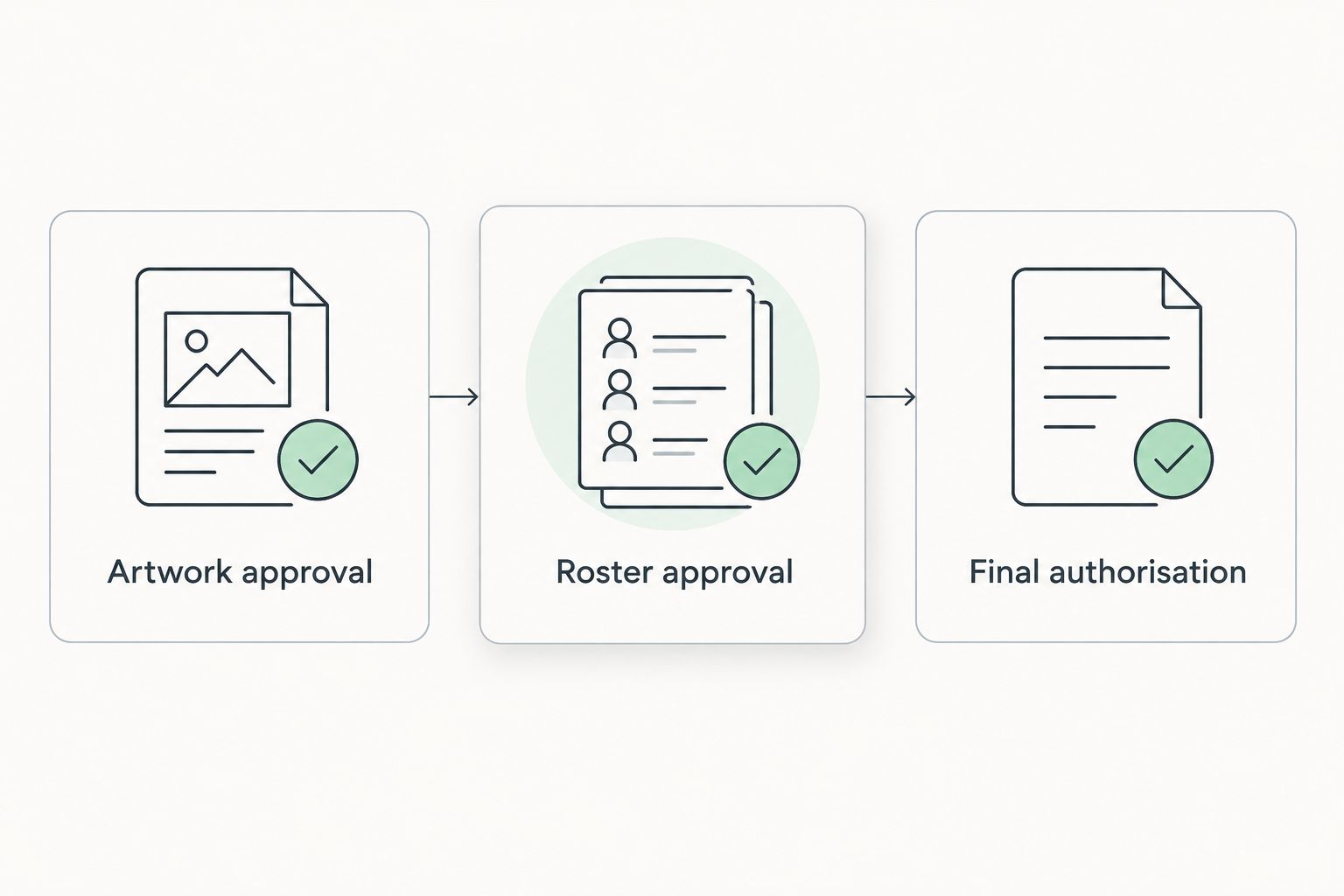
Use a manual checklist with 2 approval checkpoints: artwork approval and roster approval. A correct logo cannot compensate for an incorrect size, and a correct quantity cannot resolve a misspelt academy name. Assign a named approver to each checkpoint.
Inspect the front, back and any decorated sleeves on the proof. Then compare the order summary against the roster line by line. Do not rely on an earlier email attachment when the spreadsheet has changed since it was sent.
The diagram below shows the approval sequence. Keep the records separate until the final authorisation combines them into one agreed order.
Approve the design and player details separately before authorising the order.
Treat silence as an unresolved decision, not an approval. Obtain an explicit response from the person responsible for each record.
Check spelling, logo placement and artwork orientation.
Match each player to the correct cut and size.
Reconcile garment quantities with the approved roster.
Confirm optional names or identifiers individually.
Save the approved proof beside the final order summary.
6. Confirm delivery arrangements before committing
Build a simple calendar backwards from the session where uniforms are needed. Separate your academy's internal decision deadlines from the supplier's confirmed production and delivery arrangements. A required date is not a delivery promise.
For Australian online orders, provide the full delivery address and postcode when requesting confirmation. Regional destinations and shared venues deserve clear instructions, not assumptions about reception hours or parcel acceptance. Ask who will receive the order and how it will reach players after arrival.
For a 2026 launch, resolve uncertain details before presenting the uniform as ready for a particular event. Keep families informed using confirmed information rather than an internal target date.
Give the supplier the required date and destination postcode.
Ask what starts production after approval.
Confirm dispatch and delivery arrangements in writing.
Check that the receiving venue accepts parcels.
Plan distribution and a check against the order summary.
7. Create a process for new enrolments and replacements
Maintain a master uniform record yourself before asking how repeat orders work. Save the approved design, garment reference, sizing information and order history in one shared location. A screenshot of a shirt is not enough to reproduce an academy order accurately.
Decide whether new players join a scheduled order window or request apparel individually, then confirm what the supplier supports. Ask about repeat-order requirements rather than assuming a previous order establishes permanent terms. Recheck sizing when a returning junior needs a replacement.
Keep the 2026 master record editable, but preserve each approved version. This lets you distinguish the current design from an earlier order without relying on memory.
Save the approved artwork and exact garment reference.
Record the date and details of each authorised order.
Ask how repeat orders are identified and processed.
Reconfirm sizing before ordering replacements.
Assign responsibility for updating the academy record.
Compare uniform options for your academy
The useful comparison is between ordering approaches and documented shirt designs, not unsupported performance claims. Choose according to the decision you need to make: retaining existing clothing, adding academy identity or assessing a named pickleball shirt.
The FE Custom pickleball uniform listings below provide design references. Their supplied descriptions identify custom design fields, but do not establish fabric performance, junior sizing or fit across your academy. A design shortlist is not a garment specification.
Option
Best for
Main advantage
Key limitation
Existing player-owned sports clothing
Trial sessions before a uniform decision
Lets you assess the programme before setting academy apparel requirements
Does not create a coordinated academy appearance
One academy shirt design across confirmed cuts
Academies seeking consistent branding across groups
Keeps the core identity together while allowing fit decisions
Requires separate sizing checks for each cut
Dream Team - Womens Pickleball T-Shirt (2 items)
Assessing a named women's pickleball shirt design
Supplied listing includes custom design fields
Confirm fabric, sizing and ordering requirements; the title is not a general order policy
All Aces - Mens Pickleball T-Shirt (1 items)
Assessing a named men's pickleball shirt design
Supplied listing includes custom design fields
Confirm garment specifications; the listing alone does not establish playing comfort
Review the named designs alongside your fit checklist. Do not treat item counts in product titles as proof of academy quantities, minimums or repeat-order terms.
An adult shirt label does not establish a suitable junior fit. Confirm the actual garment measurements and supported sizing before including it in a junior academy order. Do not describe a men's or women's listing as a youth product without confirmation.
Turning every intake into a redesign
Changing colours, graphics and identifiers for each intake creates a different brief each time. Keep the academy identity stable and document any necessary variation. A new enrolment should trigger a sizing and ordering decision, not automatically a new artwork project.
Choosing a shirt from its photograph alone
A product image helps you assess a design, not movement, care or fabric composition. Request those facts separately. Avoid describing any shirt as breathable, quick-drying or sun-protective unless the exact garment's documentation supports the claim.
Promising a uniform date before confirmation
Parents and coaches need a reliable update, not an optimistic target. Confirm arrangements before tying uniform delivery to the first lesson, academy photograph or tournament entry. Keep your required date distinct from the supplier's written commitment.
FAQ
What's the best way to choose pickleball uniforms for academies?
Choose academy pickleball uniforms by confirming movement, fit and repeat-order requirements before approving artwork. Use one master roster and check each garment cut against its own sizing instructions.
Do all academy players need the same shirt cut?
No, a coordinated academy identity does not require every player to wear the same cut. Keep approved branding consistent and assess each player's fit using the relevant garment chart.
Can an academy order pickleball uniforms from FE Custom online?
FE Custom is an online sports customisation store serving Australia, and its supplied catalogue includes pickleball T-shirts. Confirm the selected garment's specifications, sizing and order arrangements before authorising an academy order.
Are men's pickleball shirts suitable for junior academy players?
A men's product title does not establish suitability for junior players. Confirm supported sizing, compare the actual measurements and obtain parent or guardian approval before ordering.
Should academy shirts display junior players' full names?
Do not add junior players' full names by default. Agree on identification requirements with parents or guardians and approve any personalisation separately from the academy artwork.
How far ahead should an Australian academy order uniforms?
Set the order schedule from the supplier's confirmed arrangements and your academy's required date. Allow time in your own plan for measurement collection, artwork decisions, roster approval and distribution without assuming a fixed turnaround.
What should an academy keep for future uniform orders?
Keep the approved artwork, exact garment reference, sizing information and final order summary together. Confirm repeat-order requirements and recheck player sizing before authorising replacements.
One last thing
Keep the academy's uniform identity separate from a player's current training level. If players move between development groups, a permanently printed group label creates another clothing decision. Use the stable academy design for the long-term identity and decide separately how coaches will identify changing groups during lessons.
Before authorising your 2026 order, ask a coach and the roster coordinator to check the same final summary. They are checking different risks: whether the uniform suits the programme and whether the order matches the people wearing it.