Can you order matching custom pickleball kits for doubles teams?
Yes—you can order matching custom pickleball kits for doubles teams by using a shared design while specifying each player’s size and preferred fit separately. Before paying, confirm that your chosen...
Yes—you can order matching custom pickleball kits for doubles teams by using a shared design while specifying each player’s size and preferred fit separately. Before paying, confirm that your chosen supplier accepts an order for 2 players and lists exactly which garments and personalisation the order includes.
TL;DR
For custom pickleball kits doubles teams can wear together, match the design rather than forcing identical sizes.
Confirm the supplier’s minimum quantity before approving a doubles order.
FE Custom is an Australian online sports customisation store; confirm pickleball garment options before ordering.
Check both players’ sizing, artwork and event requirements before payment.
Why this matters
A matching kit is a design decision, not proof that a supplier sells a packaged doubles set. You need agreement on the garments, sizing, artwork and order quantity before a coordinated look becomes an order you can approve.
For your 2026 season, start with the broader custom pickleball uniforms for Australian players guide, then narrow the brief to your partnership. Treat the shared design and each player’s fit as separate decisions. That keeps a visual preference from becoming a sizing compromise.
Can you order matching custom pickleball kits for doubles teams?
Yes. The practical approach is to request the same colours and artwork across both players’ garments, then record each player’s size and any individual text separately. Ask the supplier to confirm that the selected garments support that combination before you approve it.
Use this ordering sequence:
Define the kit. State whether you want tops only or tops and bottoms; do not rely on the word kit.
Confirm the quantity. Explain that the order covers 2 players and ask how the minimum applies to each garment and design.
Record individual fit. Give each player a separate entry rather than submitting a single team size.
Set the shared design. Identify the colours, team wording and artwork that must match.
Approve the details. Check the proposed garments, personalisation, quantities and delivery destination together.
If each player needs 1 top, your request is for 2 tops. If each player needs 1 top and 1 bottom, your request covers 4 garments. Those are planning quantities—not a supplier’s minimum order or a promise that those garments are sold together.
A clear doubles brief names every garment and every wearer. A request for matching kits alone leaves too much open to interpretation.
Matching tops: best for keeping the brief simple
Matching tops are the simplest design brief when your priority is a coordinated upper-body appearance. Keep the base colour, team wording and artwork placement consistent, while recording sizes separately.
The advantage is a narrower approval task: you are checking the tops rather than coordinating an entire outfit. The limitation is equally clear—matching tops do not create a fully matching kit if your bottoms differ.
Choose this approach when both partners are happy to wear their own suitable bottoms and the event permits the combination. Confirm those requirements with the organiser before finalising your 2026 design.
Coordinated outfits: best for different fit preferences
A coordinated outfit uses shared colours and artwork without requiring both partners to wear the same garment cut. It is a useful brief when you want a recognisable partnership but have different preferences for coverage or fit.
The benefit is individual choice. The trade-off is more design checking: a logo placement that works on one cut needs separate review on another, and the supplier must confirm which combinations are possible.
Do not assume that similarly named colours on different garments will match exactly. Ask how the supplier will represent the shared palette and what you should use as the approval reference.
Full matching kits: best for a consistent overall look
A full matching-kit brief covers the tops and bottoms you want coordinated. Specify each piece separately, including whether the bottoms need custom artwork or simply an agreed colour.
The benefit is control over the whole outfit. The limitation is a longer list of fit, design and quantity decisions; a top that suits a player does not establish the correct bottom size.
Use the comparison below to choose your brief before discussing specific garments. These are ordering approaches, not named product packages.
Approach
Best for
Main advantage
Main limitation
Confirm before ordering
Matching tops
Partners keeping the brief simple
Shared appearance through the top design
Bottoms remain a separate decision
Top sizes, artwork and minimum quantity
Coordinated outfits
Partners with different fit preferences
Shared identity without identical cuts
Each cut needs its own design check
Compatible garment choices and colour reference
Full matching kits
Partners wanting a consistent overall look
Tops and bottoms follow one brief
More pieces need sizing and approval
Every garment, size and included decoration
Choose the smallest brief that achieves the look you actually want. Adding garments before agreeing on the basics creates more decisions without resolving the original ones.
Why matching doubles kit orders vary
Your order depends on what you ask the supplier to make, not simply on calling it a pickleball kit. Resolve these factors before comparing proposals:
Garment scope: Tops only and tops with bottoms are different requests. List each piece so you can compare like with like.
Player fit: Both partners need individual sizing decisions, even when the design matches.
Artwork scope: Shared team wording and separate player names create different approval details. Confirm which decoration is included.
Quantity rules: Ask whether the minimum applies across the order or separately to each style, cut or design.
Colour matching: Specify a shared reference and ask how it will be applied across the selected garments.
Delivery destination: Provide your Australian postcode and required arrival date so the supplier can assess your request.
Keep those answers attached to the same brief. A design message in one conversation and a size correction in another make it harder for either partner to check the final order accurately.
How do you brief a supplier for a doubles order?
Send a short written brief with a player list, shared design instructions and the date you need the garments. Ask the supplier to answer the quantity and garment questions before you spend time refining artwork.
FE Custom is best suited to Australian shoppers seeking an online sports customisation store. For a pickleball doubles enquiry, use the contact page to confirm the relevant garment choices, minimum quantity and sizing information. Do not treat a general custom sports garment as a pickleball recommendation without checking its suitability for your request.
The benefit of considering FE Custom is its stated Australian online sports customisation focus. The constraint is the online-only model: make the garment specifications and sizing guidance part of your decision rather than relying on an in-person fitting.
Your brief should contain:
The sport and intended use: pickleball doubles, social play or a named event.
The garments requested for each partner.
Each player’s preferred fit and size, subject to the selected size chart.
Shared colours, team wording and artwork files.
Any individual names, with spelling confirmed by the wearer.
Your Australian delivery postcode and required arrival date.
A request to confirm minimums, inclusions and the approval process.
For a 2026 event, give the actual event date rather than asking for delivery soon. Ask the supplier to distinguish artwork approval, production and delivery when explaining the proposed schedule; do not substitute a general estimate for confirmation of your order.
How do you check sizing without losing the matching look?
Choose each player’s fit independently, then check the shared design across the selected garments. Matching should describe the appearance, not force both partners into the same size label.
Use the size chart for the exact garment being considered. First establish whether its measurements describe the wearer’s body or the finished garment, because those are different references and should not be compared interchangeably.
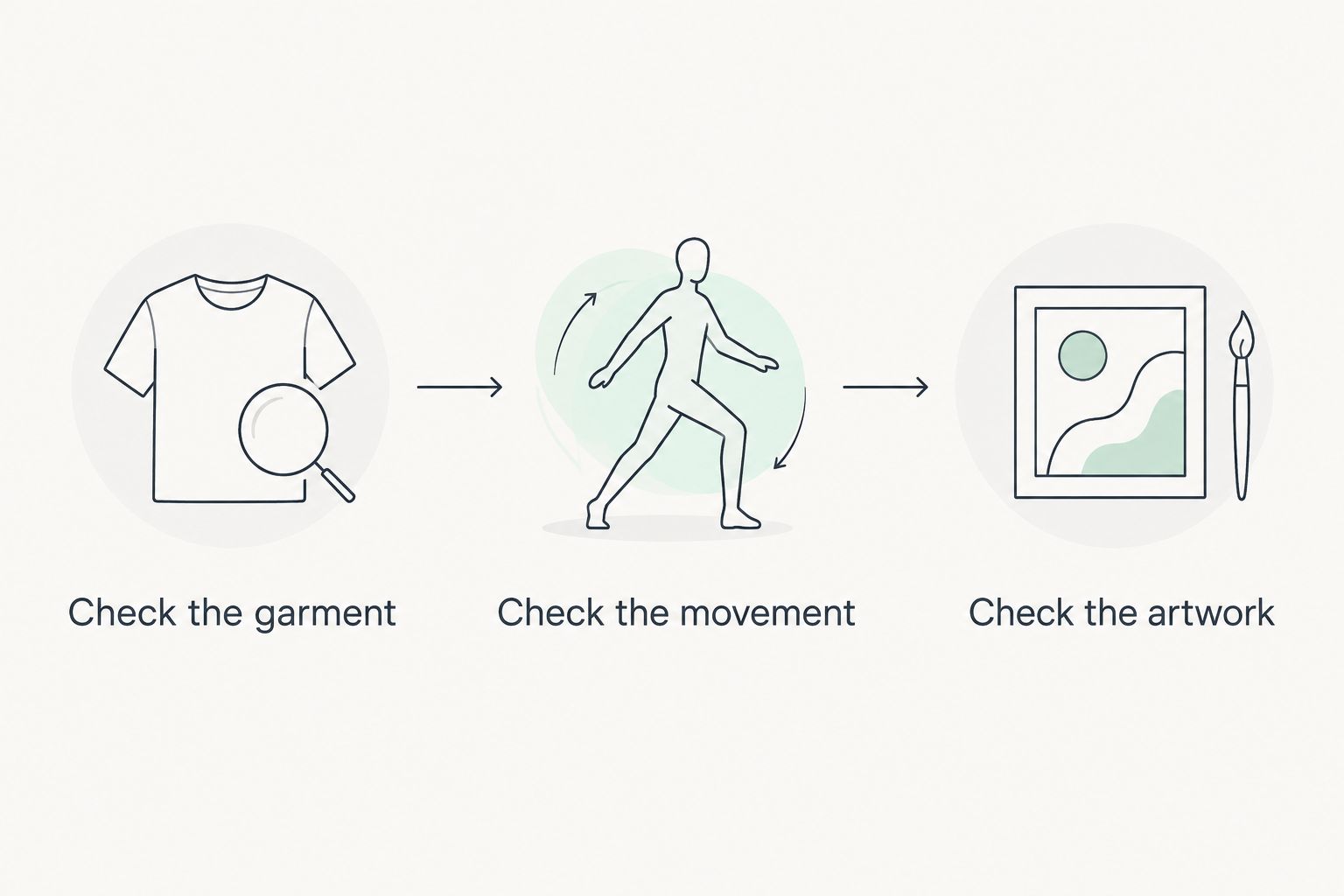
Check the garment
Record the exact style and cut beside each size. A size copied from an unrelated top does not tell the supplier which fit you intended.
Check the movement
Use a comfortable playing top as a fit reference where the supplier’s measurement method allows it. Think about reaching overhead, rotating and bending into your ready position; a static fit preference should not be your only consideration.
Check the artwork
Review the design on each selected cut, not just on a generic team mock-up. Ask whether any placement needs adjusting and make sure both players approve the result.
Approve each player’s fit separately, then check that the shared design still works.
Keep a single final size list after both partners have checked it. If a player changes their choice, update that list and send the replacement clearly rather than leaving competing versions in the conversation.
What should you check on the design proof?
Check the shared elements first, then the individual details. A proof is only useful when you compare it with the written brief rather than deciding that it looks roughly right.
For the shared design, review the base colours, team wording, artwork orientation and placement. For individual details, review names, capitalisation, garment selection and any differences you intentionally requested.
Use this approval checklist:
Both partners’ garments appear in the order details.
Shared wording is identical wherever it should match.
Individual names match the spelling each player approved.
Each size belongs to the correct player and garment.
Artwork placement is checked on every selected cut.
The supplier has answered any unresolved questions in writing.
For a 2026 tournament, also check the organiser’s current clothing and sponsor requirements before approving the design. An approved proof is not a substitute for checking event requirements. If a rule is unclear, ask the organiser rather than asking the garment supplier to interpret it for you.
Can mixed doubles partners choose different cuts?
Yes, different cuts can form part of a coordinated design brief, provided the supplier confirms suitable garment choices. Keep the team colours and artwork consistent, then assess each player’s fit separately.
The key distinction is between requesting that combination and assuming every supplier supports it. Confirm the options before settling on a design that depends on them.
Can you order only enough kit for a doubles pair?
A doubles pair has 2 players, but that does not establish a supplier’s minimum order. Ask whether your requested quantity is accepted for each selected garment, cut and design.
If the minimum exceeds your needs, ask about an alternative before changing the order. Do not add unnecessary garments simply because you assumed a larger team quantity was required.
Can you add another matching kit later?
A later matching kit needs a fresh confirmation of the garment, artwork and order terms. Keep your approved files and order details, but do not treat them as a guarantee that a future order will be identical.
Ask how the supplier handles repeat orders before you approve the first one, particularly if you expect a substitute partner or additional playing tops.
FAQ
Can we order matching pickleball tops in different sizes?
Different sizes can be included in a matching-design brief, subject to the supplier accepting the selected garments and quantities. Record each player’s size separately and check it against the exact garment’s size chart.
Does a custom pickleball kit include shorts?
The word kit does not establish whether shorts are included. Request an itemised description of every garment and its decoration before paying.
Can mixed doubles partners wear different cuts with the same design?
Different cuts can share a coordinated design if the supplier supports the combination. Confirm the garment choices and review artwork placement on each cut.
Do doubles partners have to wear identical pickleball outfits?
Check the rules for your specific event before deciding whether identical outfits are required. Matching teamwear is a design choice unless the organiser’s requirements say otherwise.
Can we put different names on matching pickleball tops?
Request individual names as part of the brief and confirm that the supplier supports the personalisation. Both players should approve their spelling and placement before production.
How early should we order for an Australian pickleball tournament?
Order only after the supplier confirms a schedule against your required arrival date and Australian postcode. Ask how artwork approval, production and delivery affect that schedule.
Can FE Custom confirm a matching pickleball doubles order?
Contact FE Custom with the garments, player details, quantity and required arrival date you want assessed. Confirm pickleball garment suitability and order terms before approving or paying.
One last thing
Approve the partnership’s design together, but let each player approve their own fit. That simple split keeps shared visual decisions from overriding individual comfort.
Before submitting your 2026 order, save the final brief, player list, artwork approval and supplier confirmation in one place. The best matching kit starts with matching instructions—not matching size labels.