
Can you match your club colours exactly on a custom jersey?
You can request a close match to your club colours on a custom jersey, but an exact match is not guaranteed by selecting a colour online. A screen preview or...
You can request a close match to your club colours on a custom jersey, but an exact match is not guaranteed by selecting a colour online. A screen preview or...

You can request a close match to your club colours on a custom jersey, but an exact match is not guaranteed by selecting a colour online. A screen preview or colour code identifies your target; it does not prove how that colour will look on fabric. For your 2026 order, agree on the reference, ask how the supplier checks the result, and confirm the approval standard before production.
Your club’s navy needs a clearer description than simply navy. An old playing top, the website crest and a committee member’s phone photo can present different targets, leaving the supplier to interpret which version matters.
Choose the reference before choosing the shade. If your club is still deciding its palette, start with how to pick sports kit colours for your team. Matching an established colour and choosing a new colour are different jobs.
An exact-match request needs a defined target and an agreed way to judge the finished fabric. Without those, exact means different things to the designer, supplier and club committee.
Use this comparison to decide what to send with your brief. Each reference has a purpose, but none should be treated as an automatic production guarantee.
| Reference | Best for | Strength | Limitation |
|---|---|---|---|
| Club brand guide | Clubs with an established identity | Gives the supplier a documented starting point | A digital specification does not establish the fabric result |
| Named colour standard | Colour-critical identity work | Identifies a reference within a specified system | The system and reference material must be stated |
| Approved physical jersey | Matching an existing uniform | Shows the actual garment you want to coordinate with | Wear and fading can change the target |
| HEX or RGB value | Communicating digital artwork | Records a precise digital value | Screens and fabric reproduce colour differently |
| Phone photo | Explaining the overall design | Shows placement and the general colour relationship | Lighting, camera processing and screen settings affect appearance |
For your 2026 brief, state which reference takes priority if the files disagree. A physical jersey and an old logo file should not silently compete for approval.
A colour code is a specification, not proof of a fabric match. Ask the supplier what matching process is possible for the garment you have selected.
A HEX colour code uses 6 hexadecimal digits to describe a digital RGB colour. RGB describes 3 channels—red, green and blue—with standard 8-bit channel values running from 0 to 255. Those values help communicate artwork consistently; they do not describe a particular textile, ink or manufacturing process.
A named physical colour reference serves a different purpose. If your club has one, provide the full system name and reference rather than a colour name alone. Do not assume a paper reference and a textile reference are interchangeable.
An approved jersey adds useful context because the supplier can inspect the material you want to match. Its weakness is condition: the top worn every weekend is not necessarily an unchanged record of the original colour.
Send the original artwork where possible, alongside the reference. Avoid sampling a colour from a screenshot and presenting that sampled value as the club’s official specification.
Use the following sequence for a 2026 club order. It separates the colour target from the decision about whether the finished result is acceptable.
Each step answers a different question. Combining them into a single instruction to make it the same blue leaves too much room for interpretation.
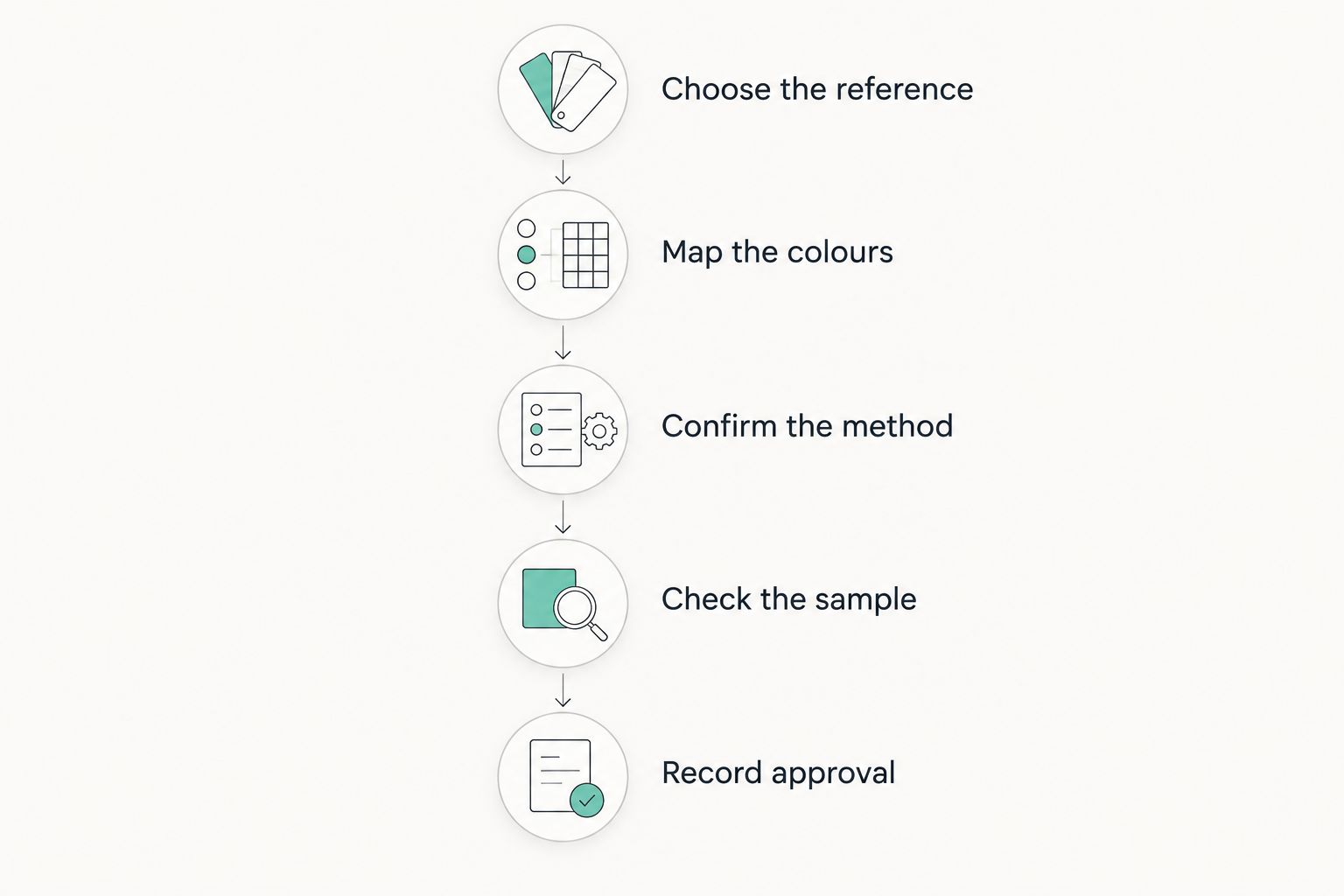
Your brief should also name the garment type, adult or youth sizing requirements, delivery postcode and the date the kit is needed. Ask for the supplier’s confirmed schedule; do not treat a club deadline as an accepted delivery commitment.
Colour differences have identifiable causes. These factors explain why copying a digital value is not the same as approving a finished jersey:
Resolve the cause before requesting a correction. If the artwork contains conflicting blues, asking the supplier to make the blue more accurate does not identify which blue to use.
Treat each face of a reversible basketball jersey as its own design. Your club colour can remain consistent while the base colour, number colour and overall light–dark balance change between faces.
For your 2026 reversible basketball jersey brief, identify the base and contrasting elements on each face. Avoid instructions such as reverse the colours unless you have also shown exactly what that means for the crest, player name and number.
Review these points before approving the artwork:
A successful colour match does not automatically create a readable uniform. Dark lettering on a dark base can preserve the palette while weakening contrast, so assess identity and legibility separately.
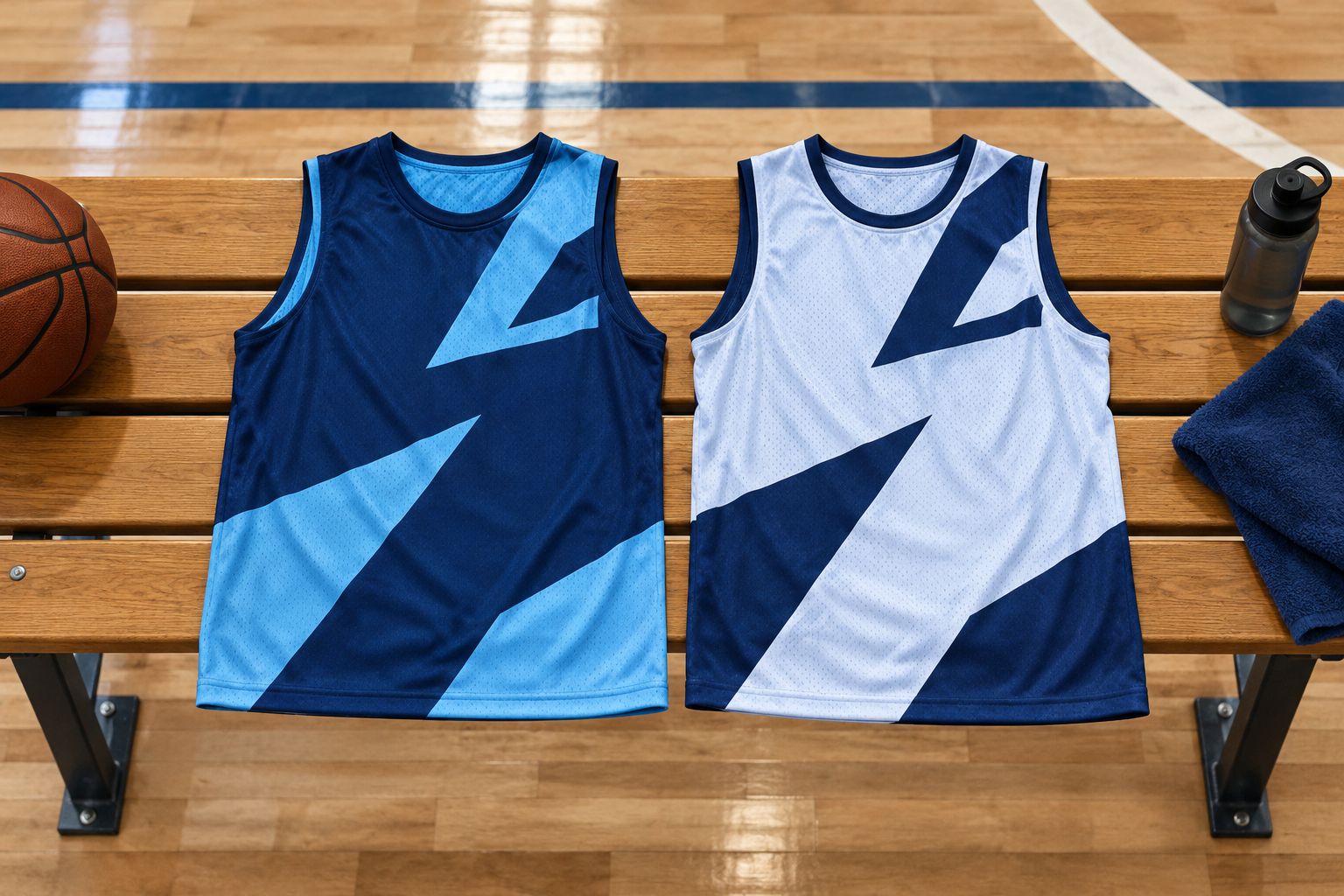
Ask how the supplier will represent both faces in the approval material. A clear view of one side does not establish the colours or placement on the other.
FE Custom suits Australian teams ordering custom sportswear online; colour-critical orders need a separately agreed matching standard. The online-only ordering model makes a precise written brief especially useful.
FE Custom’s supplied reversible jersey listings record named base colours with digital values, including Dark Navy #232156 and Light Navy #17386E. Those entries show why navy alone is an incomplete instruction: even the named shades have different digital specifications.
The FE Custom listings also distinguish side selections and record team-name formatting. That supports a detailed discussion about colour placement, but a listing does not establish a physical colour tolerance or an exact-match guarantee.
Use those details as a starting point for questions, not as evidence that your club’s reference has already been matched. Confirm current product details and the proposed approval process directly before ordering.
Approve colour and layout as separate decisions. A digital proof is useful for checking spelling, positioning, colour assignments and which face is shown; it does not turn your screen into a textile sample.
For a colour-critical order, ask what physical checking options exist before committing to production. If a sample is offered, confirm that its fabric and decoration method represent the proposed jersey. A sample on a different material does not answer the same question.
Keep the approval record concise but specific:
For a 2026 season order, save this record in the club’s shared files rather than a volunteer’s private messages. The next committee should be able to understand the decision without reconstructing a conversation.
An old playing top is a useful reference when the goal is to coordinate with uniforms already in use. Send the best-preserved example available and state that matching the existing kit takes priority over the original artwork.
Do not assume all old tops still match each other. Compare the proposed reference with the squad’s other garments before asking the supplier to reproduce it.
The jersey and shorts need a shared reference, but matching colour specifications alone does not establish an identical appearance. Different materials and surface finishes can affect how the garments look together.
Ask to assess the relevant materials side by side if matching the complete kit is critical. Make clear whether you want visual coordination or the closest possible reproduction of the same shade.
A later top-up order needs the original approved reference and artwork, not a fresh colour selection from memory. Keep a well-preserved garment as a comparison reference and ask the supplier what consistency can be confirmed for the repeat order.
Do not turn an earlier approval into a promise about future production. Reconfirm the garment, material and matching expectations when placing the top-up.
Can you guarantee an exact club colour match from a HEX code?
A HEX code alone does not guarantee an exact fabric match. It identifies a digital RGB colour; the supplier still needs to explain how that target will be reproduced and checked on the selected material.
What's the best reference for matching our existing club jerseys?
An approved physical jersey is the most direct reference when your goal is to coordinate with existing kit. Choose a well-preserved example and explain whether it takes priority over the original brand guide.
Can FE Custom match our club navy exactly?
FE Custom's supplied listings include named colours and HEX values, but those details do not establish an exact-match guarantee. Confirm your reference and the available approval process directly before placing a colour-critical order.
Do we need to check both sides of a reversible basketball jersey?
Check both sides separately, including the base colours, crest, names and numbers. Matching the club palette does not automatically establish readable contrast on each face.
Is a phone photo enough to match a jersey colour?
A phone photo is not a reliable sole reference for an exact colour match. Lighting, camera processing and screen settings affect its appearance, so use it to explain the design alongside a documented or physical reference.
Should we ask for a fabric sample before approving our jerseys?
Ask about a fabric sample when colour accuracy is critical to your club. Confirm whether a sample is possible and whether its material and decoration method represent the proposed finished jersey.
Will the same colour code make our jersey and shorts identical?
The same colour code does not guarantee an identical appearance across a jersey and shorts. Assess the relevant materials together and agree on the intended level of visual coordination.
Keep the approved reference out of the weekly kit rotation. A garment that is repeatedly worn and washed becomes a changing target, making future matching decisions harder to interpret.
Store the reference with the accepted artwork and approval record. Your next uniform coordinator needs the decision you approved, not just the colour everyone remembers.
Your cart is currently empty.
Start Shopping