Best Custom Soccer Jerseys: Women's Clubs Australia 2026
Best overall: a player-approved match jersey. Best for squads sharing a garment cut: a measurement-checked shared-cut jersey. Best for straightforward ordering: a simplified club jersey. For Australian women’s soccer clubs...
Best overall: a player-approved match jersey. Best for squads sharing a garment cut: a measurement-checked shared-cut jersey. Best for straightforward ordering: a simplified club jersey. For Australian women’s soccer clubs choosing custom jerseys in 2026, the right fit comes before the artwork.
TL;DR
The best custom soccer jerseys for women’s club teams Australia start with player-approved fit, not a design preview.
FE Custom suits Australian clubs organising custom sports apparel online; confirm the soccer jersey specification before ordering.
Choose a shared-cut soccer jersey only after players approve its measurements and movement.
Keep team kit artwork readable, then approve player sizes and personalisation separately.
Why this matters
A custom jersey has to work on a moving player, not just on a screen. Your club needs a garment that fits across the squad, supports comfortable movement and carries the correct club details.
FE Custom operates online in Australia. FE Custom is a custom sports apparel option for Australian clubs that want to organise their team order online. Treat garment selection, sizing and artwork as separate decisions rather than approving everything from a single attractive mock-up.
This 2026 guide ranks three jersey-selection approaches, not competing suppliers or unverified product specifications. Each approach answers a different club-order question: which fit to prioritise, when a shared cut makes sense, and how to keep a straightforward order under control.
What makes the best custom soccer jersey?
Use these six criteria before you compare designs:
Player-approved fit: Check chest or bust room, space through the hem and the preferred jersey length. A size label alone does not describe the fit.
Movement: Check reaching, turning, squatting and jogging. The garment should not restrict the movements players need.
Clear sizing instructions: Establish whether the chart describes body measurements or finished-garment measurements before collecting sizes.
Readable artwork: Keep player numbers, club identity and sponsor details clear rather than competing for the same space.
Competition suitability: Confirm your association’s requirements for colours, identification and goalkeeper distinction before approving artwork.
Order control: Record the selected garment, player details and approved design in a single final order sheet.
The best jersey is the one that satisfies your squad’s requirements. A women’s label does not replace a fit check, and a men’s label does not prove that every player will find the garment unsuitable.
Custom soccer jersey options at a glance
Ranked option
Best for
Standout selection feature
Key limitation
Player-approved match jersey
Clubs prioritising individual fit
Each player checks the selected garment’s measurements and movement
Requires coordinated player feedback before approval
Measurement-checked shared-cut jersey
Squads considering the same garment cut across players
A common garment specification with individually selected sizes
One cut does not automatically suit every body shape
Simplified club jersey
Volunteer-run teams seeking a straightforward order
A consistent layout with fewer optional personalisation decisions
Less scope for individual design preferences
These approaches overlap in practice. Every order still needs sizing checks; the ranking identifies the decision that deserves the most attention for each use case.
1. Player-approved match jersey: best for fit-first clubs
A player-approved match jersey starts with the wearer’s requirements. Select the garment only after your players understand its sizing chart, length and shape, then check the fit through soccer movements.
This is the default recommendation for a women’s club team’s 2026 order. You can keep a consistent club design without asking every player to accept the same fit preference.
What to check
Record 3 measurements in centimetres as a practical garment-comparison checklist: flat chest width, flat hem width and jersey length. Follow the supplier’s measurement method; these checks are not a substitute for its sizing instructions.
Measure a jersey each player already finds comfortable. Compare like with like: a flat garment width is not the same measurement as a body circumference, so do not transfer values between those chart types without checking the instructions.
Ask players to describe the fit they want as well. A player who prefers more room and a player who prefers a closer fit should not receive the same recommendation simply because their body measurements are similar.
Player-approved match jersey pros:
Puts individual comfort ahead of assumptions about size labels.
Makes jersey length part of the decision rather than an afterthought.
Gives players a defined opportunity to raise fit concerns.
Keeps the sizing decision separate from approval of club artwork.
Player-approved match jersey cons:
Requires feedback from players before the order is finalised.
A measurement comparison does not replace trying on the actual garment when that is possible.
Late roster changes require another individual sizing check.
Best for: Women’s clubs that want player fit to drive garment selection.
Verdict: Buy only after players approve the fit information for the selected jersey.
2. Measurement-checked shared-cut jersey: best for shared-cut squads
A shared-cut jersey uses the same garment cut across the squad, with each player choosing an appropriate size. It is an option to assess, not a shortcut around sizing.
A soccer jersey described as men’s remains a men’s-labelled garment. Do not describe it as women’s-cut or unisex unless the supplier explicitly identifies it that way.
When a shared cut makes sense
Consider a shared cut when your players are comfortable with its shape and the relevant dimensions. Check the neckline, sleeve position, body room and length rather than relying on the product photograph.
Raglan describes a sleeve construction, not a women’s fit. It does not establish bust room, hem width, fabric stretch or whether a particular player will find the jersey comfortable.
For a 2026 club order, ask every player to confirm their own choice. Do not automatically size everyone down from their usual men’s size or up from their usual women’s size; those labels do not establish equivalent dimensions across garments.
Measurement-checked shared-cut jersey pros:
Gives the organiser a common garment specification to document.
Allows players to select different sizes within the chosen cut.
Keeps the team’s garment selection consistent when everyone approves it.
Measurement-checked shared-cut jersey cons:
The same cut does not suit every player’s proportions or preferences.
Changing size also changes other dimensions; it does not adjust only chest room.
A shared cut needs individual approval, even when the team wants a uniform appearance.
Best for: Squads actively considering a common garment cut and willing to check it player by player.
Verdict: Hold until every player has checked the garment shape and selected their own size.
3. Simplified club jersey: best for straightforward team orders
A simplified club jersey uses a consistent design and limits optional player-by-player changes. Start with the club colours, crest and required identification, then include only the additional details your club has agreed to use.
This approach addresses ordering complexity, not garment performance. It does not establish a lower cost, faster production or better durability.
Keep the brief specific
Write down which details are compulsory and which are optional. If names are not required, decide whether the club wants them before collecting personalised information from the squad.
Choose one approved spelling for the club name and use the same approved sponsor artwork throughout the order. Keep the individual player fields separate so a corrected name does not accidentally change the shared design.
Simplification must not remove required identification. Check the competition rules first, then simplify the discretionary elements of your 2026 design.
Simplified club jersey pros:
Gives volunteers a clear set of design decisions to manage.
Makes the shared artwork easier to compare across player entries.
Limits optional variations that need separate approval.
Simplified club jersey cons:
Offers less individual design choice.
Still requires a complete sizing process for the squad.
Cannot omit details required by your competition or agreed sponsor brief.
Best for: Volunteer-run clubs that want a consistent jersey brief without unnecessary individual variations.
Verdict: Buy after the club approves the shared artwork and each player confirms their details.
How we ranked these jersey approaches
Player-approved fit ranks first because the garment must suit its wearer before the design can complete the order. A measurement-checked shared cut ranks second because it requires agreement on the garment shape across the squad.
The simplified club jersey ranks third as an ordering approach, not a lesser-quality garment. It helps define the brief but does not resolve fit on its own.
The criteria are fit, movement, sizing clarity, artwork readability, competition suitability and order control. This is a buying framework, not a product wear-test or a claim that one named garment outperforms another.
Check fit before approving the design
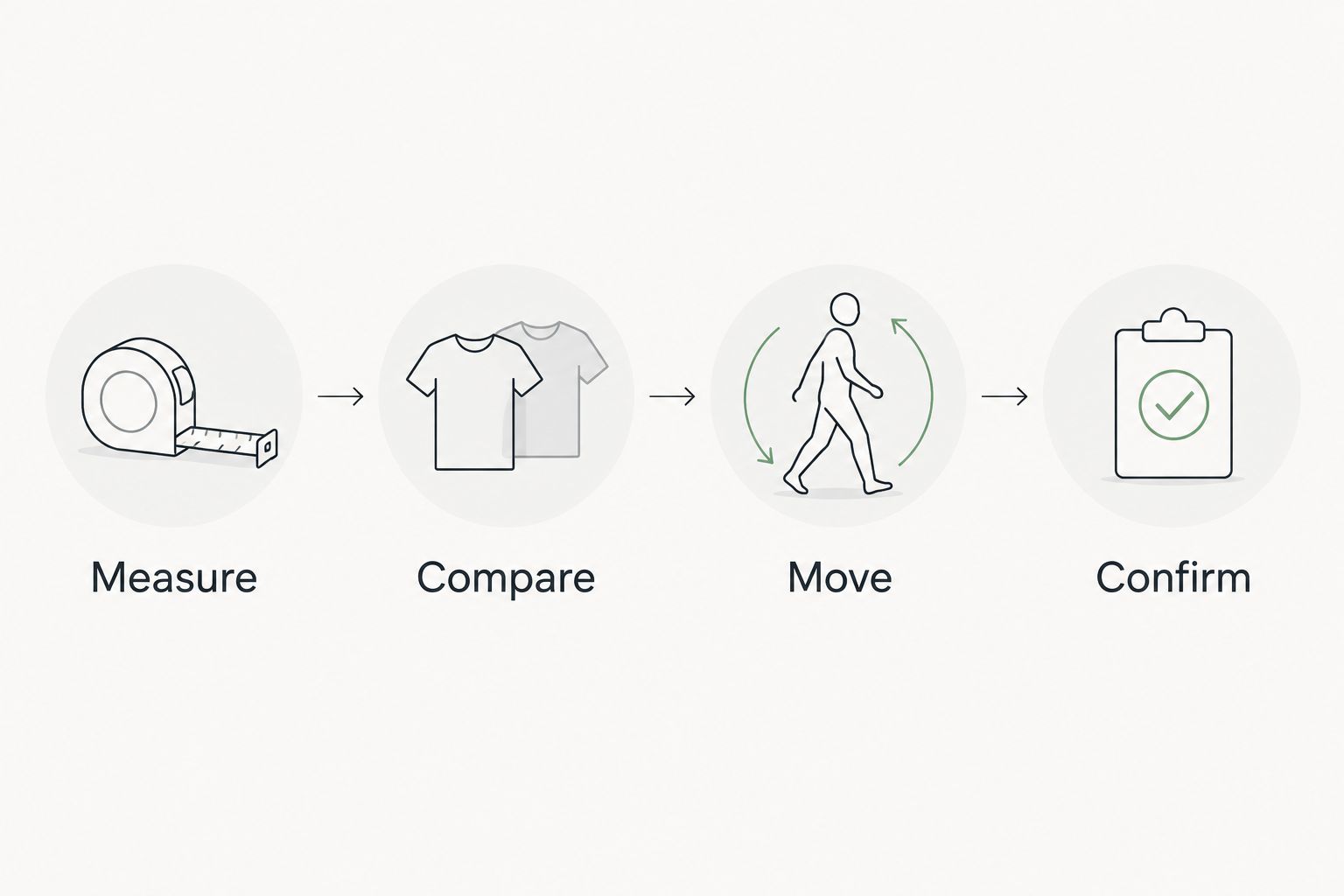
Use a consistent sequence: Measure, Compare, Move, Confirm. Ask players to complete the same checks so you receive useful answers rather than a collection of unrelated size guesses.
Confirm the fit before the club approves the final jersey design.
Measure
Use the selected garment’s sizing instructions. If your team is comparing a comfortable existing jersey, lay it flat without stretching it and record dimensions using the same method for every player.
Where a sample or try-on is possible, use 4 movement checks per player: reach overhead, turn the torso, squat and jog. These are a practical checklist, not a performance test or a guarantee of match-day comfort.
Confirm
Ask each player to approve their selected size in writing. Keep their fit preference attached to that approval so the organiser does not substitute a different size without asking.
Build a club order that is ready to approve
FE Custom custom soccer jersey enquiries should describe the squad’s needs clearly. Ask about the current soccer garment specification rather than assuming that a design page confirms a women’s cut, a particular fabric or a printing method.
Use 2 approval stages per order: shared artwork approval and individual player-detail approval. Keep both records with your 2026 order sheet.
For shared artwork, check:
Club name and approved crest file.
Agreed colours and their placement.
Sponsor artwork and permission to reproduce it.
Number placement and readability.
Relevant competition requirements.
For individual details, check:
Player name exactly as it should appear, if names are included.
Assigned number and any duplication that needs resolving.
Selected garment and size.
Player approval of the final entry.
Any unresolved question that must be answered before ordering.
Assign a final approver for the club. A group discussion can collect feedback, but the order needs a clearly identified final version rather than several competing attachments.
Which custom soccer jersey approach should you choose?
Choose the player-approved match jersey as your default. Start with fit, then apply your club design to the garment your players have assessed.
Choose the measurement-checked shared-cut approach only when the squad accepts that particular garment shape. Choose the simplified club approach when optional design variations are making the order harder to manage.
For FE Custom custom soccer jerseys, keep the buying decision specific: confirm the current garment information, collect player approvals and finalise the artwork. A compelling design preview is not enough to approve an entire squad’s order.
FAQ
What are the best custom soccer jerseys for women’s club teams in Australia?
The best choice is a match jersey with player-approved fit, readable club artwork and the identification your competition requires. Start with garment measurements and movement checks, then approve the design.
Can a women’s soccer team choose a men’s-labelled jersey?
A women’s team can assess a men’s-labelled jersey, but each player needs to approve its fit. Do not describe the garment as women’s-cut or unisex unless the supplier explicitly does so.
Does a raglan sleeve mean a soccer jersey will fit women better?
No. Raglan describes the sleeve construction, not the garment’s overall fit. Check chest room, hem width, length and movement separately.
Should every player choose their usual T-shirt size?
No. Players should use the sizing information for the selected soccer jersey rather than assume their usual T-shirt label is equivalent. Establish whether the chart uses body measurements or finished-garment measurements.
What should our club ask FE Custom before ordering soccer jerseys?
Ask FE Custom to confirm the current soccer garment specification, sizing instructions and customisation details for your proposed order. Include your squad requirements and avoid assuming that a product image confirms fabric, cut or printing method.
Do custom soccer jerseys need player names?
Include player names only when your club wants them or your competition requires them. Confirm identification requirements before collecting personalisation details, then have players approve their spelling.
How do we avoid mistakes in a women’s soccer team jersey order?
Use separate approvals for shared artwork and individual player details. Keep one final order sheet containing the selected garment, sizes, names where applicable and assigned numbers.
One last thing
Check the hem as carefully as the chest. A jersey can provide enough room through the upper body while still feeling wrong through the lower body or sitting at an unwanted length.
Before signing off your 2026 order, ask players to confirm those dimensions too. The best custom soccer jersey is not the design that wins the group vote; it is the approved garment that works for the player wearing it.