
KPI Sports alternatives in 2026
KPI Sports is a sensible benchmark if your club already has an approved uniform and an ordering arrangement that works. That arrangement stops being enough when your next team order...
KPI Sports is a sensible benchmark if your club already has an approved uniform and an ordering arrangement that works. That arrangement stops being enough when your next team order...

KPI Sports is a sensible benchmark if your club already has an approved uniform and an ordering arrangement that works. That arrangement stops being enough when your next team order needs a different buying process or garment brief. FE Custom is a KPI Sports alternative to shortlist in 2026 for Australian teams seeking online sports customisation; a local apparel decorator is the route to investigate if in-person garment assessment is essential.
Changing a teamwear supplier means more than choosing another jersey design. You need to decide what stays consistent, what changes and who approves the order. Start there.
For Australian basketball, soccer, netball, tennis and pickleball teams, the useful comparison is the buying process behind the clothing. A supplier belongs on your shortlist only when the proposed garment, sizing instructions and artwork approval process suit your actual team order.
You can explore FE Custom as an Australian online sports customisation store. Treat the shortlist below as a decision guide: it separates online ordering, local decoration and retaining your current supplier without assuming that every route offers identical garments or services.
Use this 2026 comparison to choose which buying route deserves further investigation. The distinctions below concern how you organise the purchase, not unverified claims about fabric performance, production speed or supplier service.
| Option | Best for | Main distinction | What to confirm | Difference from staying with KPI Sports |
|---|---|---|---|---|
| KPI Sports | Teams whose existing arrangement meets their requirements | Retaining your current supplier relationship | Whether the next order matches the approved garment and design | Your benchmark rather than a change of supplier |
| FE Custom | Australian teams seeking online sports customisation | An online-only Australian store | The relevant garment, sizing instructions and customisation requirements | A separate online store to assess against your current arrangement |
| Local apparel decorator | Teams prioritising in-person assessment | A local enquiry route centred on garment decoration | Whether garment assessment, sourcing and the required decoration are offered | Investigating a different purchasing route rather than assuming an equivalent service |
Choose the route that resolves your specific requirement. A longer list of supplier names does not help if you have not decided whether the problem is fit, artwork approval, ordering administration or continuity.
FE Custom is an Australian sports customisation store that operates solely online. It belongs on your shortlist when you want to investigate custom teamwear through an online store rather than make a physical shop visit. That online-only model is also its clearest limitation.
Keep your enquiry focused on the apparel your team actually needs. For basketball or soccer, separate the playing top from the shorts in your brief; for netball, tennis or pickleball, describe the intended garment and playing use before considering design details.
The latter two points are buying responsibilities, not claims about a defective product or service. They matter because changing suppliers requires you to establish a new reference for the order.
| Decision | Online-store route | Retaining KPI Sports |
|---|---|---|
| Purchasing channel | Online-only Australian store | Assess the channel used in your existing arrangement |
| Garment reference | Confirm the exact garment you intend to order | Confirm whether your previously approved garment still meets the brief |
| Fit reference | Follow the selected garment’s sizing instructions | Use your existing fit information only where the garment remains comparable |
| Approval task | Approve the proposed order specification | Check what has changed since your previous order |
Best for: Australian teams comfortable managing a custom sportswear purchase online.
Verdict: Hold until the garment, fit and artwork requirements are confirmed; then decide whether to switch.
A local apparel decorator is a buying route, not a claim that every nearby business can supply competition teamwear. Investigate this option when inspecting a garment in person matters more than using an online-only store. Ask what the business actually offers before adding it to your shortlist.
This route starts with a different question: can the decorator handle the garment and artwork you need? Some orders require a complete teamwear purchase; others concern decorating a garment you have already selected. Make that distinction explicit.
Best for: teams that require in-person garment assessment and can confirm a local business offers it.
Verdict: Hold until the decorator confirms the garment and decoration requirements together.
Switch to solve a defined problem, not merely to change the name on the order. An alternatives search is useful when your buying brief has changed. It does not establish that your current supplier has failed.
For a 2026 order, write down the requirement that prompted the search. Keep it concrete: you want to investigate online purchasing, assess garments in person, change the uniform design or organise the roster more clearly.
Use these conditional tests:
None of these tests requires a claim about outages, unexpected policy changes or poor service. Your club’s requirements are enough to define the comparison.
Give every shortlisted supplier the same written brief. Otherwise, you are comparing different orders and calling the result a supplier comparison. Keep the brief separate from the artwork so neither gets lost in a message thread.
State the sport, intended use and garment type. Distinguish match clothing from training clothing, and identify whether you are replacing the whole uniform or only part of it.
For basketball, clarify whether your brief calls for a reversible or single-sided playing top. For soccer, decide whether you are assessing the top alone or a top-and-shorts combination. These are order requirements, not assumptions about what a particular supplier sells.
Ask for the sizing instructions attached to the exact garment under consideration. Establish whether measurements describe the body or the finished garment, and follow that method consistently across the roster.
Do not transfer a size label from an old jersey without checking the new reference. A familiar letter on a label is not a substitute for a confirmed fit choice.
Prepare the club artwork, approved colours and any permitted sponsor marks. Identify which elements stay fixed and which change for each player, such as names or numbers where the proposed order supports them.
Check permission to use the artwork before submitting it. If someone else owns a logo or illustration, obtain the necessary approval rather than treating an image found online as usable club artwork.
Use a single approved roster as the order reference. Record each player’s garment selection and size, plus any personalisation that forms part of the agreed brief.
Nominate one person to submit the final version. Ask players to check their own entries before that person approves the order, and keep later changes distinct from the approved file.
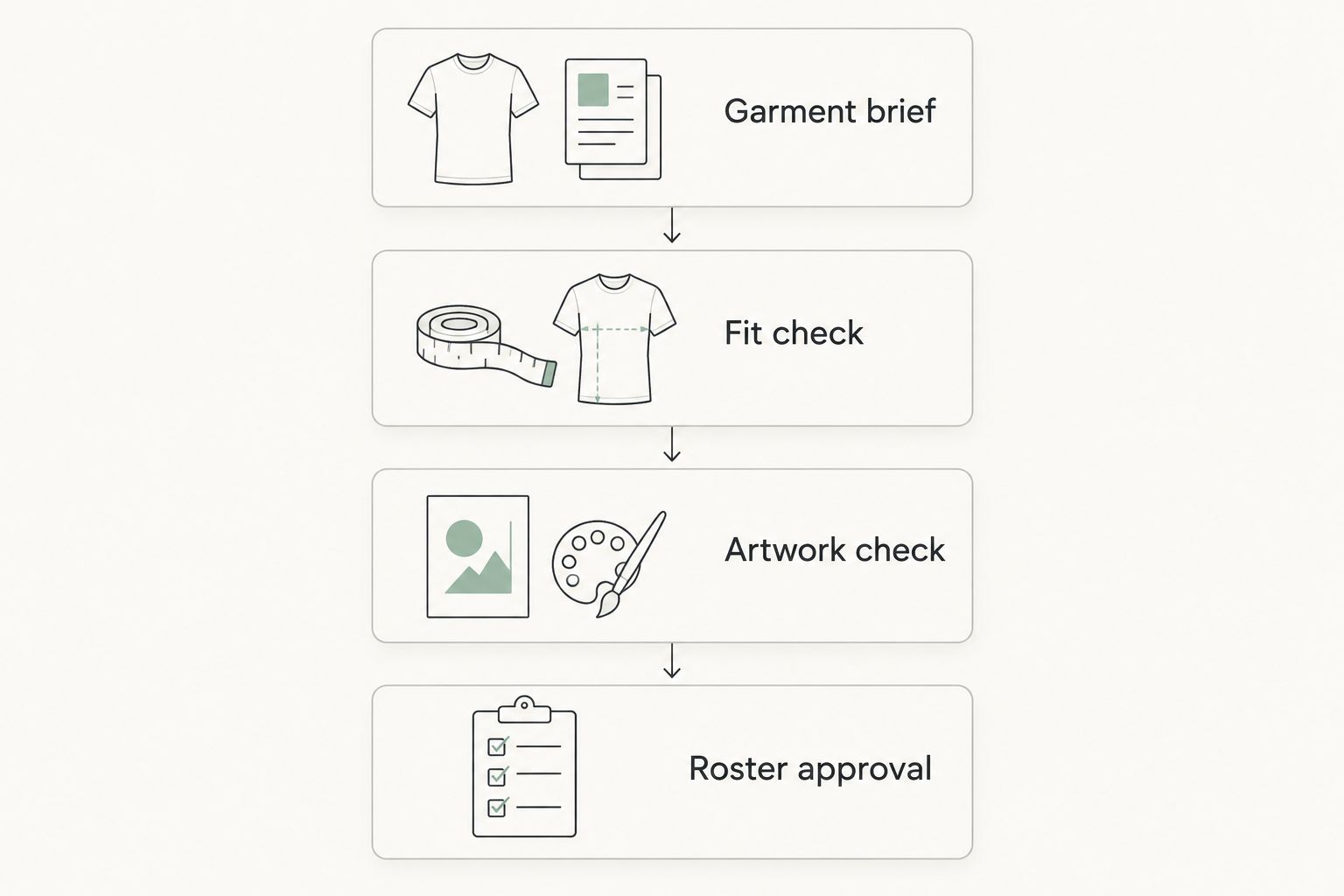
This sequence gives you a clear basis for the supplier decision. Approving a visual design before deciding what garment it belongs on leaves an important part of the order unresolved.
Ask questions that produce an order specification, not a general sales answer. For your 2026 shortlist, the goal is to understand what you are approving and what information the supplier needs from you.
| Ask this | Why the answer matters |
|---|---|
| Which exact garment matches this brief? | Establishes the item you are assessing |
| Which sizing instructions apply to it? | Gives the roster a consistent fit reference |
| How are artwork and personalisation approved? | Clarifies what the club must check |
| What order quantities apply? | Establishes whether the proposed team order fits the ordering requirements |
| What date can you commit to for this order? | Connects the proposed purchase to your actual playing schedule |
| What should the club retain for a later order? | Identifies the records needed to discuss future continuity |
Do not infer answers from a product title, a previous season’s order or a different team’s purchase. Obtain answers for your own garment brief and retain them with the final approval.
For clubs covering several sports, use a separate brief for each playing use. A basketball uniform decision should not become the default specification for a netball, tennis or pickleball team simply because the club colours are shared.
Stay with KPI Sports if your current arrangement meets the new order’s requirements. Changing suppliers is not an improvement by itself.
Retaining the existing arrangement is a sensible decision when you have a suitable approved garment, dependable fit information for the same item and an ordering process your club wants to keep. Confirm those points for the next order rather than assuming nothing has changed.
A mixed replacement order also deserves a continuity check. If new garments must sit alongside existing uniforms, compare the proposed specification against the club’s approved reference before making a supplier decision.
What’s the best KPI Sports alternative for online ordering in Australia?
FE Custom is an option to shortlist for Australian online sports customisation. Compare the relevant garment, sizing instructions and approval requirements against your team’s written brief before choosing.
Is an online sports customisation store better than a local decorator?
An online store suits online purchasing, while a local decorator is a route to investigate when in-person garment assessment is essential. Confirm that the local business offers the garment and decoration services your team needs.
Should my club switch from KPI Sports in 2026?
Switch only when another buying route better meets a defined requirement for your 2026 order. Stay with KPI Sports if the existing garment and ordering arrangement still suit your club.
Can we reuse our current jersey sizes with another supplier?
Do not reuse size labels without checking the sizing instructions for the proposed garment. Confirm the measurement method and have players approve their fit selections.
What should we prepare before comparing custom teamwear suppliers?
Prepare a garment brief, size roster, approved artwork and required playing date. Give each supplier the same information so you assess equivalent orders.
How do we compare basketball and soccer uniform orders?
Compare each sport against its own garment brief. Specify the playing top and any shorts separately, then check the sizing and design requirements for each item.
What should we check on a custom uniform design proof?
Check the approved artwork, colours and any agreed names, numbers or sponsor marks against the final order specification. Have the club’s nominated approver confirm the proof before submitting approval.
Keep the approved garment specification, artwork and roster together. That record gives your club a reference for the next enquiry, whether you retain KPI Sports or choose another route.
For 2026, make the supplier decision last: define the garment, confirm fit, check artwork and approve the roster first. A shortlist becomes useful when every option is answering the same brief.
Your cart is currently empty.
Start Shopping