Budget for a full club custom uniform kit by listing every required garment, multiplying confirmed quantities by current quoted amounts, then adding delivery and any separately quoted services. Keep optional...
Budget for a full club custom uniform kit by listing every required garment, multiplying confirmed quantities by current quoted amounts, then adding delivery and any separately quoted services. Keep optional apparel outside the essential playing-kit total, and subtract only confirmed club contributions or sponsorship when calculating player payments. A jersey-only figure is not a full-kit budget when shorts are sold separately.
TL;DR
For a budget club custom uniform kit, approve the garment list before collecting player payments.
FE Custom suits Australian clubs buying custom soccer and basketball uniforms online.
Reversible basketball jerseys provide two customisable sides; confirm competition acceptance before replacing separate playing tops.
Keep delivery, spare garments and confirmed club funding visible in the budget.
How do you budget for a full club custom uniform kit?
Build your budget from garment quantities, not just player numbers. A player receiving a jersey and shorts creates separate order lines, while a player reusing approved shorts does not need the same purchase.
For Australian clubs ordering through FE Custom, keep the selected garment, cut, size and personalisation attached to each order line. That gives your committee a purchasing record rather than a rough headcount.
Use this breakdown for your 2026 uniform budget:
Budget line
What to record
Check before approval
Playing jerseys
Quantity by design, cut and size
Whether personalisation is included
Playing shorts
Quantity by style and size
Whether shorts are purchased separately
Alternate playing tops
Required colours and quantities
Competition requirements
Spare garments
Specific garments and sizes
Who will use and own them
Optional apparel
Separate opt-in quantities
Whether players or the club pay
Delivery
Quoted amount for the destination
Whether the order is consolidated
Other quoted services
Services expressly listed by the supplier
Whether already included elsewhere
Club funding
Approved contribution
Whether funds are committed
Sponsorship
Confirmed uniform contribution
Payment timing and artwork approval
Club purchase total = garment subtotals + delivery + separately quoted services.
Player-funded balance = club purchase total − confirmed club funding − confirmed sponsorship.
Allocate that balance according to your club's agreed payment policy. Equal payments make sense only when the club has agreed to share costs equally; different garment selections require a clear allocation method.
Why this matters
Your committee needs to approve the same kit that players expect to receive. A budget labelled full uniform creates confusion when it covers only a playing top, or when some players expect alternate colours and others do not.
For the 2026 season, write a plain-language inclusion statement before requesting quotes: the compulsory garments, who receives them, and what remains optional. Use that statement in the committee approval, player communication and supplier brief.
The benefit is control. You can remove an optional item without quietly changing the essential playing uniform, and you can explain a revised total by pointing to the exact order line that changed.
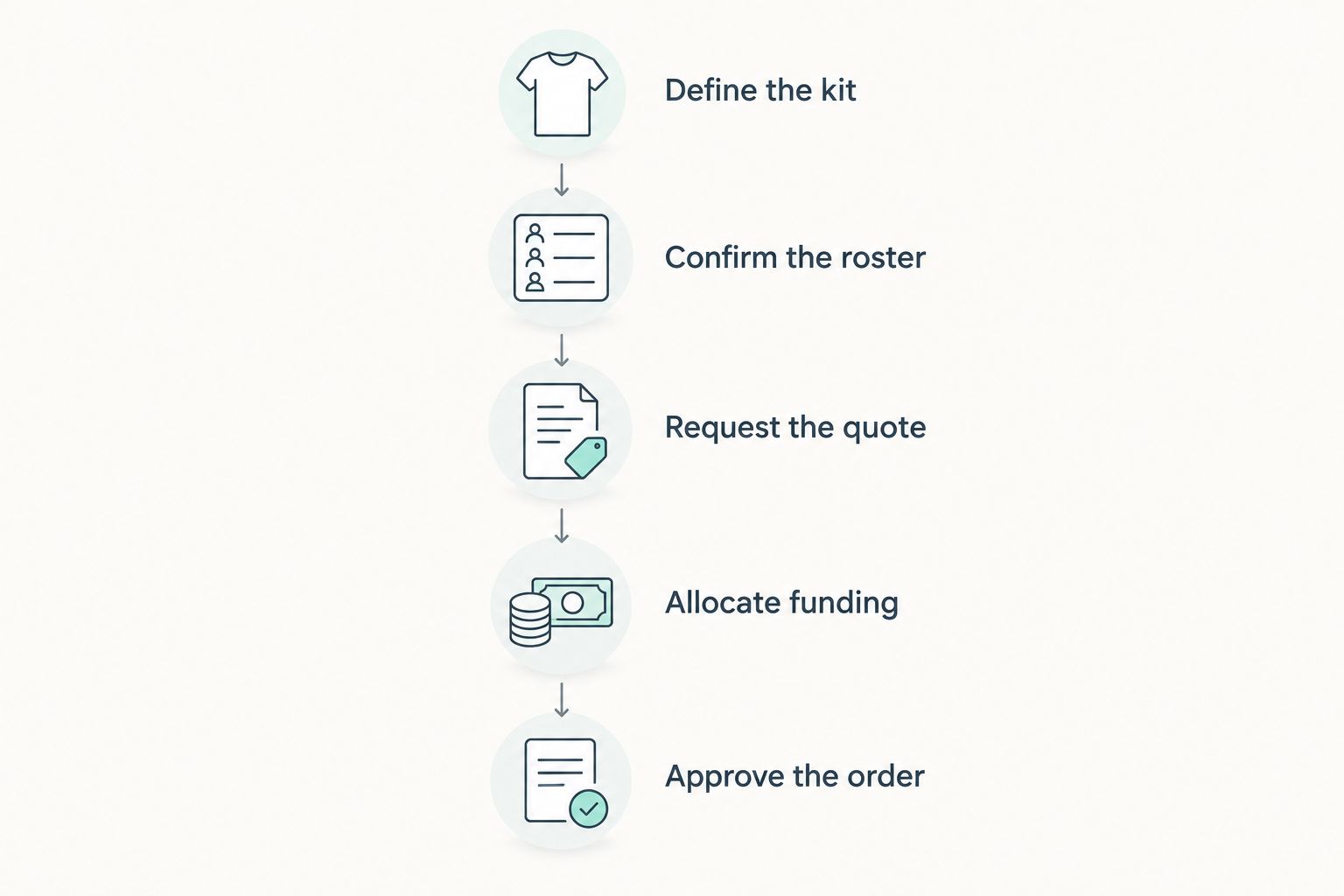
Build the budget in a controlled sequence
Define the kit
Start with what your competition requires players to wear. Check colour requirements, numbering and any alternate-uniform rules with the relevant competition organiser rather than assuming a previous season's arrangement still applies.
For soccer, distinguish the jersey purchase from the complete playing outfit. For basketball, decide whether the club needs a single playing colour, separate alternate tops or reversible basketball jerseys.
Write exclusions as clearly as inclusions. If players supply an existing approved garment themselves, say so; do not leave it implied by a team photo or design preview.
Confirm the roster
Record each player's required garments, preferred cut, selected size and approved personalisation. Separate confirmed orders from expressions of interest so the purchasing quantity remains visible.
Do not apply a jersey size automatically to shorts or assume that the same size label means the same fit across garment types. Use the selected product's sizing information and resolve uncertain entries before approval.
Send the same garment list, quantities, artwork brief and delivery destination to every supplier you compare. Ask each supplier to identify inclusions and exclusions against that list.
For your 2026 quote request, specify Australian dollars and ask how GST is treated. Record the quote's validity and payment terms as supplied; do not assume that a saved product page settles the terms for a club-wide order.
Allocate funding
Separate the purchase commitment from the way the club funds it. The supplier-facing total and the amount collected from players are different figures when sponsorship or club funds contribute.
Record who approved each contribution and when it becomes available. Treat proposed sponsorship as unconfirmed until the club has a firm commitment, rather than reducing player payments on the strength of a conversation.
Approve the order
Reconcile the final quote against the roster, artwork and budget before anyone authorises payment. Check that additions and removals appear in all of those records.
Give a named club organiser responsibility for sending the approved version. Players can contribute their details, but a controlled final instruction prevents separate messages from becoming competing order records.
Confirm the kit and roster before allocating payments and approving the purchase.
Essential playing kit: protect the compulsory garments
Best for: clubs funding the garments players must have to participate. Put compulsory playing apparel ahead of presentation extras or optional purchases.
The advantage is a clearly defined first purchase. The limitation is that an essential kit does not automatically cover every training or club-event need, so explain those exclusions before players pay.
Check whether the selected jersey is sold alone or as part of a defined kit. Several FE Custom soccer and basketball jersey descriptions specify matching shorts sold separately, so keep shorts on their own budget line unless the chosen listing expressly includes them.
Where players already own acceptable garments, ask the club to confirm whether reuse is permitted. Apply the decision consistently rather than leaving individual players to interpret the uniform policy.
Reversible basketball kit: assess both playing sides
Best for: basketball clubs that need contrasting sides in a single jersey. Reversible basketball jerseys offer a different garment arrangement from buying separate playing tops.
The benefit is the two-sided format. The limitation is that the club still needs to check whether the chosen colours, numbers and presentation satisfy its competition; reversibility alone does not establish acceptance.
FE Custom reversible basketball jerseys include options described with 2 customisable sides. Budget for the actual reversible jersey selected, then add the required shorts separately rather than treating the word reversible as a complete-kit inclusion.
Review the artwork on each side. A sponsor or club mark that works against one colour still needs checking against the other, and the committee should approve both views before ordering.
Do not claim a saving simply because a jersey reverses. Compare complete quoted configurations that meet the same playing requirements.
Optional club apparel: separate the decision
Best for: clubs letting players choose extras without expanding the compulsory kit. Keep optional garments in a separate subtotal and collect individual selections before including them in an order.
The advantage is choice. The limitation is additional administration: optional selections need their own quantities, sizing confirmations and payment record.
For your 2026 order, give players a clear distinction between required playing apparel and optional club purchases. An optional item should not appear inside a compulsory player contribution without explicit agreement.
If funding is limited, approve the essential uniform first. Revisit optional apparel only after the club knows what remains available and has checked the terms of any later purchase.
Which kit arrangement should your club compare?
Compare arrangements by purpose before comparing their quoted totals. A jersey-only option and a jersey-plus-shorts option are not equivalent purchases.
Arrangement
Best for
Practical advantage
Limitation to budget for
Jersey only
Players reusing approved shorts
Limits the purchase to the required replacement
Does not provide a complete outfit
Jersey and shorts
Clubs issuing coordinated playing apparel
Makes the core garment scope explicit
Requires separate sizing and quantity checks
Reversible basketball jersey and shorts
Teams needing contrasting jersey sides
Places alternate sides in a single top
Needs competition and artwork checks on both sides
Separate primary and alternate tops
Teams requiring distinct playing garments
Keeps each playing top separate
Adds another garment line to manage
Compare only arrangements that meet the same club and competition requirements. Removing a required garment is a scope reduction, not a like-for-like saving.
Why a full club uniform budget varies
These decisions change what your club purchases and how the payment is shared:
Garment scope: A jersey-only order differs from a jersey-and-shorts order. Define the complete kit before comparing totals.
Confirmed quantities: Count the garments actually being ordered, including approved spares, rather than relying on registration totals alone.
Playing configuration: Reversible jerseys and separate alternate tops create different order structures. Confirm which arrangement meets your needs.
Personalisation scope: List the required logos, sponsors and wordmarks, then confirm what the selected quote includes.
Delivery arrangement: Supply the destination and ask for the relevant delivery terms. Do not treat delivery as included without confirmation.
Funding allocation: Club contributions and sponsorship change the player-funded balance, not the underlying garment list.
Keep these drivers visible when presenting alternatives. A committee can make a useful decision between clearly described scopes; unexplained totals hide what players would actually receive.
How should you handle spares and later additions?
Budget for identifiable needs rather than applying an arbitrary spare quantity. Ask which garments the club needs for loan use, replacements or confirmed additions, and record the intended sizes.
Club-owned spares need an ownership rule. Decide who stores them, who authorises their use and whether players return them, so the purchase remains available for its intended purpose.
Before choosing club-owned spare garments, consider whether player-specific personalisation suits their purpose. Confirm the permitted artwork and numbering with the competition organiser and supplier rather than assuming interchangeable use.
Ask about later orders before committing the main purchase. Keep the approved artwork, garment details and roster record, but do not assume that a future order will carry identical terms.
What should the committee approve before collecting payments?
For a 2026 club order, the approval record should contain:
The compulsory garment list and explicit exclusions.
The confirmed purchasing quantities and sizing record.
The supplier's written quote and stated inclusions.
The treatment of delivery, GST and any separately quoted services.
The confirmed funding sources and player payment method.
The approved artwork and person authorised to place the order.
Separate unresolved questions from approved decisions. If a sponsor contribution or garment choice remains unsettled, resolve it before presenting the player payment as final.
After approval, document changes in the same record. A changed size, added player or removed optional garment should update the purchasing instructions and the relevant payment calculation together.
FAQ
How do I budget for a full club custom uniform kit?
List every required garment, multiply confirmed quantities by current quoted amounts, and add delivery and separately quoted services. Subtract confirmed club contributions and sponsorship when calculating the player-funded balance.
Does a custom jersey purchase include matching shorts?
Do not assume a custom jersey includes matching shorts. Several FE Custom soccer and basketball jersey descriptions state that matching shorts are sold separately, so check the selected listing and quote.
Are reversible basketball jerseys better for a club budget?
Reversible basketball jerseys are worth comparing when your club needs contrasting playing sides. Confirm competition acceptance and compare the complete quoted kit against separate tops before deciding.
Should every player pay the same amount for uniforms?
Equal player payments suit a club-approved shared funding policy. If players receive different garments, document whether the club shares those differences or allocates payments by individual selection.
How many spare uniforms should a club order?
Choose spare garments against identified club needs and sizes rather than a fixed percentage. Record who owns them and whether personalisation suits their intended use.
Can sponsorship reduce what players pay for their kits?
Confirmed sponsorship can reduce the player-funded balance. Keep the full purchase total visible and record when the contribution becomes available.
What should I check before paying for a club uniform order?
Match the final quote to the approved garment list, quantities, sizes and artwork. Confirm delivery terms, payment terms and the person authorised to approve the purchase.
One last thing
The player contribution is a funding decision, not the full purchase total. Keep both figures visible even when sponsorship covers a substantial part of the order.
That distinction gives the next club organiser a usable record: what the club bought, what funding supported it, and what players were asked to contribute. Save that record with the final artwork and garment selections, not just the payment receipt.