Custom soccer jerseys for holiday clinics: complete 2026 guide
Holiday clinic soccer kit is customised playing apparel for short coaching programmes, with the aim of giving participants a shared identity and organisers a manageable uniform order. Choose soccer jerseys...
Holiday clinic soccer kit is customised playing apparel for short coaching programmes, with the aim of giving participants a shared identity and organisers a manageable uniform order. Choose soccer jerseys for holiday clinics around confirmed sizes, session groups and the handover date—not a design alone.
TL;DR
For soccer jerseys for holiday clinics, confirm participant sizes and the required handover date before approving artwork.
FE Custom suits Australian organisers buying custom sports apparel online; confirm the exact garment details before ordering.
Choose reusable clinic branding when jerseys must serve changing groups across school holidays.
Keep junior soccer kit measurements, artwork approval and distribution records in one controlled order sheet.
Why soccer jerseys matter for holiday clinics
A holiday clinic is not a season-long squad. Your participants can attend different sessions, move between coaching groups and need a jersey before they first step onto the pitch. That makes sizing and distribution part of the buying decision, not jobs to leave until delivery.
For your 2026 programme, decide whether the jersey is a take-home item or equipment the club will collect. A personalised keepsake and a reusable clinic shirt need different artwork and allocation rules. Set the ownership model before choosing names, numbers or dates.
FE Custom operates online in Australia, so organise your garment questions and order details for an online purchase. Do not assume you can resolve fit questions through an in-store visit.
The practical objective is straightforward: each participant receives the intended garment, and coaches can identify session groups without relying on the shirt to replace attendance records.
How to organise custom soccer jerseys for holiday clinics
Define the jersey's job
Start with a shared document or spreadsheet. Write down who will wear the jerseys, who will own them afterwards and whether participants stay in fixed groups throughout the clinic. This manual brief gives parents, coaches and the person placing the order the same instructions.
Best for take-home jerseys: a clinic identity that participants can wear after the programme. The benefit is a lasting connection to the event; the limitation is that individual allocation needs careful checking. For collected jerseys, favour reusable identification and keep personal names off shared garments.
Do not ask a shirt colour to communicate several things at once. If colour identifies a coaching group, use a separate attendance record for the participant's session and collection arrangements.
State whether each jersey is retained or returned.
Separate participant garments from staff garments.
Record which sessions each participant attends.
Define what shirt colours mean to coaches.
Name the person responsible for the order.
Collect measurements before size labels
Ask families to follow the exact garment's measurement instructions rather than supplying an age or a familiar retail size. A youth label is not enough to establish fit. Check whether the chart describes body measurements or a finished garment before anyone enters figures.
Use a form with separate fields for the selected size and the measurements used to select it. Where the chart calls for them, record 2 measurements—chest and length—in centimetres, using the supplier's stated method. Do not double a flat garment width unless the instructions require it.
For a 2026 holiday clinic, include a sizing confirmation in the registration process rather than chasing it after artwork approval. Allow families to flag fit concerns privately, without asking them to explain those concerns in a group chat.
Send the relevant size chart with the form.
Specify centimetres as the measurement unit.
Distinguish body measurements from garment measurements.
Ask families to confirm their selected size.
Flag unanswered sizing questions before ordering.
Match the garment to the wearer
Begin with a requirements list: participant fit, intended movement, session conditions and any sensory preferences raised by families. Then compare those requirements with the exact garment description. Ask for clarification where composition, care instructions or sizing information is unclear.
FE Custom's supplied soccer jersey records include youth, men's and women's raglan categories. Use those categories to frame your enquiry, not as evidence that every cut suits every participant. Best for online custom sports apparel buying: FE Custom serves Australian organisers who want an online store rather than an in-store fitting visit.
The online model matches a remotely coordinated order, but you still need to resolve fit questions before committing. A photograph cannot establish fabric feel, and a category name cannot confirm a particular child's fit.
Check the exact garment's sizing information.
Ask about any undocumented fabric properties.
Confirm care instructions for repeated clinic use.
Compare suitable cuts without assigning them by assumption.
Record unresolved questions alongside the proposed garment.
Design for changing clinic groups
Sketch the front and back on paper before preparing artwork. Decide which elements identify the clinic, which identify the group and which are purely decorative. Keeping those jobs separate makes the design easier to review.
Best for repeated programmes: reusable clinic branding without a printed year. It avoids tying the garment to one holiday period, but gives participants less event-specific detail. For a dedicated 2026 keepsake, a dated design is a deliberate choice rather than a default.
Names require an individual spelling check and a decision about how children's information appears publicly. If coaches regroup players during drills, fixed shirt colours will not always match the current teams. Keep a separate method for identifying temporary groups.
Make the clinic name easy to read.
Reserve clear space around the club crest.
Confirm permission to reproduce supplied artwork.
Choose personal names only after family approval.
Leave dates off garments intended for reuse.
Set the order sequence before committing
Build the schedule backwards from the date you need to inspect and sort the jerseys, not just the opening whistle. Your internal handover date should come before families expect to receive their kit. Ask the supplier to confirm the proposed order sequence against your actual deadline and Australian delivery postcode.
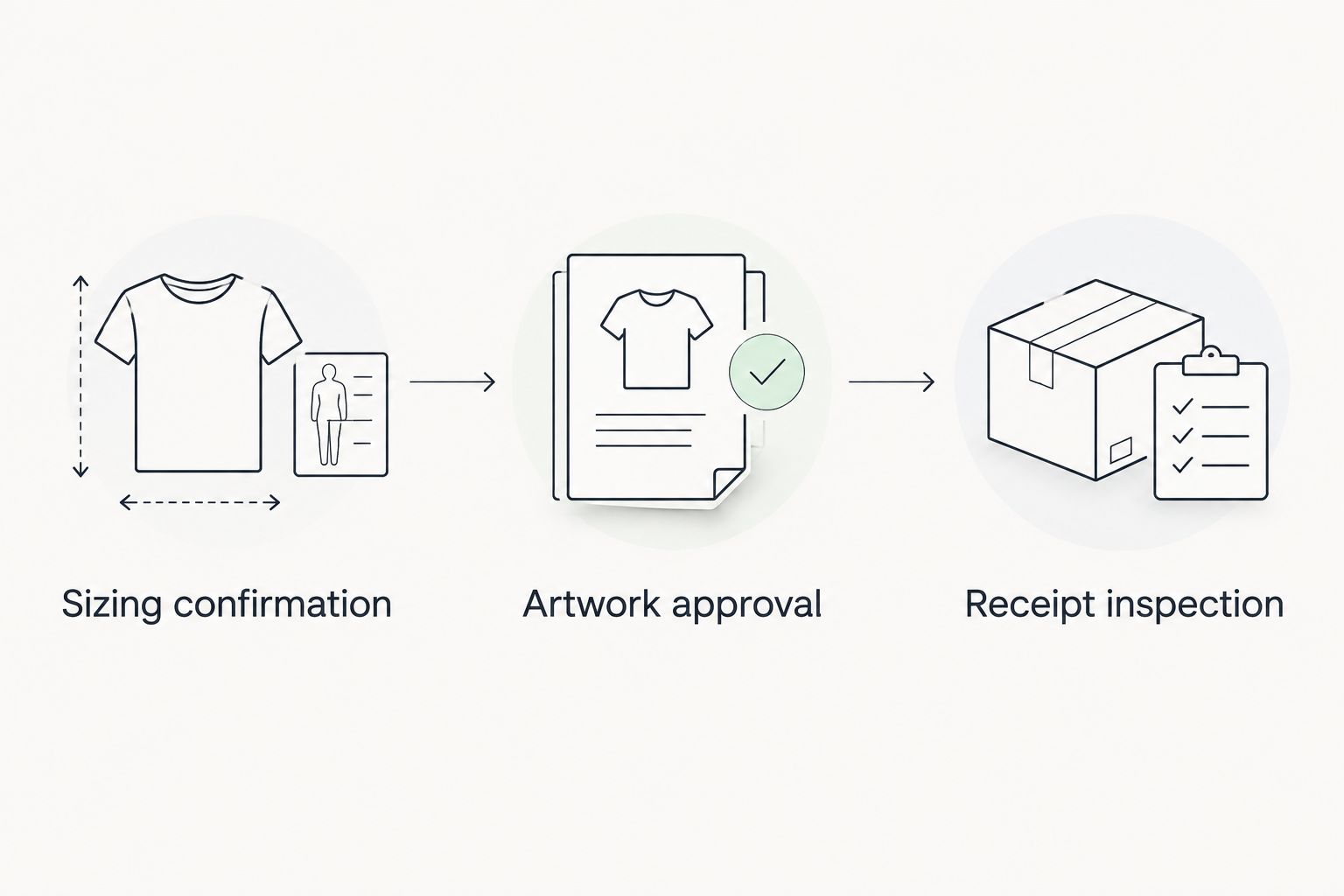
Use 3 checkpoints: sizing confirmation, artwork approval and receipt inspection. These are organiser controls, not a supplier's production promise. Record the agreed responsibilities at each checkpoint so an unanswered question does not become an assumed approval.
For your 2026 clinic, keep the schedule in the same document as the order quantities. This makes the effect of a late registration visible before anyone promises that participant a personalised garment.
Treat sizing, artwork and receipt as separate checks, not one final approval.
The sequence needs a named owner at each stage. A coach can check group colours while the order coordinator checks quantities; neither task substitutes for the other.
Record the clinic's opening date.
Set an earlier inspection and sorting date.
Confirm the delivery address and postcode.
Agree who can authorise each checkpoint.
Define what happens to late registrations.
Proof artwork against the order sheet
Check the artwork and participant list together. A correct logo does not establish that names, sizes or quantities are correct. Start with a side-by-side review, then ask another organiser to check the details without relying on the first person's annotations.
Assign 1 approval owner to send the final decision. Other people can review, but conflicting messages make it unclear which file is authorised. Mark the approved version clearly and retain the corresponding order sheet.
For a 2026 event-specific design, check the printed year as carefully as the clinic name. Ask for clarification on anything the proof does not show rather than treating an incomplete view as confirmation. Approve the complete order specification, not just an attractive front view.
Match every personalised entry to its registration record.
Check the front and back separately.
Verify crest and sponsor artwork permissions.
Reconcile quantities by size and garment type.
Save the approved artwork with the final order sheet.
Inspect and distribute by participant
When the jerseys arrive, compare the contents with the order record before packing individual allocations. Check garment type, size labels and visible customisation. Follow the supplier's instructions for reporting any discrepancy; do not promise a remedy to families before it is confirmed.
Sort take-home jerseys into participant allocations and reusable jerseys into labelled size groups. Keep the administrative labels on bags or storage containers rather than adding anything permanent to the garments without checking suitability.
Best for busy clinic check-in: a prepared allocation list that another volunteer can understand. It makes handover traceable, but requires you to record exchanges rather than relying on memory. Keep personal information out of public-facing piles and photographs.
Reconcile the delivery against the approved quantities.
Check personalised details before allocation.
Separate participant garments from staff garments.
Record each handover and any size exchange.
Retain care instructions for the clinic team.
Compare jersey approaches for your clinic
Choose the approach that matches ownership and attendance. These options describe ways to organise a clinic order, not promises about a particular garment or supplier.
Option
Best for
Main advantage
Key limitation
Reusable clinic-branded jersey
Recurring school-holiday programmes
Keeps the design relevant across different groups
Needs collection, cleaning and allocation records
Individually named jersey
Confirmed participants keeping their kit
Gives each garment a clear intended recipient
Spelling changes and participant substitutions need review
Numbered jersey without names
Clinics wanting identification without personal names
Connects garments to an allocation record
Numbers only help when the record stays accurate
Group-colour jersey
Participants staying in fixed coaching groups
Gives coaches a visible group cue
Stops matching the group when players are reassigned
Choose reusable clinic branding when the garment must outlast the participant list. Choose individual names when a confirmed participant will retain the jersey and the family has approved the wording.
Do not confuse a jersey's identification role with attendance or supervision. Even a clearly numbered shirt cannot tell a volunteer whether a participant is booked into the current session or authorised to leave.
Common mistakes holiday clinic organisers make
Using age as the size order
An age-group registration list is not a garment measurement record. Keep age information for programme administration and collect size confirmation separately. A single assumed size for a coaching group leaves individual fit questions unanswered.
Printing group details before groups are settled
A shirt printed for a fixed group becomes awkward when attendance changes. Finalise the grouping rule before putting it into artwork, or use a clinic-wide design that does not depend on group allocation.
Treating a product title as an ordering rule
A quantity written in a catalogue title does not establish the minimum for a new custom order. Ask for the applicable requirements for your exact design and size mix. Do not turn an example listing into a promise to families.
Scheduling delivery for the opening morning
Arrival and readiness are different milestones. You still need to inspect, sort and resolve questions before handing jerseys out. Set your own earlier receipt target and confirm the proposed timing with the supplier.
Duplicating orders for repeat attendees
A participant attending several sessions does not automatically need several take-home jerseys. Link bookings to a participant record, then apply your stated kit entitlement. Check duplicates before converting session totals into garment quantities.
FAQ
What's the best type of soccer jersey for a holiday clinic?
A reusable clinic-branded jersey is the best fit when organisers will collect it for future programmes. An individually named jersey suits a confirmed participant keeping the garment, but needs spelling and allocation checks.
How do I choose soccer jersey sizes for children?
Use the exact garment's size chart and ask families to confirm the selected size. Establish whether the chart uses body measurements or finished garment measurements before collecting figures in centimetres.
Should holiday clinic jerseys have children's names on them?
Print children's names only after families approve the wording and you decide how personal information will appear. For shared jerseys, use clinic branding or an identification system linked to a private allocation record.
How early should I order jerseys for a school holiday clinic?
Set your order schedule backwards from an inspection date before participant handover. Confirm the proposed timing with the supplier for your artwork, quantities and delivery postcode rather than assuming a standard turnaround.
Can I use the same jerseys for every school holiday programme?
Use an undated clinic design if you intend to reuse the jerseys across programmes. Keep collection, cleaning and size-allocation records so the next programme starts with an accurate kit list.
Does a quantity in a jersey title mean that is the minimum order?
A quantity in a product title does not confirm the minimum for a new custom order. Ask the supplier which requirements apply to your garment, design and size mix.
Is FE Custom suitable for Australian holiday clinic organisers?
FE Custom suits Australian organisers buying custom sports apparel online. Confirm the exact soccer garment's fit, customisation requirements and proposed order schedule before committing; the store operates online rather than through an in-store fitting visit.
One last thing
Count people before you count bookings. A returning participant can appear in several session lists while needing only one take-home jersey under your clinic policy. Reconcile participant identities first, then add any separately approved staff or replacement requirements. That final check protects the order from a mistake artwork proofing will never catch.