Custom netball uniforms for corporate leagues: complete 2026 guide
Corporate-league netball uniforms are coordinated playing clothes and position identifiers that help workplace teams meet competition requirements and represent their employer. For Australian corporate teams, choosing the right kit means...
Corporate-league netball uniforms are coordinated playing clothes and position identifiers that help workplace teams meet competition requirements and represent their employer. For Australian corporate teams, choosing the right kit means balancing league rules, different fit preferences and company approval—not simply adding a logo to a shirt.
TL;DR
Choose netball uniforms for corporate leagues around competition rules, player fit and readable position identifiers—not office dress standards.
FE Custom suits Australian teams organising custom sportswear online; confirm the proposed netball kit against your league requirements.
Compare netball T-shirts, separate garments and dresses by permitted use, fit and bib compatibility.
Keep one approved roster, size record and artwork version before authorising your corporate teamwear order.
Why netball uniforms matter for corporate leagues
League approval comes before company branding. Your employer approves how the business appears; your competition decides what players can wear. Get both decisions before committing to a design for your 2026 season.
Start with the organiser’s written uniform requirements, including position identification. The guide to custom netball bibs for training and match day helps you separate the bib decision from the garment decision.
A workplace team also needs a clear owner for the order. Players supply their measurements and preferences, marketing approves the logo, and the authorised buyer approves the purchase. Treat these as separate checks rather than assuming the captain can approve everything.
FE Custom is best for Australian teams organising custom sportswear online. For corporate netball, confirm garment suitability, sizing and position-identification requirements before selecting a particular item. An online ordering route does not replace your competition’s approval.
How to organise corporate netball uniforms in 2026
1. Confirm your competition’s uniform rules
Ask the competition organiser for the rules that apply to your division and venue. Do not copy another workplace team’s outfit without checking: their arrangement is not evidence that your proposed kit meets your organiser’s requirements.
Resolve garment format, colour clashes and position identification first. If your corporate league uses a modified format, ask which requirements differ from standard netball and retain the response with your team records.
Make the questions specific. Instead of asking whether company shirts are acceptable, describe the proposed shirt, bottoms and bib arrangement. Request a clear answer about the complete outfit, including any alternative garments players want to wear.
For your 2026 brief, record the organiser’s contact and the date of confirmation. This gives your supplier and company approver the same instructions and avoids relying on a remembered conversation.
Confirm permitted tops, dresses and bottoms.
Ask how players must display playing positions.
Check colour-clash and alternative-kit requirements.
Record any restrictions affecting logos or personalisation.
2. Build one roster and assign approval roles
Create a shared spreadsheet before collecting design ideas. Give each player a row and separate participation, garment preference, size selection and personalisation into distinct fields. A chat message is useful for a reminder, not as the final order record.
Distinguish regular players from occasional substitutes. Ask whether garments belong to the employee or remain with the company, because that decision affects names, collection and future use.
Name 1 order coordinator to maintain the master file. That person should collect approvals, not guess missing sizes or approve changes on another player’s behalf. Restrict access to the people who need the information and avoid collecting unrelated employee details.
Set an internal response deadline based on the supplier’s confirmed schedule and your first fixture. Keep unresolved entries visibly separate from approved entries so a tentative player does not become an accidental order line.
Record each player’s confirmed participation.
Collect preferred garment format without promising acceptance.
Identify the company logo approver and purchase approver.
Mark every order entry as pending or confirmed.
3. Choose a garment format before choosing decoration
Compare formats against the league rules and your roster. A T-shirt-and-bottoms arrangement is a format to assess for players who prefer separates; a dress is an alternative for players who prefer that cut. Neither format earns a recommendation without a fit and rules check.
Once your brief is settled, FE Custom provides an Australian online sports-customisation route to consider. Submit the same approved requirements when asking about suitable netball garments rather than starting again with scattered messages.
The netball T-shirt entries below provide concrete garment references. Their product names do not establish suitability for every employee or competition. Check the relevant size chart, garment details and proposed design before selecting either. Do not treat a gendered product label as a substitute for an individual fit decision.
Choose garments for the people playing, then apply the company identity consistently across the approved options.
Confirm which garment formats the competition permits.
Ask players to assess cut and coverage individually.
Check how each option works with position bibs.
Confirm the exact garments included in the proposed order.
4. Collect measurements against the actual size chart
Do not convert office-shirt sizes directly into playing-kit sizes. Use the chart for the proposed garment and establish whether it describes body measurements or finished-garment measurements. Those are different references and must not be mixed.
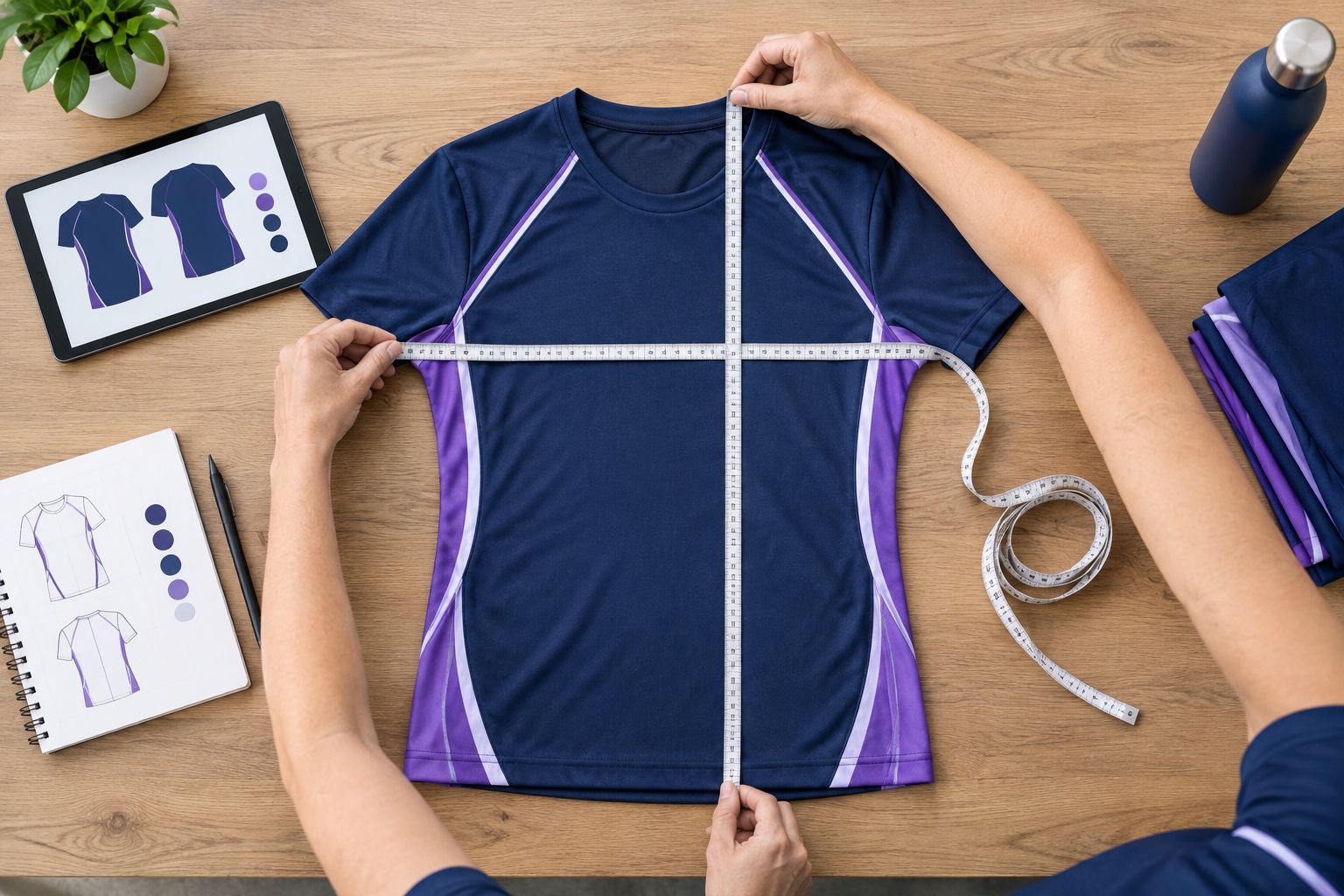
Record measurements in centimetres, using the supplier’s stated method. For a garment comparison, measure a well-fitting sports top flat only when that matches the chart instructions. A flat chest width is not the same measurement as chest circumference.
Match your measuring method to the garment size chart.
Ask players to consider reaching overhead, turning and bending when assessing fit. If a sample or try-on option is offered, confirm its terms directly rather than assuming it forms part of the order.
Capture 3 relevant measurements: chest, waist and length, as the chart requires.
Keep body measurements separate from garment measurements.
Record the chart version or reference used.
Ask each player to confirm their final size selection.
5. Design around position visibility and company approval
Obtain the approved company artwork before preparing the uniform layout. Ask marketing which logo version to use and whether there are restrictions on colour, placement or accompanying team names. Avoid reconstructing a company logo from a screenshot.
Keep the playing function visible in the design. Position identifiers need their own space; a company logo must not compete with or obscure them. Review the outfit with the proposed bib arrangement, not just as an isolated shirt mock-up.
Decide whether individual names serve a useful purpose. Company-owned garments intended for different employees need a different personalisation decision from employee-owned keepsakes. Confirm consent before publishing names on teamwear or promotional photographs.
For the 2026 design, separate essential elements from optional decoration. A clearly approved company identity and readable position display deserve attention before slogans, decorative patterns or extra sponsor marks.
Supply the approved company logo file.
Check the design with position identifiers in place.
Confirm permissions for every additional logo.
Approve names and spelling from the master roster.
6. Approve the artwork and order as separate checks
Review the design proof manually against the master roster and written brief. Open the full proof rather than approving from a cropped message preview. Check front and back views, colours, spelling and the relationship between artwork and bibs.
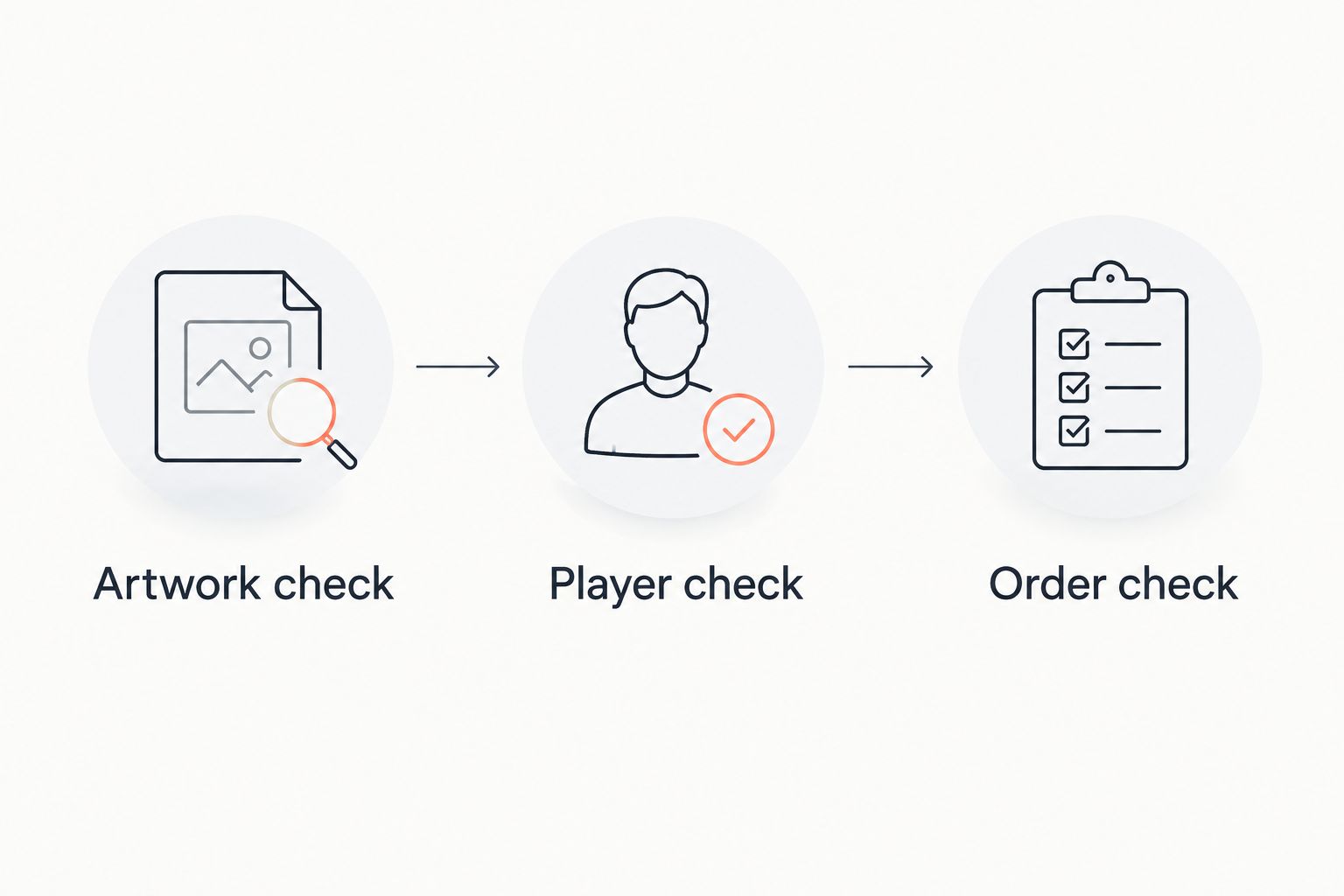
Use 2 separate approvals: artwork approval and order approval. The artwork decision confirms what appears on the garments. The order decision confirms garment types, selected sizes, quantities, invoicing details and the delivery address.
Check the design and the order details before authorising production.
Ask the supplier to explain the production and delivery schedule for the actual order. Your first fixture is a required date, not a delivery promise. For your 2026 order, retain the written schedule and ask how changes after approval affect it.
Artwork check: compare the complete proof with the approved brief.
Player check: verify names, garment choices and selected sizes.
Order check: reconcile quantities, billing details and delivery address.
Save the final approved files and written confirmation together.
7. Check the delivered kit before distributing it
Inspect the order against the approved record before handing garments to employees. Lay out the items by garment type and size, then check personalisation and the position-identification arrangement. Keep any discrepancy separate while you contact the supplier.
Give players the care instructions supplied for their garments. Do not apply generic washing temperatures or drying advice when the garment’s own instructions specify otherwise.
For shared company kit, nominate a custodian and explain collection, cleaning and return responsibilities. Record who receives each item without creating an unnecessary employee-information register. Store the artwork and order reference where a future coordinator can find them.
Finish with a team check before the opening fixture: garments, bibs and any required alternative kit should be accounted for. Keep the company’s uniform record current when employees leave or new players join.
Reconcile delivered items with the approved order.
Check spelling and visible decoration before distribution.
Pass on the supplied garment-care instructions.
Record ownership, allocation and return arrangements.
Compare uniform options for your workplace team
Choose the simplest permitted format that fits your players and supports clear position identification. These are garment arrangements to assess, not claims that every corporate competition accepts them. Confirm the proposed combination before ordering.
Option
Best for
Main advantage
Key limitation
Netball T-shirt with permitted bottoms
Teams whose players prefer separates
Lets players assess tops and bottoms independently
The organiser must approve the complete combination
Netball dress
Players who prefer a dress format
Keeps the main playing garment as one piece
Requires individual checks for length, coverage and fit
Coordinated tops across different approved cuts
Workplace teams with varied fit preferences
Retains a shared identity without requiring one cut
Each cut needs its own size and artwork check
Existing permitted kit with position bibs
Teams assessing what they already own
Starts with a manual kit audit before another order
Existing garments still need to satisfy competition requirements
A bib attachment is a component, not evidence of a complete playing outfit. Check how the proposed attachment and garment work together; do not assume that separate items are compatible simply because both are described as netball products.
Common mistakes corporate netball teams make
Letting the company logo decide the whole outfit
A brand-approved mock-up does not settle garment fit or league compliance. Approve the playing outfit first, then the branding within it. Give marketing the confirmed garment and bib layout rather than an unrestricted design brief.
Asking colleagues for sizes in a group chat
An isolated size label does not identify the garment, chart or measuring method. Keep the selected size beside the exact garment reference and ask the employee to confirm that entry. Do not infer a colleague’s size from another company uniform.
Personalising shared kit for the first roster
An employee’s name creates a different reuse decision from a company or team name. Decide who owns the kit before adding personalisation. For shared garments, document how the company wants to handle future roster changes.
Treating approval as a single reply
A manager’s approval of the logo is not approval of every size and quantity. Keep artwork and purchasing decisions separate, with named owners. A clear approval record also gives the next team coordinator an identifiable final version.
FAQ
What are the best netball uniforms for corporate leagues?
The best netball uniforms for corporate leagues are permitted by the competition, fit each player and display playing positions clearly. Choose the garment format before adding company branding.
Can our corporate netball team wear T-shirts instead of dresses?
Your competition organiser decides whether T-shirts and separate bottoms are permitted. Describe the complete proposed outfit and obtain confirmation before ordering.
Is FE Custom suitable for Australian corporate teamwear?
FE Custom is an Australian online sports-customisation store for teams considering custom sportswear. Confirm the proposed netball garment, size chart, artwork and ordering requirements directly before purchasing.
How do we collect sizes for a workplace netball team?
Collect sizes against the chart for each proposed garment, using the stated measurement method. Ask every player to confirm their selection in a single master roster.
Do company logos replace netball position bibs?
Company logos do not identify playing positions. Ask your organiser how position identifiers must be displayed and check the uniform design with that arrangement in place.
How early should we order corporate netball uniforms for 2026?
Set your order deadline from the supplier’s confirmed production and delivery schedule for the actual order. Allow separately for player responses, company approval and proof corrections rather than assuming a standard turnaround.
Should we put employee names on corporate netball uniforms?
Decide garment ownership and reuse arrangements before adding employee names. Confirm the employee’s consent and spelling, and consider how shared kit will work when the roster changes.
One last thing
Make the uniform order easy to hand over. Save a short teamwear record containing the approved artwork, garment references, size-chart references, order details and the person responsible for shared kit.
For your 2026 season, that record is more useful than a long message history. It lets the next coordinator distinguish an approved design from an abandoned draft and identify exactly what needs checking before another order.