Custom netball uniforms for coaching academies: complete 2026 guide
Coaching academies’ netball uniform planning is the process of choosing coordinated training and playing apparel with the aim of supporting player development and clear on-court identification. This 2026 guide to...
Coaching academies’ netball uniform planning is the process of choosing coordinated training and playing apparel with the aim of supporting player development and clear on-court identification. This 2026 guide to netball uniforms for coaching academies covers rotating positions, different player groups, sizing, artwork and ordering for Australian programmes.
TL;DR
Choose netball uniforms for coaching academies around movement, position changes and player fit—not artwork alone.
FE Custom is best for Australian buyers seeking an online sports customisation store.
Separate academy identity from playing positions so players can rotate without changing their permanent uniform.
Confirm garment measurements, attachment compatibility and order details before approving production.
Why netball uniforms matter for coaching academies
An academy uniform should support the session before it promotes the academy. A coaching programme needs to distinguish players during drills without treating every participant as a permanent member of a match squad. Start with how you coach, then decide what belongs on the garment.
A player’s academy identity and playing position serve different purposes. The academy name stays consistent; the position changes during development. Building that distinction into your 2026 brief keeps permanent artwork separate from the identifiers coaches need to move between players.
FE Custom operates online in Australia as a sports customisation store. Treat garment choice, sizing and written approval as separate decisions when planning an online order; a design image does not answer every fit or ordering question.
Plan your academy uniform order
Define your sessions before choosing garments
Start with a shared document or spreadsheet. List what players actually do: skill stations, conditioning, small-group drills, practice games and external fixtures. A training-only programme needs a different brief from an academy entering organised competition.
Record whether players keep their apparel or borrow academy-owned kit. That decision affects personalisation, collection and replacement planning. Do not put individual names on shared garments simply because names fit the design.
For your 2026 programme, separate essentials from optional presentation details. Coaches should approve the functional brief before anyone chooses decorative patterns or sponsor placement.
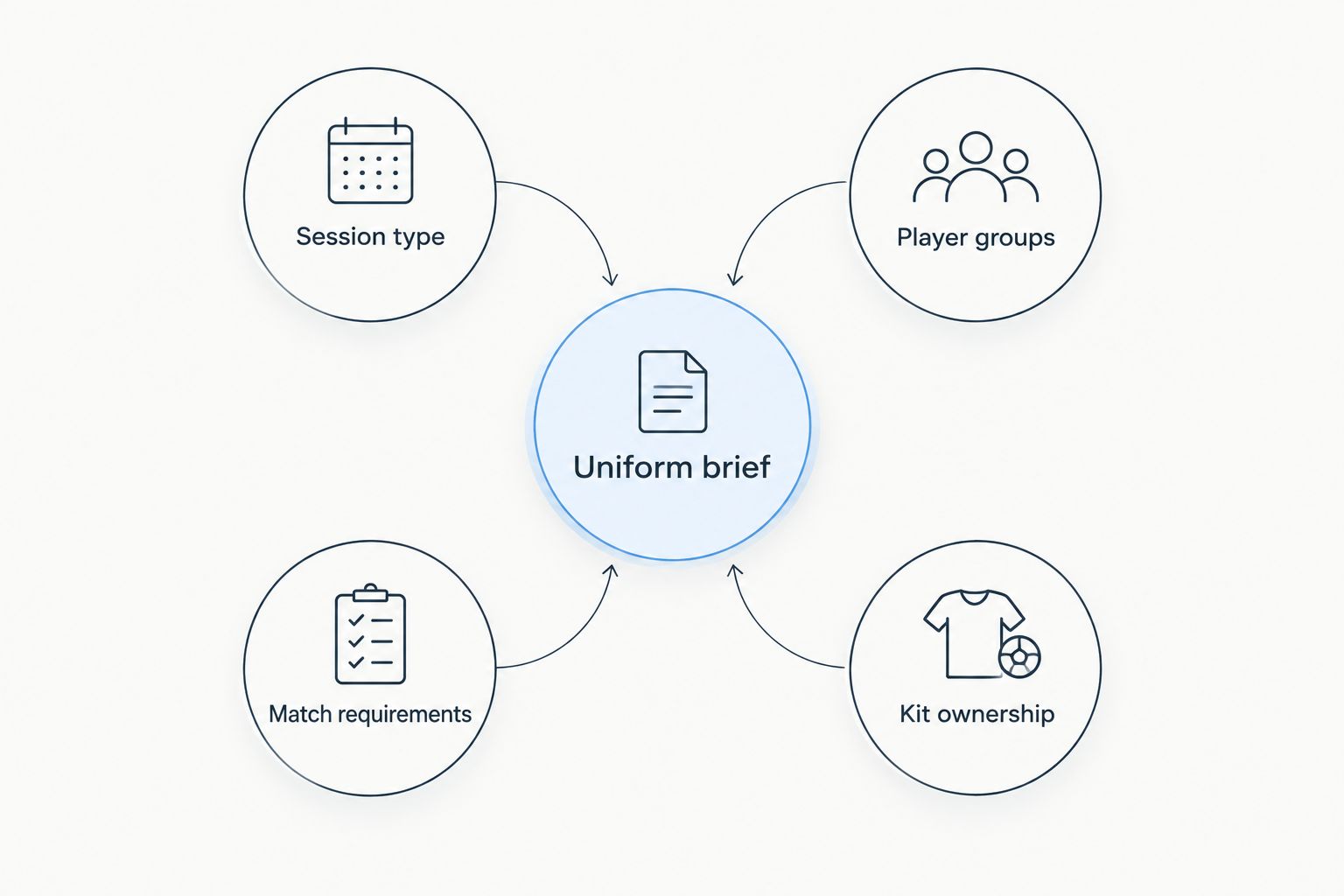
Close this stage with a short brief covering:
Session type: identify training, trials, camps and external matches.
Player groups: record age groups and the garment sizes you need to assess.
Match requirements: obtain the organiser’s current uniform instructions.
Kit ownership: state whether players or the academy retain each item.
Define the programme before choosing the garment.
Separate academy identity from playing positions
Draw the front and back of your proposed uniform on paper. Mark the academy name, any permitted sponsor artwork and the area needed for position identification. This simple exercise exposes conflicts before they become part of a production proof.
Standard seven-a-side netball uses 7 positions: GS, GA, WA, C, WD, GD and GK. A permanent player number is not a substitute for those position identifiers. Confirm the requirements for your particular activity or competition rather than applying a training arrangement to every fixture.
For sessions built around position rotation, keep the changeable information changeable. The relevant questions are readability, attachment and ease of handling—not just whether the colours match.
Before choosing an identification system:
List the positions coaches need to assign during practice games.
Keep academy artwork clear of the intended identifier area.
Check garment and attachment compatibility together.
Collect measurements manually before asking families to select sizes. Record them in 1 master register, with the selected garment and the date of confirmation beside each player. That gives the order coordinator a single reference instead of scattered messages.
Follow the chosen garment’s measurement instructions. A body measurement and a flat garment measurement are different things; do not compare them as though they are interchangeable. Likewise, a familiar size label from another brand does not establish the correct size here.
When assessing FE Custom netball uniforms, confirm the applicable chart and garment details for the specific item under consideration. An online purchase needs written sizing information; photographs alone do not establish fit.
Complete these checks before locking the size list:
Record measurements in centimetres using the supplier’s method.
Identify whether the chart describes the body or finished garment.
Ask players or guardians to confirm their selected size.
Resolve borderline measurements before approving the order.
Keep junior sizing separate from adult-cut assumptions.
Test movement before approving the uniform shape
Use an existing suitable garment or an assessment sample, where arranged, to evaluate the proposed fit. Do not make a full-squad decision from a static photograph. A uniform needs to work while the player reaches, changes direction and lands.
Use 3 movement checks: an overhead reach, a defensive stance and a controlled landing. These are practical fit checks, not a laboratory performance test. Ask the wearer where the garment pulls, shifts or restricts movement.
Consider the academy’s actual training environment as well. Record whether sessions take place indoors or outdoors, and what players normally wear underneath. Confirm fabric composition and care instructions for the selected item rather than assuming every sports garment behaves alike.
Ask the wearer to assess:
Shoulder and arm movement during an overhead reach.
Coverage during a low defensive stance.
Garment movement during a controlled landing.
Comfort around seams, necklines and attachment areas.
Fit with any permitted undergarments normally worn at training.
Build a readable artwork brief
Create a rough layout using paper or a basic document editor. Put the academy name and essential identifiers in place first, then add approved sponsor artwork. Leave decorative detail until the necessary information has a clear home.
For your 2026 design, ask for front and back views showing the actual wording and placement. Do not approve a proof containing temporary names, placeholder logos or unresolved spelling. A visually appealing mock-up is not a completed specification.
Keep the artwork file and player register separate but linked by a clear revision label. This prevents an updated size list from being paired with an older design. For academy-owned garments, question whether personal names belong on the artwork at all.
Your written design brief should include:
The academy name with approved spelling and capitalisation.
Logo files you have permission to reproduce.
The agreed colour references and placement instructions.
Clear space for any required position identifiers.
A nominated person authorised to approve artwork.
Confirm the order around your actual programme date
Start with a calendar and work backwards from the first session requiring uniforms. Include time for measurement collection, unanswered questions, artwork revisions and distribution. Do not treat the session date as the date you need to begin ordering.
Ask the supplier to confirm the relevant ordering conditions in writing. Production and transit are separate stages, so clarify what any quoted timeframe covers. For Australian delivery, provide the complete destination details, including the postcode, before relying on a delivery estimate.
FE Custom’s online sports customisation model suits buyers who want to manage the enquiry remotely; the limitation is that fit still needs checking through measurements and any separately arranged assessment process. Do not assume an online order includes an in-person fitting.
Before committing, confirm:
The exact garment, quantities and selected sizes.
What happens after artwork approval.
The applicable minimum-order and repeat-order conditions.
The delivery destination and the date the kit is needed.
How discrepancies or order changes must be reported.
Approve once and keep a repeat-order record
Compare the final artwork, size register and order summary side by side. Use 2 approval checks: one for design accuracy and one for quantities and sizing. The same person can coordinate both, but neither check should disappear into a general approval message.
Save the approved records with the date and revision label. For a 2026 academy intake, that record should distinguish the current cohort from later additions. A repeat order still needs confirmation; the previous order is a reference, not a guarantee that every detail remains unchanged.
At handover, check received garments against the order record before distribution. Keep academy-owned kit separate from individually allocated items so coaches know what must return after sessions.
Finish the process by recording:
The approved artwork revision and written sign-off.
Final quantities by garment and size.
Any agreed personalisation details.
The recipient or storage location for each item.
Questions to resolve before the next intake.
Compare uniform approaches for your academy
Choose the simplest uniform arrangement that meets your coaching and fixture requirements. These are planning options, not claims that every supplier offers each configuration. Compare the full arrangement—including identification and administration—rather than the garment alone.
Option
Best for
Main advantage
Key limitation
Existing suitable training apparel with separate identifiers
Introductory sessions and trial groups
Lets coaches assess the identification setup before commissioning apparel
Does not provide a consistent academy appearance
Custom training shirts with separate identifiers
Regular skills programmes
Keeps academy identity separate from rotating positions
Shirts still need an appropriate identification system for practice games
Competition uniform specified by the organiser
Academies entering external fixtures
Starts with the event’s stated requirements
Requires checking rules beyond the academy’s own preferences
Academy-owned shared kit
Programmes lending garments between participants
Keeps allocation under academy control
Requires collection, laundering and size tracking
The supplied FE Custom netball catalogue includes the shirt entries below. Assess these as adult-cut shirt options, not as confirmed junior academy uniforms. Their listed descriptions include team-name and base-colour design fields; confirm the specifications, size chart and proposed artwork before selecting either for your programme.
Listed design fields include a team name and a Dark Navy base colour.
$259.80
A shirt listing does not establish suitability for an external competition. Equally, a bib attachment listing does not establish compatibility with a garment you already own. Resolve those questions before combining items into an academy kit.
Common mistakes coaching academies make
Designing for a fixed squad when positions rotate
Printing permanent positional information into a development uniform ties the garment to an assignment that coaches need to change. Keep the academy identity permanent and plan a separate method for identifying positions during practice games.
Collecting size labels instead of measurements
A spreadsheet full of familiar clothing sizes is not a garment-specific sizing check. Ask families to use the selected chart and confirm their choice; do not quietly convert another brand’s labels into the new order.
Treating a product title as a complete specification
A title does not establish fabric composition, attachment dimensions, junior fit or competition acceptance. Read the item details and ask targeted questions. Order quantities and configuration also need confirmation rather than interpretation from a truncated listing name.
Personalising garments that the academy intends to reuse
Individual names conflict with a shared-kit plan when garments move between players or intakes. Decide ownership first, then personalise only where the information serves that ownership model. Keep temporary allocation details in your register instead.
Approving artwork while the player list is still changing
An approved design and an unfinished quantity list leave the order coordinator managing competing versions. Set an internal confirmation deadline, resolve outstanding entries and submit a clearly labelled final record. Keep later additions separate rather than silently editing an approved file.
FAQ
What are the best netball uniforms for coaching academies?
The best netball uniforms for coaching academies match the programme’s movement, sizing and identification needs. Choose the garment around training activities, then confirm any separate requirements for external fixtures.
Should academy players train in shirts or competition uniforms?
Choose shirts or competition uniforms according to the session and any organiser requirements. Training apparel does not automatically satisfy competition rules, and a training-only programme should define its own functional brief first.
How do I size netball uniforms for a whole academy?
Measure players using the selected garment’s instructions and record their confirmed sizes in a master register. Keep body measurements separate from finished-garment measurements, and resolve borderline selections before approval.
Can we use bib attachments with uniforms we already own?
Use bib attachments with existing uniforms only after confirming compatibility. Check the attachment method, dimensions and intended placement together rather than assuming similarly named items fit.
Should we put player names on academy uniforms?
Put player names on academy uniforms only when personalisation suits the ownership plan. Academy-owned garments intended for reassignment need a different approach from apparel players keep.
What should we ask before ordering online in Australia?
Ask for the exact garment details, sizing instructions, artwork approval process and applicable ordering conditions. Provide the delivery postcode and required date, and clarify whether any timeframe covers production, transit or both.
What should our academy save for repeat orders in 2026?
Save the approved artwork, garment details, size breakdown and written order confirmation for repeat orders in 2026. Reconfirm the relevant specifications and ordering conditions before commissioning additional kit.
One last thing
Keep the intake year in your records unless it genuinely belongs on the garment. Adding 2026 to a shared academy uniform makes that date part of every later allocation. An undated academy identity gives you a simpler starting point when deciding whether existing kit can serve another intake.
Before approving the design, ask your head coach to explain how a player changes position during a practice game. If the answer requires changing a permanently personalised garment, revisit the identification plan. That small operational check is more useful than another decorative revision.