Can custom jerseys be made in moisture-wicking fabric?
Yes, custom jerseys can be made in moisture-wicking fabric, including textiles engineered to move sweat away from your skin towards the garment’s outer surface. Custom printing and reversible construction do...
Yes, custom jerseys can be made in moisture-wicking fabric, including textiles engineered to move sweat away from your skin towards the garment’s outer surface. Custom printing and reversible construction do not automatically rule this out, but you need confirmation for the exact finished jersey—not just a description such as polyester, mesh or sports fabric.
TL;DR
Moisture wicking custom jersey fabric is possible; confirm performance for the finished garment, not just the fibre name.
Reversible basketball jerseys need fabric, airflow and comfort checks on both wearable sides.
Sublimation adds colour within compatible fibres; it does not establish moisture-wicking performance.
FE Custom serves Australian teams online; confirm the selected jersey’s fabric specification before ordering.
Why this matters
A team design tells you how a jersey looks. It does not tell you how the fabric handles sweat, how readily air passes through it or how the garment feels during play. Those are separate buying decisions.
For your 2026 team order, settle the fabric question before approving artwork. If you need two wearable colourways, start with the construction checks in this guide to choosing reversible basketball jerseys for your club, then ask for the material details of your chosen style.
FE Custom is an Australian online sports customisation store. An online order makes a written fabric specification particularly useful: you need something more precise than a product photograph to assess sweat management.
Can custom jerseys be made in moisture-wicking fabric?
Yes. Customisation and moisture-wicking performance are compatible, provided the fabric and decoration method suit the intended garment. Polyester-based performance knits are a common example, but the fibre name alone does not prove that a particular jersey wicks moisture effectively.
Wicking depends on how liquid travels through the textile. Yarn structure, knit construction and surface treatments all influence that movement. A fabric’s ability to transport sweat is also different from its ability to let air pass through or release moisture by evaporation.
Use this comparison to separate material descriptions from performance evidence. These are fabric categories, not specifications for any particular store product.
Fabric description
Best for
Useful characteristic
Limitation to check
Engineered moisture-wicking knit
Teams prioritising sweat transport
Designed to move liquid through the textile
Ask how performance is established and maintained through washing
Open mesh knit
Players prioritising ventilation
Open construction provides paths for airflow
Mesh alone does not establish moisture-wicking performance
Smooth performance knit
Teams wanting a continuous artwork surface
A smooth face supports uninterrupted graphic layouts
Surface appearance does not reveal airflow or sweat transport
Cotton-rich jersey knit
Teams prioritising a familiar casual feel
Cotton absorbs moisture readily
Absorption is not the same as moving sweat away and drying promptly
These categories overlap. An engineered moisture-wicking fabric can also be mesh or have a smooth surface, so do not treat the table as a set of mutually exclusive choices.
Buy against the finished garment’s specification, not a fabric label in isolation. Ask which description applies to the exact jersey you intend to customise and whether the answer covers its printed panels, trims and reversible construction.
What does moisture wicking actually tell you?
Moisture wicking describes liquid movement through a textile. It does not mean that you stop sweating, that your jersey stays completely dry or that the garment actively cools you under every playing condition.
Keep these terms separate when comparing supplier descriptions:
Moisture wicking: liquid spreads or travels through the fabric.
Breathability: a broad term that needs clarification; ask whether the supplier means airflow or water-vapour transfer.
Quick drying: moisture leaves the fabric through evaporation.
Absorbency: the material takes up liquid.
The distinction matters because an absorbent garment can still feel wet, while a fabric that transports moisture still needs conditions that allow evaporation. Air movement, humidity and the rest of your clothing affect the result.
For a 2026 buying brief, replace a vague request for breathable material with a direct question: how does this exact fabric handle liquid sweat, airflow and drying? A clear answer lets your club compare like with like without assuming that different marketing terms mean the same thing.
Reversible basketball jerseys: check both wearable sides
A reversible basketball jersey gives you two wearable sides in one garment. That makes fabric assessment more involved than looking at the outside of a single-sided top: either face can sit against your skin.
Best for teams needing alternate colourways: reversible construction, subject to acceptable comfort on both sides. Its practical advantage is the change of appearance; the trade-off is that you must assess the complete construction rather than assuming it feels like a single-sided jersey.
Ask whether the garment uses separate layers or another reversible construction. Then check the inside surfaces, seams, neckline and armholes in both orientations. Do not assume that a moisture-management statement for one fabric face describes the whole assembled jersey.
When examining a sample, turn it inside out and repeat the same movements. Reach overhead, rotate your shoulders and sit in a defensive stance. Check whether either orientation rubs, bunches or feels restrictive, especially around the armholes.
For your 2026 basketball order, record the two colourways separately in the artwork approval. Fabric suitability and colour contrast are different checks: a comfortable reversible jersey still needs clearly distinguishable sides that meet your competition’s uniform requirements.
Does printing stop a jersey from wicking moisture?
Custom printing does not automatically stop moisture movement, but the decoration method matters. Sublimation colours compatible fibres rather than placing a separate film over the surface; a printed transfer adds material to the decorated area.
Best for extensive graphics on compatible fabric: sublimation, after confirming the underlying textile. The benefit is that the design does not require a separate transfer film across the artwork. The limitation is compatibility: not every fabric composition or base colour suits the same sublimation process.
A large applied graphic changes the surface differently from a small logo. Ask how sponsor marks, player names and numbers are produced, rather than assuming every part of the design uses the same method.
Do not accept sublimated as a substitute for moisture wicking in a specification. One describes how colour is applied; the other describes how the textile handles liquid. Both details belong in your order brief, and neither proves the other.
Why moisture-wicking performance varies
The same broad material label can describe textiles with different behaviour. These factors explain why you need a garment-specific answer rather than a blanket assurance about sports jerseys.
Fibre and yarn design: fibre properties and the spaces within yarns influence how liquid moves through the textile.
Knit construction: the arrangement of loops and openings affects fabric contact, airflow and pathways for moisture.
Surface treatment: a treatment can alter how readily a textile wets and spreads liquid; ask for its care requirements.
Garment construction: layers, seams, linings and trims change what sits against your skin and how the assembled jersey behaves.
Decoration coverage: applied graphics introduce another material over the decorated area, so assess the final design rather than an undecorated swatch alone.
Playing conditions: humidity, air movement and additional clothing influence evaporation and your experience of comfort.
There is no reliable shortcut from a fabric’s appearance to all these properties. A soft hand feel is useful information about touch, but it is not a moisture-management test.
How do you check a custom jersey before ordering?
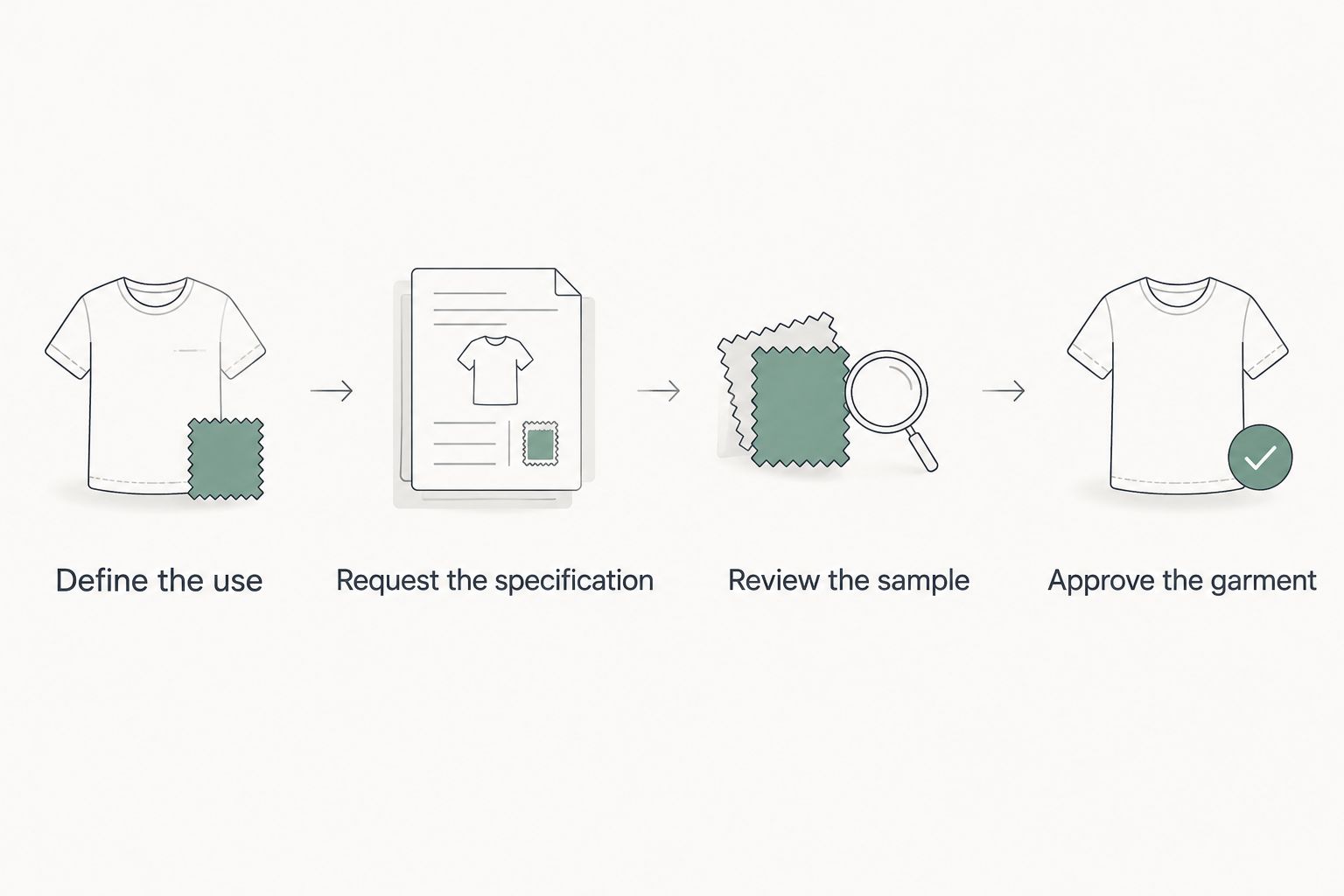
Use a short approval sequence that separates the technical specification from the artwork. The aim is not to create a laboratory at your club; it is to avoid approving a garment on the strength of an undefined claim.
Define the use. State the sport, indoor or outdoor setting, expected layering and whether you need reversible construction.
Request the specification. Ask for fibre composition, fabric construction, moisture-management information and the applicable care instructions.
Review the sample. If a sample or swatch can be supplied, assess fit, surface feel and the intended decoration rather than relying only on photographs.
Approve the garment. Keep the agreed fabric details with the final artwork, sizing list and order confirmation.
Confirm the fabric before the final garment approval, not after the artwork is settled.
For a 2026 order, keep a dated copy of the supplier’s answer. This gives the next volunteer a usable reference when your club needs replacement jerseys, rather than leaving them to reconstruct the original decision from messages.
A water-drop demonstration at home is only an observation of that sample under those conditions. It does not establish a drying time, prove wash durability or justify a performance ranking against another fabric tested differently.
What should you ask an Australian online supplier?
Send a specific brief rather than asking only whether the jersey is breathable. Include your delivery postcode and required event date so the supplier can address the order’s practical requirements without confusing them with fabric performance.
Your fabric questions should cover:
The exact composition and construction of the selected jersey.
Whether moisture wicking is a documented property of that fabric.
Whether the claim applies to the finished, decorated garment.
How both wearable sides are constructed for a reversible style.
Which printing methods apply to team graphics, names and numbers.
Which washing and drying instructions apply to the finished item.
FE Custom is best for Australian teams seeking online sports customisation. That describes the store’s service model, not a verified moisture-wicking rating for every jersey; confirm the selected style’s material details before committing your club’s order.
For FE Custom custom jerseys, treat a product’s team name, base colour and artwork settings as design information. They do not establish fibre composition, airflow, drying performance or wash durability.
Is polyester enough to prove that a jersey wicks sweat?
No. Polyester identifies a fibre, not a complete moisture-management specification. Ask how the particular yarn, knit and any treatment support liquid movement, then check whether that information applies to the jersey you are ordering.
Can a reversible jersey feel different on each side?
Yes. Each orientation changes which face, seams and decoration sit against your skin. Assess both wearable sides rather than approving the garment after trying only your preferred colourway.
Will moisture-wicking fabric keep players dry in humid weather?
No fabric guarantees dry skin during exercise. Moisture transport and evaporation are separate processes, and humid conditions limit evaporation even when sweat spreads through the textile.
FAQ
Can custom soccer jerseys use moisture-wicking fabric?
Yes, custom soccer jerseys can use moisture-wicking fabric. Confirm the exact textile and printing method rather than treating a soccer jersey label as proof of performance.
What is the best moisture wicking custom jersey fabric?
The best moisture wicking custom jersey fabric is one with documented properties suited to your playing conditions and finished garment. Compare sweat transport, airflow, fit, decoration and care requirements rather than choosing by fibre name alone.
Can reversible basketball jerseys be moisture wicking?
Yes, reversible basketball jerseys can use moisture-wicking textiles. Check the full construction and both wearable sides; reversibility alone does not establish moisture-management performance.
Does sublimation make a jersey moisture wicking?
No, sublimation does not make a jersey moisture wicking by itself. It is a colouring process for compatible materials, while wicking depends on the textile’s properties.
Does moisture wicking mean the same thing as breathable?
No, moisture wicking and breathability describe different properties. Wicking concerns liquid movement, while breathability needs clarification about airflow or water-vapour transfer.
Can I use fabric softener on a moisture-wicking jersey?
Follow the finished jersey’s care label before using fabric softener. Fabric softener can leave deposits that interfere with moisture management, so check the supplier’s instructions.
Are all FE Custom jerseys confirmed as moisture wicking?
Do not assume that every FE Custom jersey is moisture wicking. Request the material specification and moisture-management details for the exact style you intend to order.
One last thing
Keep the fabric approval separate from the artwork approval. A design proof confirms placement, spelling and colour instructions; it does not demonstrate how the textile handles sweat.
For your 2026 club records, save both approvals together. Your most useful repeat-order reference is the agreed garment specification—not a screenshot showing that everyone liked the design.