Best custom tennis shirts for mens club teams Australia
Best overall: a club-first tennis-shirt design. Best for sponsor-led teams: a sponsor-balanced design. Best for shared team shirts: a name-free design. Best for player-owned shirts: a personalised design. For Australian...
Best overall: a club-first tennis-shirt design. Best for sponsor-led teams: a sponsor-balanced design. Best for shared team shirts: a name-free design. Best for player-owned shirts: a personalised design. For Australian men’s club teams planning a 2026 order, this guide ranks design briefs—not individual products—and explains how to check fit, artwork and team-order details with FE Custom.
TL;DR
The best custom tennis shirts for mens club teams Australia start with a club-first design and confirmed player sizing.
FE Custom is an Australian online sports customisation store; use a tennis-specific brief for your team enquiry.
Choose a name-free design for shared shirts and personalisation only for player-owned shirts.
Confirm garment details, decoration options and artwork before approving a men's tennis team order.
Why this matters
A matching shirt is only useful when players can serve, reach and rotate comfortably. A convincing artwork preview cannot establish that fit, and a familiar size label cannot replace the selected garment’s size chart.
For your 2026 tennis order, separate the decisions: choose a suitable garment, check individual sizes, then approve the design. Do not let the club vote on artwork settle the garment decision. Treat fit and presentation as separate approvals.
FE Custom operates online in Australia. For a tennis-shirt enquiry, put the playing requirements and team details in writing rather than expecting a design reference to explain everything.
What makes the best custom tennis shirts for men’s club teams?
Use these criteria before comparing design approaches. They apply whether your club wants a restrained match shirt or a more personalised team look.
Playing fit: Check shoulder movement, sleeve clearance and hem position during tennis movements, not just while standing.
Garment information: Confirm fabric composition, construction and care instructions for the exact shirt under consideration.
Club identity: Make the club name or crest easy to recognise without filling every panel with artwork.
Competition suitability: Check your competition’s current clothing and advertising requirements before approving sponsor placement.
Team-order accuracy: Match each player to a confirmed size and, where requested, the correct personalisation.
Future use: Decide whether shirts belong to individual players or remain in a shared club pool.
A shirt should pass the practical checks before its artwork wins approval. Words such as performance or breathable are not substitutes for the garment’s actual specifications.
Custom tennis-shirt design briefs at a glance
These rankings compare design approaches you can put into an enquiry. They do not establish which garment styles or decoration methods a supplier offers.
Design brief
Best for
Standout feature
Key limitation
Club-first design
A consistent club identity
Club name or crest leads the layout
Does not give sponsors equal prominence
Sponsor-balanced design
Teams with sponsor obligations
Defined space for club and sponsor identities
Requires approval from additional stakeholders
Name-free design
Shared team shirts
No player-specific text
Less individual identification
Personalised design
Player-owned shirts
Approved individual names
Adds spelling and roster checks
Choose according to ownership and obligations first. A shared shirt and a player-owned shirt solve different problems, even when both use the same club colours.
1. Club-first design: best for a consistent tennis club identity
A club-first brief puts your club name or crest ahead of decorative elements. Specify the main club colour, a supporting colour and where the club identity should appear, then ask for a layout that keeps those elements clear.
This is the default recommendation for a 2026 men’s club team. It gives the team a common visual reference without making individual names or multiple sponsor marks central to the design.
Club-first design pros:
Keeps the club identity central to the brief.
Gives players a clear common design to approve.
Separates essential artwork from optional decoration.
Club-first design cons:
Gives less emphasis to individual player identity.
Needs revision if sponsor obligations require prominent placement.
Best for: Clubs that want a recognisable team shirt without player-specific artwork.
Use the actual club artwork rather than asking a supplier to recreate a crest from a small screenshot. Confirm permission to reproduce it and keep an approved copy with the order records.
Verdict: Buy only after the selected garment, player sizes and club artwork pass approval.
2. Sponsor-balanced design: best for sponsor-led tennis teams
A sponsor-balanced brief defines where the club identity and sponsor artwork belong. It starts with agreed priorities rather than fitting every logo into whatever space remains.
List the required marks, their relative prominence and who approves each one. Check competition requirements before treating a sponsor’s preferred position as final.
Sponsor-balanced design pros:
Makes sponsor requirements explicit before artwork begins.
Gives each stakeholder a defined approval responsibility.
Helps distinguish required marks from optional additions.
Sponsor-balanced design cons:
Adds approval steps beyond the playing group.
Creates competing priorities when several marks need prominence.
Best for: Teams with existing sponsor commitments that affect shirt artwork.
For a 2026 enquiry, send approved logo files and written placement requirements together. Ask for front and back views; a front-only preview leaves rear artwork unresolved.
Verdict: Hold until sponsor placement and competition requirements are confirmed.
3. Name-free design: best for shared men’s tennis team shirts
A name-free brief excludes individual player names while retaining the club identity. It suits an order where the club intends to assign shirts to different players rather than give every shirt a permanent owner.
Keep the artwork independent of a changing roster. Record shirt sizes separately so the team organiser can distinguish garment allocation from design approval.
Name-free design pros:
Avoids individual-name spelling checks.
Keeps the artwork usable when the playing roster changes.
Supports a shared-shirt approach without player-specific text.
Name-free design cons:
Does not identify individual players by name.
Still requires clear allocation and care responsibilities.
Best for: Clubs organising a shared pool of tennis shirts.
Name-free does not mean one size fits everyone. Your club still needs a size mix based on the players expected to wear the shirts, plus a process for recording who has each garment.
Verdict: Buy for shared team use only after confirming the size mix and ownership arrangements.
4. Personalised design: best for player-owned tennis shirts
A personalised brief includes individual names where the chosen garment’s customisation options permit them. Keep the club layout consistent and handle personalisation as a separate order field.
Ask every player to approve the exact spelling and presentation of their name. Do not assume a nickname in a team chat is the name that belongs on a shirt.
Separates each player’s details from the common club artwork.
Makes personalisation an explicit part of the approval process.
Personalised design cons:
Adds individual spelling and formatting checks.
Makes reassignment less straightforward when ownership changes.
Best for: Players keeping their own shirts rather than returning them to a club pool.
Confirm whether personalisation is supported before collecting a final name list. Include capitalisation, punctuation and the requested position, then reconcile each name against its size entry.
Verdict: Hold until personalisation options and every player’s details are approved.
How these design briefs are ranked
The ranking puts club identity first, then addresses sponsor obligations, shared ownership and individual ownership. It uses the criteria above rather than claiming differences in fabric performance between unverified products.
Club-first is the default because it centres the team’s common identity. Sponsor-balanced, name-free and personalised briefs become better choices when the club has the corresponding requirement.
FE Custom tennis-shirt enquiries are best suited to Australian clubs organising an online team order. Keep the design brief separate from questions about the selected garment’s specifications and customisation options.
Check sizing before you approve artwork
Start with the selected garment’s measurement instructions. A body measurement and a flat garment measurement describe different things; do not substitute one for the other or double a flat width unless the chart tells you to.
For your 2026 roster, record measurements in the units used by the chart. If it uses centimetres, label every entry in cm rather than sending bare numbers.
Record the right measurements
Where the selected chart requests garment measurements, organise these 3 measurements in cm:
Chest width: Measure between the specified points with the shirt flat and unstretched.
Body length: Follow the chart’s stated starting and finishing points.
Hem width: Measure the lower opening according to the chart’s instructions.
Use these only when they match the supplier’s chart. If the chart requests body measurements instead, follow that method and record those measurements separately.
Check movement, not just appearance
If you can assess a sample or the selected garment, raise your serving arm, rotate through a forehand and reach across your body for a backhand. Check for pulling at the shoulders, restricted sleeves and a hem that moves uncomfortably.
Do not choose a tighter size just to make the artwork look neater. Players need a fit suited to movement, and different players can wear different sizes within the same club design.
Record the confirmed size beside the player’s name. Keep unconfirmed entries clearly separate from approved ones so an incomplete roster cannot become an accidental order.
Build a tennis-shirt brief your club can approve
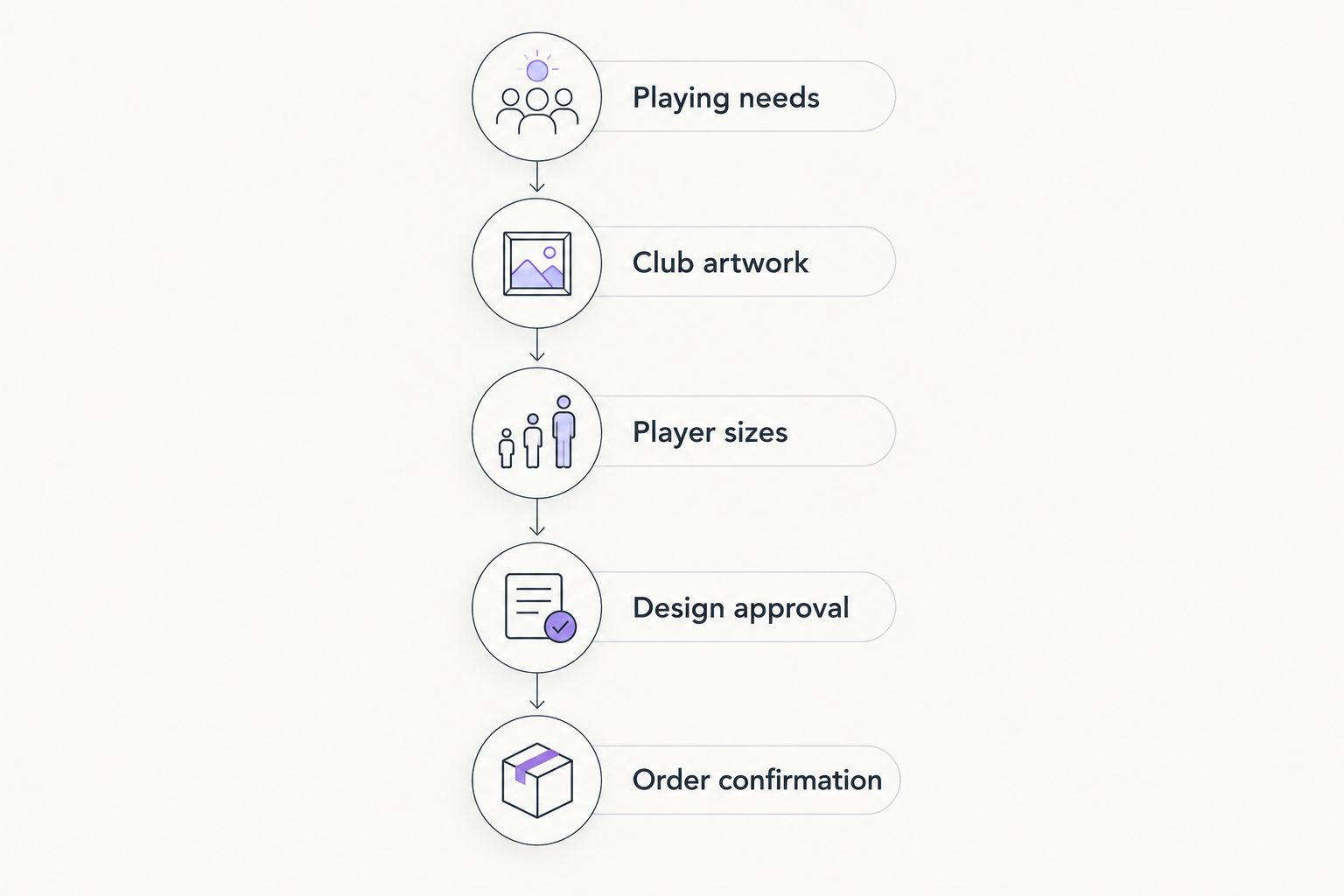
A written brief keeps garment selection, artwork and player details together without mixing their approvals. Use the following sequence for your 2026 enquiry with FE Custom.
Playing needs
Describe the shirt’s intended use: club competition, social matches or team training. Include any competition requirements your club has already confirmed and ask about the exact garment’s fabric, fit and care information.
Club artwork
Supply the club name, approved crest and colour references. Identify which elements are mandatory and which can change; a reference image is clearer when you explain what you want to retain from it.
Player sizes
Create a roster with player names, selected sizes and confirmation status. If shirts are shared, use size quantities and allocation records instead of treating each shirt as permanently assigned.
Design approval
Request 2 artwork views: front and back. Check the crest, sponsor marks and any personalisation against the written brief rather than approving from memory.
Order confirmation
Reconcile the approved artwork with the final roster. Nominate 1 club approver to send the consolidated decision, while players remain responsible for confirming their own sizes and names.
Approve garment details, player sizes and artwork separately before confirming the order.
Keep the final approval in writing. Save the artwork version and roster together so later questions refer to the same decision, not different attachments from a long message thread.
Which custom tennis-shirt design should you choose?
Choose a club-first design unless sponsor obligations or shirt ownership require something different. It is the clearest starting brief for an undecided men’s tennis club team.
Use sponsor-balanced artwork when contractual requirements shape the layout. Choose name-free artwork for shared shirts, and consider personalisation only when players own their shirts and the selected customisation options support it.
For a 2026 order, settle the garment and sizing before committing to the finished design. An approved crest cannot fix a shirt that restricts a player’s serve.
FAQ
What are the best custom tennis shirts for men's club teams in Australia?
The best starting point is a club-first design on a garment whose fit and specifications suit your players. Confirm individual sizes, competition requirements and artwork before approving the team order.
Should our men's tennis team choose a polo or a crew-neck shirt?
Choose according to your competition requirements, player preferences and the selected garment's fit. Confirm which styles the supplier offers rather than assuming both are available for customisation.
Can our tennis club order through FE Custom online?
FE Custom is an Australian online sports customisation store. Put your tennis-shirt requirements, size questions and artwork needs into the enquiry, then confirm the garment and customisation details before ordering.
Should we put player names on club tennis shirts?
Use player names for player-owned shirts only when the selected customisation options support them. A name-free design is the clearer choice for shirts that remain in a shared club pool.
How do we choose sizes for a men's tennis team?
Use the size chart and measurement method for the exact garment under consideration. Each player should confirm their own size, and any garment assessment should include serving and reaching movements.
Can we put sponsor logos on custom tennis shirts?
Confirm the selected garment's decoration options and your competition's advertising requirements before approving sponsor logos. Obtain approved artwork and written placement instructions from the sponsor.
What should we check before approving the shirt design?
Check front and back artwork against the written brief, including club details, sponsor marks and any personalisation. Reconcile the approved design with the final size roster before confirming the order.
One last thing
Check the smallest and largest selected shirt sizes when reviewing artwork placement. Ask whether the artwork dimensions stay the same or change across sizes; a preview on a single shirt size does not answer that question.
Make that check before final approval, alongside the name list and size roster. It connects the design decision to the actual garments your players will wear.