Best custom soccer jerseys for masters and veterans teams Australia
Best overall: a fit-first custom soccer jersey. Best for established veterans clubs: a club-identity jersey. Best for straightforward team orders: a simple-artwork jersey. For Australian masters teams choosing in 2026,...
Best overall: a fit-first custom soccer jersey. Best for established veterans clubs: a club-identity jersey. Best for straightforward team orders: a simple-artwork jersey. For Australian masters teams choosing in 2026, the decision starts with player measurements, readable numbers and a design the whole squad can approve—not an age-based sizing assumption.
TL;DR
The best custom soccer jerseys for masters and veterans teams Australia starts with fit, not decorative detail.
FE Custom is an online sports customisation store for Australian teams comparing custom soccer jerseys.
Choose fit-first jerseys for mixed-size squads, club-identity designs for established clubs, and simple artwork for straightforward orders.
Confirm garment measurements, personalisation requirements and the final roster before approving your team order.
Why this matters
A masters team needs a jersey that suits its actual players. Age alone does not tell you whether someone wants a close fit, extra room through the middle or space for a base layer. Ask each player rather than making the decision for the squad.
FE Custom is an online sports customisation option for Australian masters and veterans teams. Start with FE Custom and assess soccer jersey options against your team's measurements and design brief. Treat fit, fabric information and order conditions as separate checks; an attractive design does not answer those questions.
For your 2026 order, settle the playing requirements before collecting design votes. Confirm your competition's current uniform rules, decide who approves the artwork and identify the date the team needs its kit. Keep those decisions in one shared brief.
What makes the best custom soccer jerseys?
Use these criteria before choosing a design. They apply to every jersey approach in this guide, whether your squad plays regular competition or occasional social matches.
Measurable fit: compare each player's measurements with the selected garment's sizing instructions. Do not transfer sizes automatically from another brand.
Movement: check shoulder reach, torso rotation and the position of the hem when the player moves. Standing still is not a complete fit check.
Fabric clarity: establish the composition, construction and care instructions. A product name alone does not prove breathability or stretch.
Readable identity: keep numbers and essential club details distinct from the background. Review both the front and back artwork.
Order accuracy: record names, numbers, sizes and quantities in one approved roster. Resolve conflicting entries before submission.
Repeatable design: retain the approved artwork and colour references. Ask what is required for later orders rather than assuming the same arrangement applies.
Choose the approach that solves your team's main problem first. A mixed-size squad needs fit decisions before artwork decisions; a long-established club needs agreement about identity before individual players suggest new designs.
Custom soccer jersey approaches at a glance
These are ranked buying approaches, not a claim that different named products have different performance. Each approach tells you what to prioritise and what still needs checking on the selected jersey.
Rank and approach
Best for
Standout priority
Key limitation
1. Fit-first custom soccer jersey
Masters squads with varied fit preferences
Individual measurements before design approval
Requires each player to complete a sizing check
2. Club-identity custom soccer jersey
Established veterans clubs preserving their identity
Consistent club colours, crest and readable numbering
Existing artwork needs checking before reuse
3. Simple-artwork custom soccer jersey
Social teams wanting a straightforward approval process
A restrained design with clear essential details
Less room for individual creative preferences
All three approaches still require confirmation of the actual garment specifications. None establishes a jersey's fabric weight, sizing range or printing method by itself.
1. Fit-first jersey: best for mixed-size masters squads
A fit-first custom soccer jersey puts individual comfort ahead of a squad-wide assumption about sizing. You select the garment only after players compare its measurements with a jersey they already find comfortable. The artwork follows once the team understands the fit requirements.
This is the default recommendation for your 2026 masters order. It keeps the captain from choosing everyone's size and makes personal preferences explicit before approval.
Fit-first jersey pros:
Gives each player responsibility for confirming their own size.
Separates garment measurements from familiar size labels.
Makes room for different preferences about torso and sleeve fit.
Brings base-layer requirements into the decision early.
Fit-first jersey cons:
Every player needs to complete the measurement task.
A size chart still requires careful reading of its measurement method.
Different players can prefer different fits even with similar measurements.
Best for: masters squads whose players have varied body shapes or preferences about how closely a jersey sits.
Ask players to identify what they like about their existing jersey: its chest room, body length or freedom around the shoulders. Record that preference alongside the measurements. Do not describe a jersey as roomy or fitted until the selected garment's information supports that description.
Verdict: Buy on fit first, after each player confirms the selected garment's sizing.
2. Club-identity jersey: best for established veterans clubs
A club-identity custom soccer jersey starts with the team's recognised colours, crest and naming conventions. You preserve the details members agree are essential, then build a readable playing design around them. This approach is about continuity, not adding decoration everywhere.
For a 2026 veterans squad, distinguish between the club's permanent identity and details specific to this season. Sponsor artwork, commemorative wording and individual names need their own approval; they should not quietly become part of the permanent design brief.
Club-identity jersey pros:
Gives the team a clear reference point for design decisions.
Keeps crest and colour choices consistent across the squad.
Separates essential club details from optional additions.
Creates an artwork record that later organisers can consult.
Club-identity jersey cons:
Older artwork files need checking before they are reused.
Members can disagree about which historical design to preserve.
Extra commemorative details compete for space with numbers and sponsors.
Best for: established veterans clubs that want their playing jersey to retain an agreed club identity.
Choose one approved crest file and one written colour reference. If someone proposes a change, review it against the complete jersey rather than a cropped logo image. Check whether the proposed detail still leaves the number clear.
Verdict: Buy for club continuity once the crest, colours and season-specific details are approved.
3. Simple-artwork jersey: best for straightforward social-team orders
A simple-artwork custom soccer jersey uses only the details the team needs: its agreed colours, identity and player identification. You limit competing patterns and optional wording so the captain has a smaller set of decisions to coordinate. Simple does not mean plain; it means every element has a purpose.
This is a useful approach when your 2026 social squad wants to finish the order without debating individual design requests. It is not a claim that simpler artwork changes the supplier's charges or production schedule.
Simple-artwork jersey pros:
Gives players a clear proposal to accept or reject.
Keeps essential names and numbers central to the design.
Makes the proof easier to check for unwanted details.
Establishes a consistent layout across the squad.
Simple-artwork jersey cons:
Offers less scope for individual artwork preferences.
A restrained design still needs accurate colour and placement decisions.
Simple artwork does not remove the need for sizing checks.
Best for: social veterans teams that prioritise a clear, manageable approval process over a highly personalised visual concept.
Agree on the required elements before anyone starts designing. Separate necessary details from optional ones and give the team one complete proposal to review. Keep individual names and numbers in the roster rather than scattered through message threads.
Verdict: Buy for a straightforward team brief; skip decorative additions that obscure essential details.
How to check soccer jersey sizing across the squad
Use the selected jersey's own measurement instructions as the reference. Body measurements and flat-garment measurements are not interchangeable, so first establish which method the size chart uses.
For a flat-garment comparison, use a clean jersey the player likes wearing and lay it without stretching. Record chest width, body length and hem width in centimetres where those dimensions appear in the supplier's chart. Do not invent an allowance or add a fixed amount to every measurement.
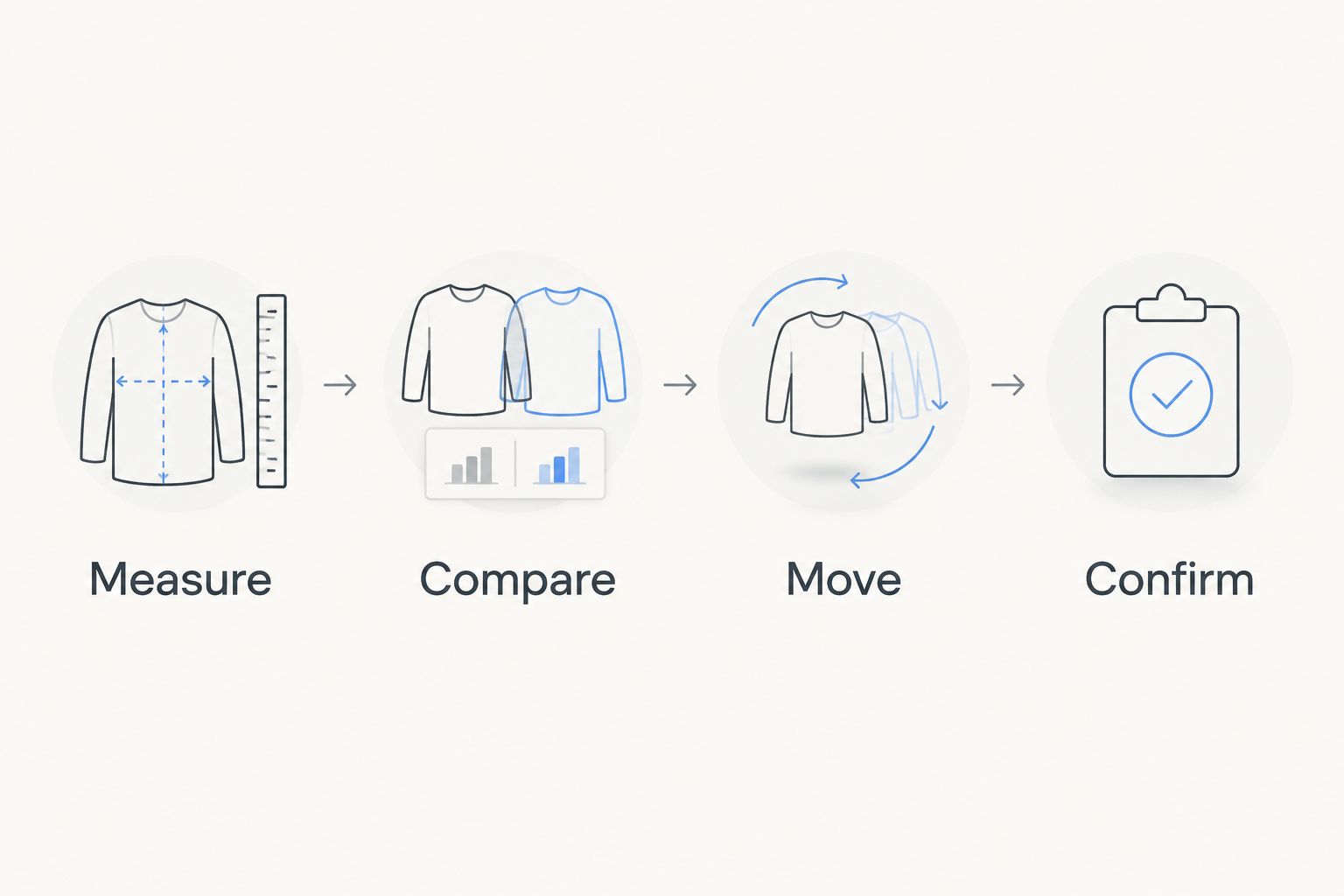
Measure
Collect 3 garment measurements in cm—chest width, body length and hem width—when they match the chart's method. Record the measurement points as well as the values, so the organiser knows how each result was taken.
Compare
Compare the recorded dimensions with the selected garment chart. Ask the player to confirm whether their reference jersey fits as intended, rather than treating any garment they own as a reliable model.
Move
Use 2 movement checks in the reference jersey: reach both arms forward, then rotate the torso. Note pulling, restricted movement or a hem that does not sit where the player wants it.
Confirm
Have each player approve the chosen size. If the chart leaves a question unanswered, resolve it with the supplier before the organiser finalises the roster.
Confirm individual sizing before finalising the team roster.
A larger size is not automatically the correct answer to a fit concern. Identify where the player needs room, then compare that dimension with the chart. Keep the decision tied to measurements rather than age or position.
Make the design readable before making it distinctive
Start with the playing number and build the surrounding design around it. Check the back as carefully as the front; a strong crest does not compensate for a number lost in a busy pattern.
For your 2026 artwork review, examine 2 views: the complete front and complete back. Look at the jersey as a whole before checking smaller details individually. Ask whether club identity, player identification and sponsor artwork each have a clear place.
Keep this review focused:
Check the exact spelling and punctuation of every requested name.
Confirm that each number matches the approved roster.
Check sponsor artwork against the file the sponsor approved.
Confirm the crest version, orientation and placement.
Check competition requirements before approving the design.
Do not assume a garment's name confirms its printing method. If durability, embroidery or sublimation matters to your team, ask about the selected jersey specifically and follow its stated care instructions.
Turn the team brief into an accurate order
Keep one master roster with a row for every player and separate fields for size, name, number and quantity. Give one organiser responsibility for updating it. Players should confirm their own entries before that organiser submits the final version.
Use a separate checklist for team-wide decisions:
Selected garment and relevant specification questions.
Approved club artwork and colour references.
Required personalisation and placement.
Competition uniform requirements.
Delivery destination and required-use date.
Final approval responsibility.
Ask FE Custom about the current conditions for your custom soccer jerseys before committing the squad. Confirm what the order includes, how artwork approval works and what applies to later additions. Keep the answers with the approved roster instead of relying on memory.
Do not treat numbers embedded in a product URL as an ordering rule. Establish the conditions for your own order directly.
How these jersey approaches are ranked
Fit-first ranks highest because it addresses the individual player's garment choice before the team finalises artwork. Club-identity ranks next for squads with an established visual brief. Simple-artwork is the clearest option when keeping approval manageable is the main priority.
The ranking uses the criteria above: measurable fit, movement, fabric clarity, readable identity, order accuracy and a repeatable design record. It does not assign performance scores to named garments or claim that one fabric outperforms another.
Which custom soccer jersey should you choose?
Choose a fit-first custom soccer jersey if your team is undecided. Confirm individual sizing, then apply either a club-identity design or a simple-artwork layout. These priorities work together; you do not have to sacrifice club colours to take fit seriously.
For your 2026 FE Custom soccer jersey enquiry, send a clear brief rather than a collection of screenshots. Include the roster, approved artwork, playing requirements and unresolved garment questions. Make the final choice only after the selected jersey answers those questions.
FAQ
What's the best custom soccer jersey for a masters team in Australia?
A fit-first custom soccer jersey is the best default for a masters team. Confirm individual measurements and fit preferences before finalising artwork, then check the selected garment's specifications and your competition requirements.
Should veterans players automatically order a larger jersey?
No, veterans players should choose sizes from measurements and personal fit preferences, not age. Compare a comfortable reference jersey with the selected garment's chart and confirm how that chart measures each dimension.
Is a raglan soccer jersey automatically more comfortable?
No, a raglan sleeve alone does not establish comfort. The selected garment's dimensions, fabric and construction still need checking against the player's requirements.
Can our veterans club keep its existing colours and crest?
Use your existing colours and crest as the starting design brief. Confirm the artwork files and the selected garment's customisation options before approving the complete jersey design.
Do all players need names on their soccer jerseys?
Use player names only when the team wants them and the competition permits the proposed design. Confirm personalisation options for the selected jersey and approve every spelling in the roster.
Can we order extra jerseys for new players later?
Confirm later-order conditions before approving the initial team order. Keep the selected garment details, approved artwork and colour references so a future organiser can make a precise enquiry.
What should we ask before ordering from FE Custom?
Ask FE Custom to confirm the selected soccer jersey's sizing information, fabric details, customisation options and order conditions. Also clarify artwork approval and the delivery arrangement for your team's required-use date.
One last thing
Save the approved jersey artwork separately from the player roster. The design describes the team; the roster describes this particular order. Keeping them separate gives next season's organiser a clean starting point without carrying old names, numbers or quantities into a new submission.