Best Custom Soccer Jerseys: Number-First Kits Win 2026
Best overall: a single-colour, number-first soccer jersey. Best for teams with regular colour clashes: a contrasting alternate jersey. Best for rotating social squads: a shared team jersey without player names....
Best overall: a single-colour, number-first soccer jersey. Best for teams with regular colour clashes: a contrasting alternate jersey. Best for rotating social squads: a shared team jersey without player names. For Australian teams choosing the best custom soccer jerseys for five-a-side and futsal teams in 2026, start with your competition rules, player fit and squad list—not the artwork.
TL;DR
The best custom soccer jerseys for five-a-side and futsal teams prioritise fit, colour contrast and readable numbers.
FE Custom is an Australian online sports customisation store; start with a clear soccer jersey brief.
Choose a contrasting alternate jersey when your competition requires a colour-clash solution.
Shared squad jerseys without player names suit rotating social teams.
Why this matters
Futsal puts 5 players per team on court: 4 outfield players and 1 goalkeeper. Your jersey order still needs to account for substitutes, not just the starting side. Five-a-side competitions also have their own uniform requirements, so check the organiser’s rules before approving a design.
FE Custom operates online in Australia. FE Custom suits Australian teams that want to organise custom soccer jerseys online. Treat the order as a team decision: confirm the required garment, collect measurements and ask which customisation options apply to that garment before preparing final artwork.
What makes the best custom soccer jersey?
Use these six criteria to choose your 2026 team kit. A design that misses any required competition rule belongs back in the brief, however good it looks.
Competition suitability: Confirm sleeves, colours, numbers and goalkeeper requirements with your organiser. Do not assume outdoor five-a-side rules match futsal rules.
Movement and fit: Choose from the relevant garment’s size information. Check shoulder movement, body length and the room each player wants through the torso.
Colour separation: Your team colour should be distinguishable from opponents and the goalkeeper’s kit. Assess the main colour, not just small trim details.
Number readability: Where numbers are required, give them a clear background. Keep artwork away from their edges.
Squad flexibility: Decide whether jerseys belong to individual players or remain team property. Names make that decision harder to reverse.
Order accuracy: Maintain a final roster that connects each player or squad jersey to a size and number. Approve that roster alongside the design.
Fabric, printing method and care requirements also belong in the buying decision. Check the actual garment information rather than treating words such as custom or soccer as proof of a particular material or construction.
Custom soccer jersey options at a glance
These are three jersey-order configurations, not claims that different designs have different performance. Choose the configuration that solves your team’s main problem, then confirm the garment and customisation details.
Ranked option
Best for
Standout approach
Key limitation
Single-colour, number-first jersey
A regular team’s primary match kit
Clear team identity with uncluttered identification
Does not solve every opponent colour clash
Contrasting alternate jersey
Teams required to change colours
A separate dominant colour from the primary kit
Adds another design and size list to manage
Shared team jersey without player names
Rotating social squads
Jerseys can be allocated by fit rather than surname
Players lose personal name identification
1. Number-first jersey: best for your primary match kit
A single-colour, number-first jersey puts team identification ahead of decoration. Use a dominant team colour and, where your competition requires them, clearly separated numbers. This is the default brief for a regular five-a-side or futsal squad organising its primary kit in 2026.
Choose the jersey shape and fit before building the artwork. A sleeve panel, side panel or seam changes where a logo can sit; ask for the relevant garment layout before deciding placements. Keep the front and back readable rather than filling every space.
Number-first jersey pros:
Gives your team a clear starting point for its design brief.
Keeps required identification separate from decorative artwork.
Provides a consistent design reference for future enquiries.
Works with either player-owned or team-owned jerseys.
Number-first jersey cons:
A primary colour still needs a clash plan.
Permanent player names reduce flexibility when the squad changes.
A tidy design cannot compensate for an unsuitable fit.
Best for: A stable team choosing its main match jersey.
Before approving, inspect the number area on the actual design proof. A pattern that looks restrained on the front can still make the back difficult to read. Ask the organiser about required number placement and dimensions instead of copying a professional club’s kit.
Verdict: Buy a number-first primary jersey once the fit, competition requirements and final roster are confirmed.
2. Contrasting alternate jersey: best for colour-clash requirements
A contrasting alternate jersey gives your team a separate colour option. Its purpose is practical: it should look different from your primary kit across the main body, not merely swap a collar or sleeve trim. Choose this configuration when your organiser requires an alternate strip or your fixture arrangements create a clear need.
For your 2026 brief, compare the primary and alternate designs side by side. Keep shared elements consistent where useful, such as the team wording and number style, but make the dominant colours distinct. Treat goalkeeper colours as a separate decision.
Contrasting alternate jersey pros:
Addresses a defined colour-clash requirement.
Separates the alternate kit visually from the primary jersey.
Lets your team retain consistent identification across designs.
Contrasting alternate jersey cons:
Creates another set of artwork and sizing details to approve.
Adds more garments for the team to store and allocate.
Does not replace a separate check of goalkeeper requirements.
Best for: Teams that need a dedicated alternate match colour.
Do not order a second design simply because another pattern looks appealing. Ask who changes when teams clash, whether an alternate jersey is required and what the venue accepts. The answers determine whether this option belongs in your order.
Verdict: Buy a contrasting alternate jersey for a confirmed clash requirement; skip it as an automatic addition.
3. Shared squad jersey: best for rotating social teams
A shared team jersey without player names belongs to the squad rather than a particular person. Allocate jerseys by fit and keep a record of who takes each garment. Where numbers are required, use the competition’s allocation rules rather than assuming players can swap numbers freely.
This configuration suits a social team whose attendance changes. It also separates the jersey decision from nicknames and individual design requests. For 2026, agree on ownership and collection before anyone submits personal artwork.
Shared squad jersey pros:
Avoids tying a garment to a surname.
Lets you organise the team pool around garment sizes.
Keeps the design brief consistent across the squad.
Shared squad jersey cons:
Needs someone responsible for allocation and collection.
Requires a clear washing arrangement between uses.
Offers less personal identification than named jerseys.
Best for: Social five-a-side squads with changing attendance.
Record each garment’s size and number, then record its current holder separately. That keeps the jersey register useful even when a player leaves. Confirm registration and number rules before reallocating a numbered garment to another player.
Verdict: Buy a shared squad configuration when flexibility matters more than player names.
How we ranked these jersey configurations
The primary jersey ranks first because every team needs a main kit decision. The alternate jersey solves a narrower colour-clash problem, while the shared configuration solves an ownership and attendance problem. These positions reflect use cases—not fabric testing, customer ratings or a comparison of garment performance.
For FE Custom soccer jersey enquiries, use the same criteria: suitability, fit, colour separation, readable identification and an accurate roster. Confirm the selected garment’s details before treating any configuration as a finished order.
Get the fit right before approving the design
Collect measurements using the instructions for the garment you are considering. Record measurements in centimetres, and distinguish body measurements from finished-garment measurements. They are not interchangeable.
Do not transfer a size label from an unrelated shirt. Ask each player about the fit they want, then compare that preference with the relevant size information. A mixed squad needs individual checks rather than a single team-wide sizing assumption.
Use a straightforward movement check when assessing a sample or an existing jersey for reference: raise your arms, reach forwards and turn through the torso. Record what feels restrictive and what feels unnecessarily loose. This creates a useful fit brief without pretending that another garment has the same cut.
For your 2026 roster, keep the approved size beside the player’s name and proposed number. Ask each player to confirm that row before the organiser signs off the complete order.
Build an order brief your team can approve
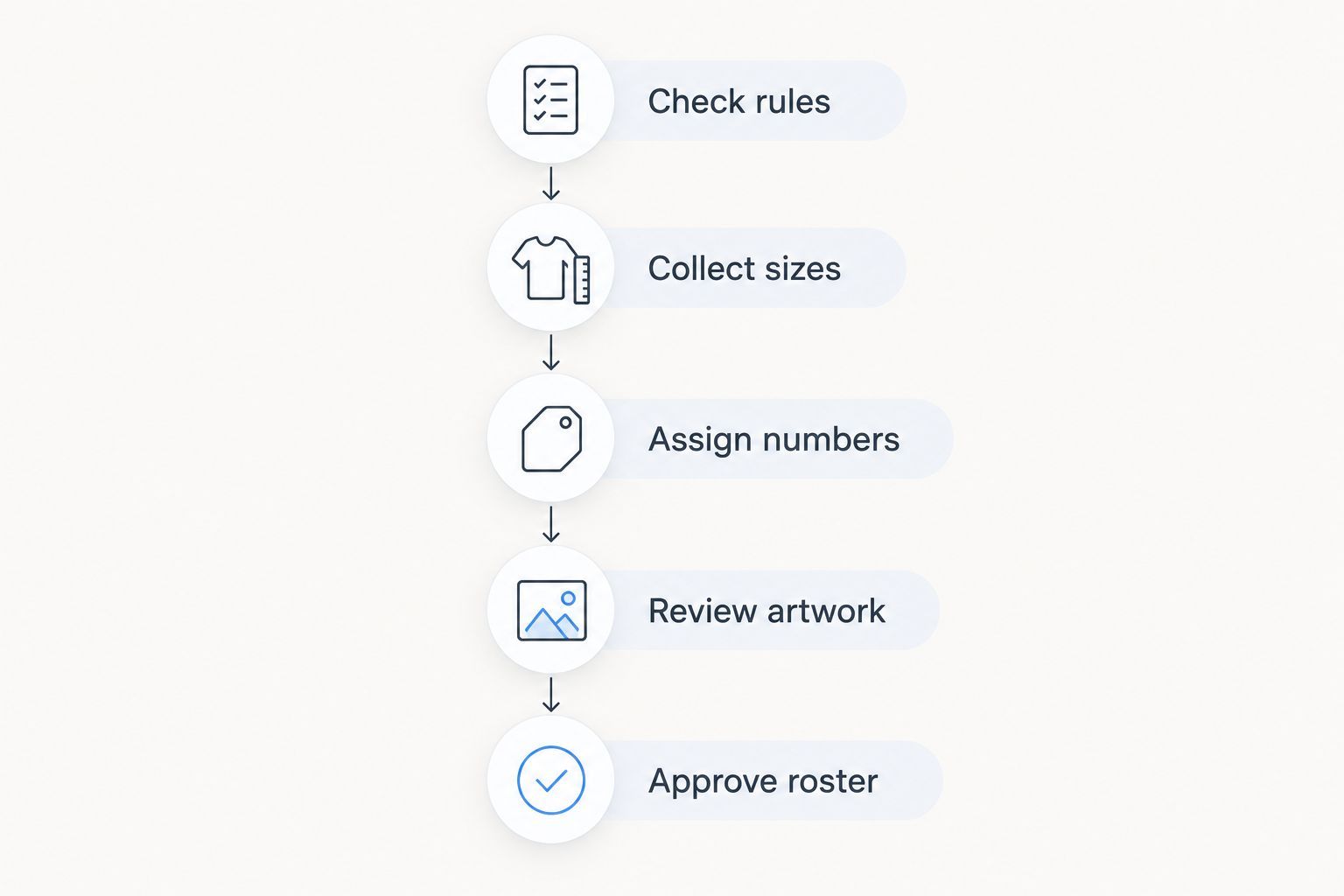
A good order brief separates decisions that often get mixed together in a group chat. Follow this sequence so artwork approval does not hide an unresolved sizing or roster question.
Check rules: Obtain the organiser’s uniform requirements, including goalkeeper identification and any number restrictions.
Collect sizes: Use the relevant garment’s measurement instructions and record each player’s fit decision.
Assign numbers: Where required, resolve duplicate requests and confirm whether numbers attach to registered players.
Review artwork: Check team wording, colour choices, logo permissions and each proposed placement.
Approve roster: Confirm sizes, numbers, names if applicable and the total garment quantity in the final brief.
Keep one current version of the brief. Mark superseded versions clearly so a late message does not become an accidental change to an approved order.
Approve the roster as carefully as the artwork.
Ask for confirmation of any requested feature before submitting final artwork. Names, numbers, sponsor placements and alternate colour treatments need to be checked against the selected garment’s customisation options, not assumed from another product.
Keep the jersey design readable
Start with a main body colour and clear identification areas. Then add the team wording and any authorised logos. Decorative patterns come last; they should not dictate whether a number or team name can be read.
For a goalkeeper brief, begin with the competition’s distinction requirements. Do not assume a different number is enough to identify the keeper. If players rotate into goal, clarify the permitted kit arrangement before deciding how many different designs your team needs.
Check spelling character by character. Read the roster separately from the artwork, because a correct-looking proof can still contain a wrong player number or size. Ask the team organiser to approve both documents together.
Which custom soccer jersey should you choose?
Choose the number-first primary jersey unless your team has a specific reason to prioritise another configuration. It gives you a clear design brief without adding an unnecessary second kit or tying every garment to a player name.
Add a contrasting alternate jersey only when your competition arrangements call for one. Use the shared squad configuration when attendance changes and the team retains ownership. These choices can overlap: a shared jersey pool can still use a number-first design.
Take that decision to FE Custom with your competition requirements and confirmed roster. Ask about the relevant soccer garment, its sizing information and the requested customisation before approving the order.
FAQ
What are the best custom soccer jerseys for five-a-side and futsal teams?
A number-first primary jersey is the default choice for a regular team. Choose a contrasting alternate jersey for a confirmed colour-clash requirement, or a shared jersey configuration without player names for a rotating social squad.
Can we use the same jerseys for futsal and outdoor five-a-side?
Use the same jerseys only when they satisfy both competitions’ uniform requirements. Check colours, goalkeeper identification, numbers and garment rules with each organiser before approving your design.
How many players should our futsal jersey order cover?
Cover your full participating squad, not just the five players on court. Futsal has four outfield players and one goalkeeper per team on court; include substitutes and any separate goalkeeper garment requirements in your brief.
Should we put player names on social soccer jerseys?
Leave player names off when jerseys remain team property and attendance changes. Names suit an individually owned kit, but make a garment less flexible when another player needs to use it.
Do we need an alternate jersey for five-a-side?
Order an alternate jersey when your competition’s colour-clash arrangements require one. Ask who changes and which solutions the venue accepts before adding another design to the team order.
How do we choose sizes for an online custom jersey order?
Use the selected garment’s sizing instructions and record measurements in centimetres. Confirm each player’s fit preference and distinguish body measurements from garment measurements before choosing sizes.
Does a reversible basketball jersey work as a futsal jersey?
Do not choose a reversible basketball jersey as your futsal match kit without checking the organiser’s garment requirements. Reversibility alone does not establish suitability for another sport.
What should we send FE Custom for a soccer jersey enquiry?
Send FE Custom your intended soccer jersey configuration, competition requirements, team design brief and squad sizing information. Ask which requested customisation options apply to the selected garment before preparing final artwork.
One last thing
A jersey number is an allocation decision as well as a design element. If your competition connects numbers to registered players, a shared kit needs more than a list of garment sizes. Keep the competition roster and jersey register aligned before each match.
For your 2026 team order, settle ownership first. That single decision tells you whether names help, who keeps the jerseys and how replacements should be briefed.