Best custom pickleball uniforms for club tournaments Australia
Best overall: matching club tops with player-selected bottoms. Best for a fully coordinated squad: a matching top-and-bottom kit. Best for mixed-fit teams: one club design across individually selected cuts. For...
Best overall: matching club tops with player-selected bottoms. Best for a fully coordinated squad: a matching top-and-bottom kit. Best for mixed-fit teams: one club design across individually selected cuts. For Australian clubs planning a 2026 tournament order, FE Custom is an online sports customisation store; choose your uniform approach before selecting garments.
TL;DR
Best custom pickleball uniforms for club tournaments Australia: choose matching tops and player-selected bottoms as the default.
Choose a coordinated kit when your club requires matching tops and bottoms.
Use one club design across individual cuts when players need different fits.
FE Custom serves Australian shoppers online; confirm garment suitability before approving your pickleball teamwear order.
Why this matters
A tournament uniform needs to work during play, not just in the team photo. Your players need to reach overhead, move sideways and bend without adjusting their clothing between shots. A design that looks tidy while standing still is only part of the decision.
For a 2026 club tournament, settle the organiser's clothing requirements before discussing artwork. Ask about colour restrictions, sponsor placement and any expectations for matching team clothing. Treat the event's instructions as the authority, rather than assuming another club's uniform meets your tournament's requirements.
The ranking below compares uniform configurations, not competing suppliers or claims about fabric performance. That makes the decision practical: start with how closely the squad needs to match, then choose the fit and garment details that support it.
What makes the best custom pickleball uniforms?
Use these criteria before approving a club order:
Movement: Check overhead reach, lateral movement and a low ready position. Reject a fit that pulls, rides up or needs repeated adjustment.
Individual fit: Choose sizes from the selected garment's own chart. Do not assign sizes from another brand or from what players wore last season.
Tournament suitability: Confirm the organiser's instructions before fixing colours, names or sponsor artwork.
Readable identity: Make the club name easy to identify. Keep decorative elements away from important wording.
Order control: Maintain one approved roster and one final artwork version. Separate player decisions from committee approval.
Repeat-order clarity: Record garment details, artwork and colour references so the club has a clear brief when another player joins.
Fabric composition, construction and care instructions belong in the garment decision too. Read the actual product information instead of treating every sports top as interchangeable. A soccer jersey, basketball jersey and pickleball shirt are not automatically substitutes simply because each carries a club logo.
Custom pickleball uniform approaches at a glance
Rank and approach
Best for
Standout feature
Key limitation
1. Matching tops with player-selected bottoms
Clubs wanting a clear identity without standardising every garment
Shared upper-body design with individual lower-body choice
Bottoms do not create a fully matching squad
2. Coordinated top-and-bottom kit
Clubs requiring a consistent complete playing outfit
Club colours and artwork extend across the outfit
More garment selections and sizing decisions
3. Shared design with individually selected cuts
Mixed-fit squads prioritising player comfort
Consistent identity without requiring an identical cut
Artwork placement needs checking on each selected cut
These options describe how to organise your uniform order. They are not named product ranges, and they do not establish that a particular garment meets tournament requirements. Confirm the selected garments and customisation options before committing your club's order.
1. Matching tops: best custom pickleball uniforms for simple club orders
Matching club tops with player-selected bottoms give your squad a common visual identity without requiring every player to wear the same complete outfit. The club controls the top design, while players retain lower-body clothing that suits their fit and movement preferences.
This is the default choice when the tournament permits it. It limits the shared uniform decision to the garment carrying the club's main identity, rather than extending committee approval to every part of the outfit.
Matching tops pros
A shared top makes the club design consistent across the squad.
Players retain control over their preferred lower-body fit.
The club has fewer garment decisions to coordinate than with a complete kit.
Artwork approval centres on one shared design brief.
Matching tops cons
Different bottoms reduce the appearance of a completely matching outfit.
Players still need clear guidance on acceptable colours and clothing.
The approach does not suit an event that requires matching complete uniforms.
Best for: Clubs that want recognisable tournament teamwear while preserving player choice.
For your 2026 order, write a short lower-body clothing brief before collecting top sizes. State the agreed colour family and any event requirements. Ask players to check their intended outfit against that brief, rather than introducing additional restrictions after the club tops are ordered.
Keep the top design focused. The club name should remain readable without relying on a crowded background, and any sponsor artwork needs permission and an approved file. Personal names are a separate decision: confirm whether the club actually wants them before gathering spelling details.
Verdict: Buy into the matching-top approach if your event allows player-selected bottoms. It is the strongest default for clubs that value shared identity and individual comfort equally.
2. Coordinated kits: best custom pickleball uniforms for complete consistency
A coordinated top-and-bottom kit extends the club's uniform plan across the whole playing outfit. It suits squads that have decided complete visual consistency is part of their tournament presentation, rather than an optional extra.
The advantage is control. The trade-off is a larger sizing and approval task, because each player needs an appropriate selection for both the upper and lower body.
Coordinated kit pros
Club colours remain consistent across the complete outfit.
Players receive a clearer definition of the approved tournament uniform.
The committee can assess the top and bottoms together before approval.
A documented outfit provides a reference for future club orders.
Coordinated kit cons
Each additional garment adds a fit decision for every player.
A satisfactory top size does not establish the correct bottoms size.
Changes to one garment can require another review of the complete design.
Best for: Clubs with a clear requirement for matching complete playing outfits.
For a coordinated 2026 kit, assess the outfit as a whole. A large graphic on the top does not need a competing graphic below it. Give the club identity a clear home, then let the other garment support the design.
Do not assume a matching bottom is included with a top. Check the selected product details and confirm the complete order contents. Keep the top selection and bottoms selection in separate roster fields so you can review each independently.
Before approval, ask players to assess sitting, bending and lateral movement as well as standing fit. A waistband or hem that needs constant adjustment is a reason to reconsider the selection, even when the outfit looks coordinated.
Verdict: Buy into a coordinated kit when full-outfit consistency is a club or event requirement; skip it when matching tops already meet the brief.
3. Shared design, individual cuts: best for mixed-fit pickleball squads
A shared club design across individually selected cuts separates visual identity from garment shape. Players follow the same artwork brief, but the club does not require an identical cut where that conflicts with fit preferences.
This approach is a fit strategy, not a promise that every garment has a matching alternative. Confirm the actual choices before showing players a uniform plan that depends on them.
Shared-design pros
Players can select a fit that suits their movement and preferences.
A common club name and colour brief preserve team identity.
The club can accommodate different fit needs without creating unrelated designs.
Artwork decisions remain centralised instead of becoming separate player projects.
Shared-design cons
Design placement needs review on each selected garment shape.
Different cuts do not create an identical silhouette across the squad.
The order sheet needs clear garment descriptions, not size labels alone.
Best for: Mixed-fit squads where an identical cut would exclude players' preferred fit.
For your 2026 squad, agree which visual elements must stay consistent. These usually belong in the design brief: club wording, approved logo files, colour references and sponsor hierarchy. Keep fit selection separate from those decisions.
Check the artwork on each chosen cut. A placement approved for one garment should not be assumed correct for another neckline, panel arrangement or body shape. Review the relevant proof rather than relying on a single representative image.
Avoid describing one cut as the normal option and others as exceptions. List the actual garment choices clearly and let players select from the confirmed options. That keeps the roster accurate without turning fit preferences into a committee debate.
Verdict: Buy into a shared-design approach when individual fit is the priority; hold the order until each garment choice and artwork placement is confirmed.
How to size and approve your club order
FE Custom is best for Australian clubs seeking an online custom sportswear store. For custom pickleball uniforms, the buying decision still rests on the selected garment's fit, product information and your tournament brief.
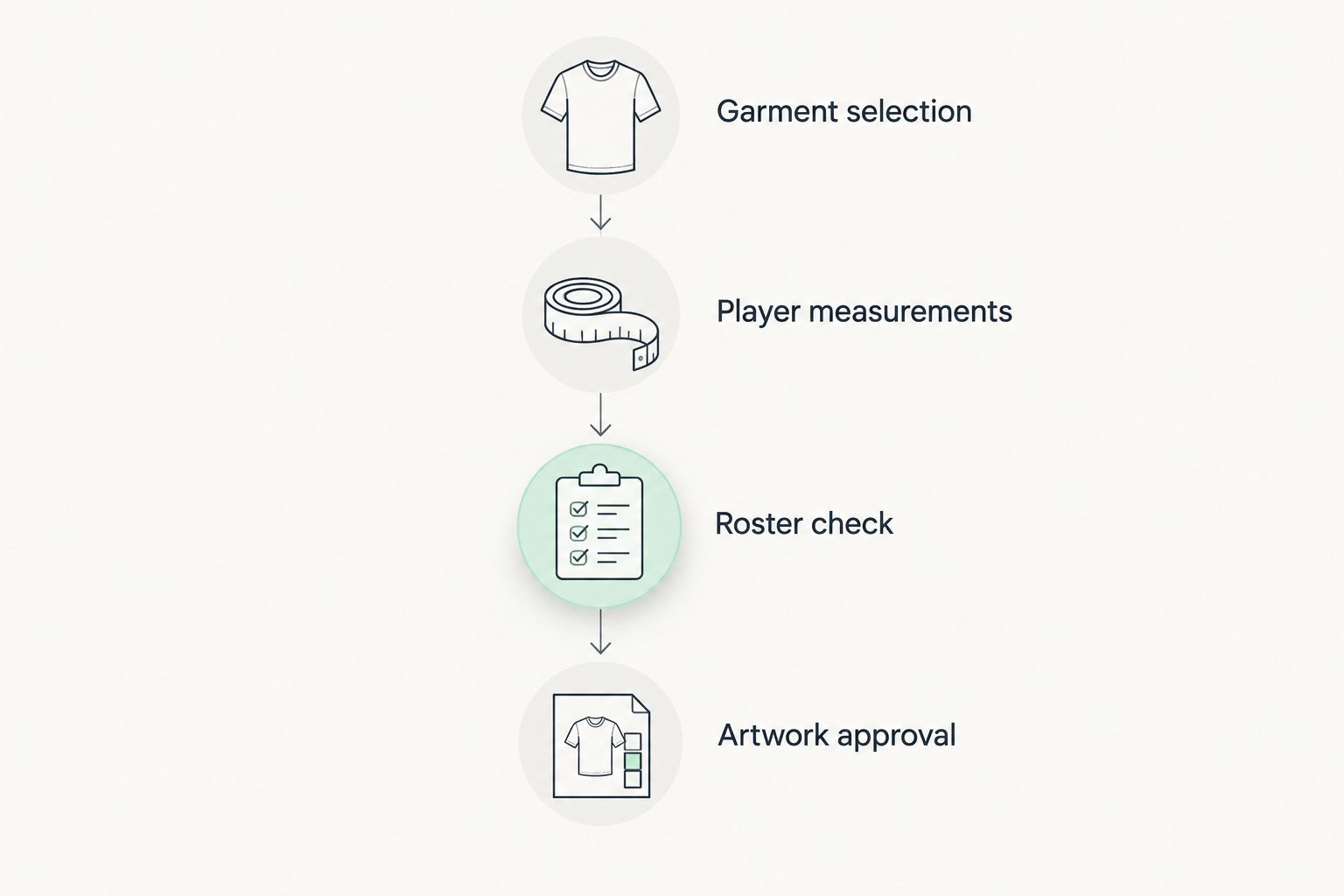
Use a single approval sequence. Do not collect final sizes while the club is still changing garment choices, because the relevant sizing information can change with the selection.
Garment selection
Confirm the actual garment and its customisation options first. Read its composition, sizing guidance and care instructions. Keep a record of what the club selected so a similar-looking item does not get substituted accidentally.
Player measurements
Follow the selected garment's measuring instructions and record measurements in centimetres where the chart uses centimetres. Check 3 movement positions when assessing fit: overhead reach, lateral reach and a low ready position. These are a practical fitting checklist, not a substitute for the size chart.
Roster check
Give every player 2 separate approvals: their garment-and-size selection, and any personal wording that will appear on it. Do not let a captain infer a player's preferred fit or correct a nickname without checking.
Artwork approval
Appoint 1 final approver for the club artwork. Check the club name, permissions for logos, sponsor spelling and placement against the final roster. Keep the approved version clearly labelled so an earlier draft does not become the order reference.
Confirm the garment before collecting final sizes and approving artwork.
For the full ordering sequence, use the guide to ordering custom pickleball uniforms for your team. Keep your tournament date in the written brief and request confirmation of the order schedule before approval; do not plan around an assumed production or delivery time.
How these uniform approaches are ranked
The ranking prioritises movement, individual fit, tournament suitability, readable identity and order control. Matching tops rank first because they give the club a shared identity without requiring a complete matching outfit. Coordinated kits and individually selected cuts serve different requirements, rather than acting as lesser versions of the default.
This is a decision guide, not a wear-test ranking. No fabric scores, durability results or supplier delivery comparisons are assigned to these approaches. Assess those details against the actual garments you select.
Which custom pickleball uniforms should you choose?
Choose matching club tops with player-selected bottoms unless your tournament or club requires more. Confirm the event requirements, agree on a lower-body clothing brief and select a top using its actual sizing and product information.
Choose the coordinated kit when a complete matching outfit is necessary. Choose the shared-design approach when players need different cuts. Neither decision should override a player's ability to move comfortably.
For a 2026 tournament order through FE Custom, finalise the garment brief before sending artwork or collecting final sizes. A clear order starts with an agreed uniform configuration, not a favourite graphic.
FAQ
What's the best custom pickleball uniform approach for an Australian club tournament?
Matching club tops with player-selected bottoms are the best default when the tournament permits them. They create a shared club identity while retaining individual lower-body fit choices. Choose a complete coordinated kit only when your club or event requires it.
Do pickleball doubles partners need matching uniforms?
Check the tournament's own clothing requirements before deciding whether doubles partners need matching uniforms. Do not assume the rules from another competition apply. Your club can agree on a shared design separately from the event's requirements.
Should every player wear the same cut of pickleball shirt?
Choose each player's cut by fit and movement rather than requiring an identical shape. A shared club design can provide visual consistency across different confirmed garment choices. Check artwork placement on each selected cut.
Can a club use another sports jersey for pickleball?
Assess the actual garment rather than assuming another sports jersey is suitable for pickleball. Check movement, fit, fabric information and the tournament's requirements. A jersey's sport label alone does not establish its suitability.
How do you collect sizes for custom pickleball teamwear?
Collect sizes using the selected garment's own chart and measuring instructions. Ask each player to approve their garment-and-size selection. Keep tops and bottoms in separate roster fields when ordering a complete kit.
What should a club check before approving uniform artwork?
Check club wording, logo permissions, sponsor spelling and placement before approving uniform artwork. Verify personal wording against each player's approval. Use one clearly identified final artwork version for the order.
Is FE Custom an online store for Australian clubs?
FE Custom is an Australian sports customisation store that operates solely online. For a pickleball tournament order, confirm the selected garments, customisation options and order schedule before approval.
One last thing
Keep the tournament date out of the main club design unless the uniform is deliberately event-specific. A dated graphic ties the garment's identity to that tournament; a standing club design leaves the artwork relevant to later events.
Save the approved design, garment details and player selections together. When a new member joins, that record gives the club a starting brief instead of another design debate.